
Microsoft 365 vs Google Workspace: Why Choose Microsoft
Why do enterprises default to Microsoft 365 while startups pick Google Workspace? This guide covers inertia, compliance, the SME scaling point and what market share numbers really show.

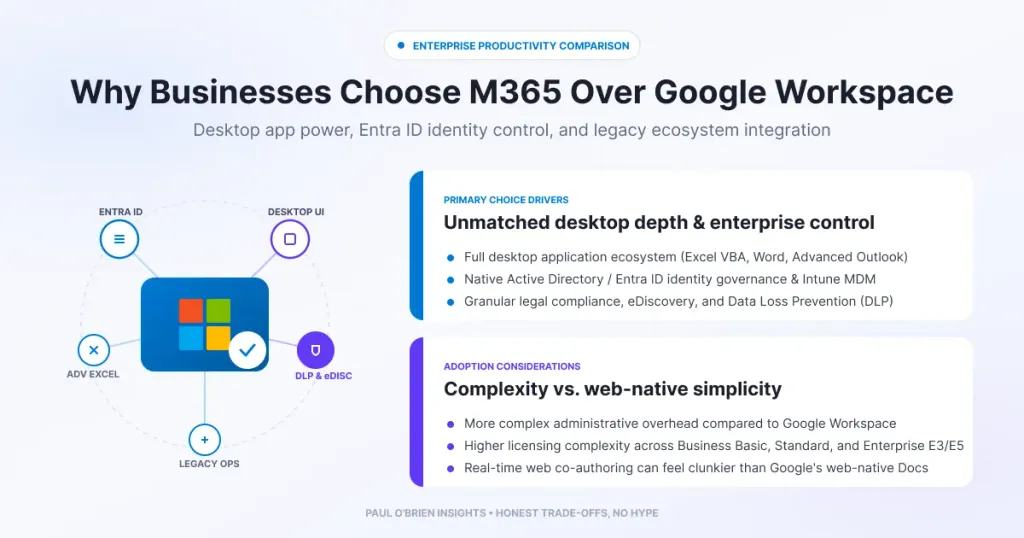
Microsoft 365 and Google Workspace do broadly the same job, yet enterprises default to Microsoft while startups and solo operators lean towards Google. This guide explains why, what the market share numbers do and don’t show, and the point where growing small businesses tend to move.
For small businesses, scaling firms and multinational corporations alike, choosing a primary productivity suite is rarely a simple feature comparison. Google Workspace and Microsoft 365 offer functionally equivalent core tools: email, document editing, cloud storage and video conferencing. Their market dynamics, though, reveal a real split in how businesses operate.
Short answer: established enterprises tend to choose Microsoft 365 because of habit, compliance tooling, desktop Office and legacy integrations. Google Workspace wins where speed, browser-first collaboration and low IT overhead matter. Businesses rarely switch to save a few pounds per user. They switch when their organisation changes.
At a Glance: Who Fits Which Suite
| User Profile | Best Fit? | Core Value Drivers / Key Trade-offs |
|---|---|---|
| Solo operator or early-stage startup | Google Workspace: strong fit | Quick to set up and light to administer. See my Google Workspace review. |
| Regulated enterprise (finance, legal, government) | Microsoft 365: strong fit | Deeper compliance, DLP and eDiscovery tooling on higher tiers. Licensing is complex. |
| SME passing 20 to 50 staff | Either: decision point | Client files, auditors and MSPs often pull towards Microsoft. |
| Browser-first, flat-culture team | Google Workspace: ideal | Real-time co-authoring and web-native tools. |
The Corporate Default: Why Organisations Inherit Microsoft
For established enterprises, adopting Microsoft 365 is seldom an active choice. It is an inherited posture. Several deep-rooted factors keep traditional corporations in the Microsoft ecosystem.
The educational pipeline
Higher education, business schools and IT administration programmes overwhelmingly train students on Microsoft systems. System administrators enter the workforce fluent in Active Directory, Exchange and PowerShell, which creates a structural bias towards Microsoft-first environments.
Perceived corporate legitimacy
Google still battles a perception in conservative boardrooms of being a consumer search engine that happens to sell email. Microsoft, by contrast, is viewed as an enterprise software partner.
The “safe choice” fallacy
Choosing Microsoft acts as an insurance policy for senior leaders. If Outlook has an outage, it is treated as an industry-wide event. If an IT director moves a traditional firm to Google Workspace and meets user resistance, it can be judged a management failure.
Compliance and governance
Google Workspace satisfies standard regulatory frameworks, but Microsoft 365’s higher-tier suites, such as E5 with Purview, offer the granular data loss prevention, legal hold and eDiscovery tooling often demanded by heavily regulated sectors. Which features you get depends on your licence, as I explain in my Outlook and Exchange review.
Deep third-party integration
Legacy enterprise resource planning (ERP) platforms, custom financial models and industry-specific software were built over decades to hook into Windows and Exchange. Replacing those connectors can introduce unacceptable operational risk.
Market Footprint: What the Numbers Do and Don’t Show
Market share claims depend heavily on what is being counted. Counting organisations favours Google, which has huge adoption among small businesses, startups and education. Counting seats or enterprise revenue tells a different story. Be careful with any single percentage.
| Measure | What it shows | Source and caveat |
|---|---|---|
| Companies detected using each suite | 6sense’s office suites ranking lists Google Workspace at 73.42% (1,869,409 customers) and Microsoft Office at 16.39% (417,373 customers) | 6sense does not publish its method or date, and counts detected companies, not seats or revenue |
| Seats and revenue | A Nasdaq/Zacks summary of Microsoft’s results says paid Microsoft 365 commercial seats grew 6% year on year | The source I checked gave the growth rate but no total seat count |
| Enterprise penetration (1,000+ seats) | I could not find a reliable public figure | Treat any precise percentage you see with caution |
Know the limits: you will often see figures such as roughly 45% for Microsoft and 50% for Google in overall share, or 58% against 32% in large enterprises. I couldn’t trace those to a published source, so I don’t quote them. The point that holds up is that Google is strong by count of organisations and Microsoft is strong in large, regulated enterprises.
Google at enterprise scale
Despite the belief that Google cannot serve scale, large organisations do run on it. Google’s own customer story says Whirlpool moved around 92,000 employees onto its productivity suite, though that story dates from 2019. Check current figures before quoting any customer numbers.
The Agility Engine: Where Google Workspace Wins
When an organisation intentionally rejects the Microsoft default in favour of Google, it is usually driving a cultural and operational pivot towards speed.
- Solopreneurs and early SMEs. For solo workers and micro-businesses, Google is the natural starting line. A founder can set up a custom domain, configure email and deploy collaboration tools quickly, without an external IT consultant.
- Low IT overhead. Managing identity and security policy in Google’s Admin console typically needs less specialist expertise than Microsoft Entra ID and Intune.
- Synchronous collaboration. Google Workspace was built for the browser. Microsoft has added real-time co-authoring to web and desktop Office, but many teams find Google’s document editing produces fewer file lockouts and version conflicts.
- Modern SaaS integration. Early-stage firms rely on tools such as Slack, HubSpot, Jira and Zoom. Google’s open authentication and lightweight APIs connect easily with these, whereas Microsoft tends to encourage staying inside Teams, SharePoint and Dynamics.
The SME Friction Zone: The Scaling Dilemma
Small and medium-sized enterprises frequently reach a crossroads as they scale past 20 to 50 employees.
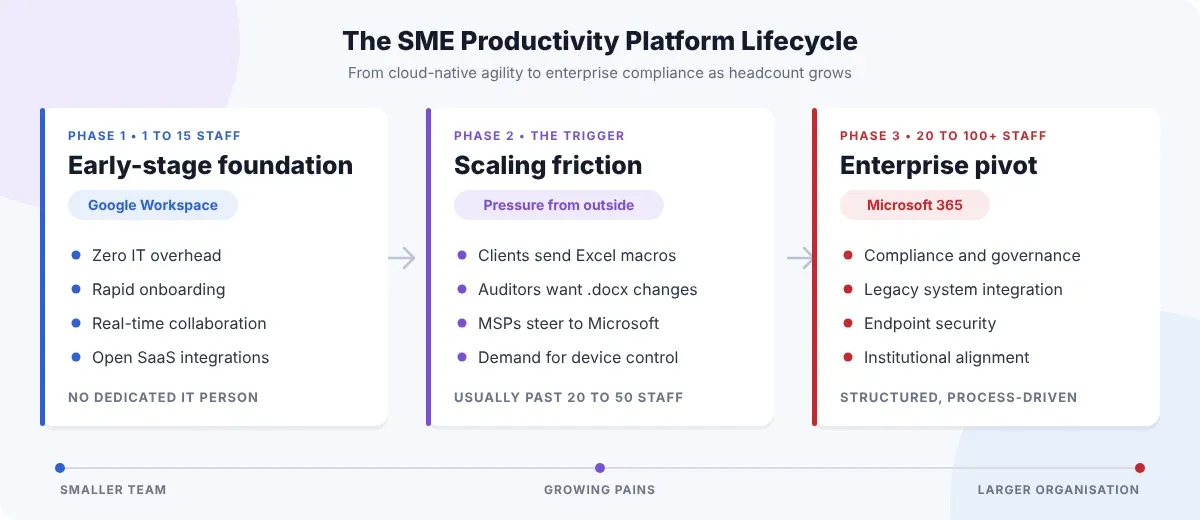
As an SME scales, external pressure builds. Clients send complex Excel workbooks with embedded macros that break when converted to Google Sheets. External law firms and auditors ask for track changes in native .docx files. Managed service providers (MSPs) often push the business towards Microsoft 365, where reseller margins and remote management tools can be more lucrative and established.
Microsoft 365 vs Google Workspace at a Glance
| Feature | Microsoft 365 | Google Workspace |
|---|---|---|
| Primary architecture | Hybrid: desktop applications with a cloud backend | Browser-native |
| Strength | Advanced Excel, deep Windows management, compliance tooling | Real-time co-authoring, quick onboarding, low IT overhead |
| Dominant sectors (my view) | Finance, legal, healthcare, government, heavy industry | Startups, media, tech, education |
| Full review | Outlook and Exchange review | Google Workspace review |
The Competitor Void: Apple and Yahoo
An analysis of business communication is incomplete without addressing the missing alternatives.
- Why Apple doesn’t compete. Apple dominates high-margin consumer hardware and, in my view, has little appetite to build an enterprise mail and productivity suite, which needs compliance infrastructure and dedicated enterprise sales teams. I explore its webmail in why iCloud Mail needs a redesign.
- The failure of Yahoo. Yahoo kept a loved consumer email portal in the early web era but never built a business-class ecosystem with productivity apps. The story is in why Yahoo Mail failed.
Frequently Asked Questions
Which has more market share, Microsoft 365 or Google Workspace?
It depends on what you count. 6sense’s ranking lists far more companies on Google Workspace, while Microsoft is strongest in large enterprises and seat counts. Figures differ between sources, so check how each is measured.
Why do large enterprises choose Microsoft 365?
Habit, compliance tooling, desktop Office, legacy integrations and the perception of Microsoft as the safe choice.
Can Google Workspace work for a large company?
Yes. Google’s own customer story says Whirlpool moved about 92,000 employees onto its suite, although that story is from 2019.
When should a small business move from Google Workspace to Microsoft 365?
Often when clients, auditors or an MSP need native Office files, or when compliance needs outgrow the current plan, typically somewhere past 20 to 50 staff.
Is Google Workspace secure?
It meets standard regulatory frameworks. My post on Google Workspace security myths goes into detail.
Do businesses switch to save money?
Rarely. Per-user licence differences are small compared with the cost of changing how an organisation works.
The Bottom Line
Ultimately, businesses rarely switch between Microsoft and Google to cut licensing costs by a few pounds per user. They switch when their organisational identity changes. Microsoft 365 remains the default tool for structured, process-driven governance, while Google Workspace serves as the engine for browser-first, collaborative execution. Whichever you choose, consider resilience: see my posts on Google Workspace resilience and building an out-of-band hub.
Note: this article contains no affiliate links. Sources: 6sense: Google Workspace vs Microsoft Office (undated 2026 ranking); Google: Whirlpool customer story; Nasdaq/Zacks: Microsoft 365 seat growth. Checked 9 October 2026.

