Email
iCloud Mail Needs a Redesign: A Webmail Concept
Apple’s hardware is world-class, but iCloud Mail on the web feels abandoned. Here is what iCloud Mail offers today, why it needs a rebuild, and a concept UI I mocked up.
Yahoo Mail didn’t disappear overnight. It faded from relevance as trust eroded, decisions stalled, and breaches exposed deeper problems. This is the story of how the internet’s most trusted brand lost its place at the centre of email.
 Paul O'Brien
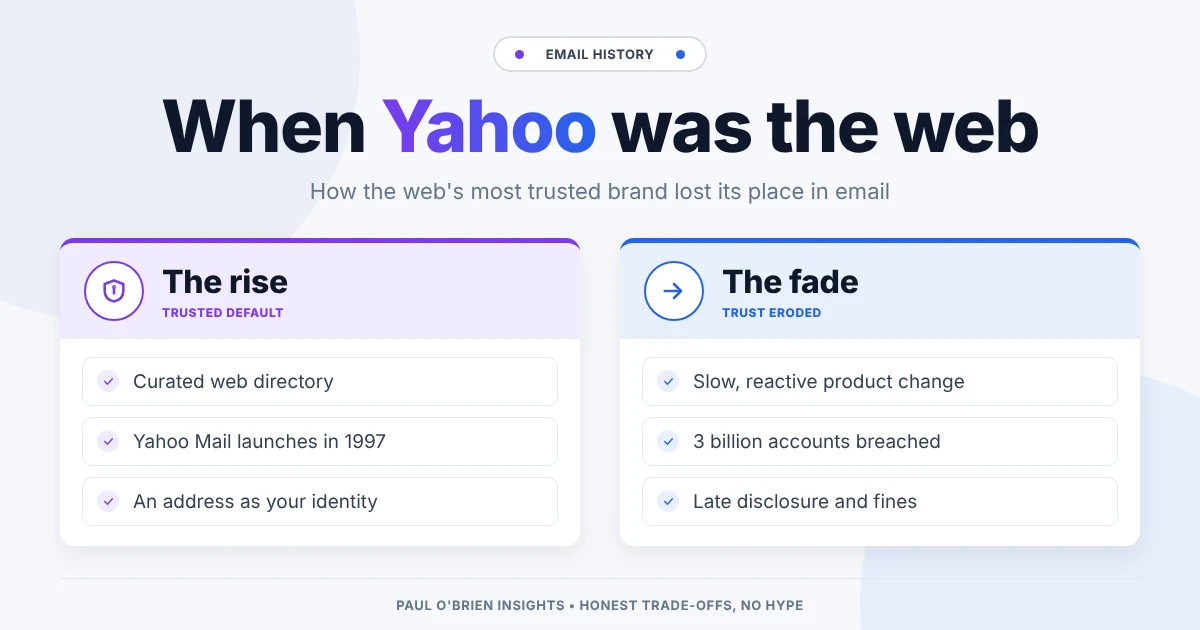
For a period in the late 1990s and early 2000s, choosing Yahoo Mail did not feel like a decision. It felt automatic.
People did not compare providers. They did not analyse privacy policies or weigh security architecture. They created a Yahoo account because Yahoo itself felt like the centre of the web, and if Yahoo offered email, it must be the safest place to keep it. That assumption built Yahoo Mail into one of the largest email platforms in the world. It also explains why its decline was gradual, understated and ultimately permanent.
This is not the story of a product beaten by cleaner design or smarter branding. It is the story of what happens when trust erodes inside infrastructure.
Short answer: Yahoo Mail did not lose because Gmail looked nicer. It lost because Yahoo kept treating email as a feature of a media portal while email was becoming identity infrastructure. Years of slow product change, then record-breaking breaches disclosed late and revised upwards, turned a trusted default into a legacy address people keep but rarely choose.
| Year | What happened | Why it mattered |
|---|---|---|
| 1997 | Yahoo buys Four11 and launches Yahoo Mail on RocketMail’s technology | The web’s best-known brand gets an inbox |
| 2004 | Gmail launches with 1GB of free storage | Expectations for webmail reset almost overnight |
| 2016 | Breaches disclosed: 500 million accounts (2014 attack), then over 1 billion (2013 attack); Reuters reports secret email scanning for US intelligence | Trust in Yahoo as an identity provider collapses |
| 2017 | Verizon completes its purchase at about $4.5 billion after a $350 million cut; Yahoo says the 2013 breach hit all 3 billion accounts | The breaches carry a price tag |
| 2021 | Apollo buys Yahoo from Verizon in a deal worth about $5 billion | Yahoo Mail becomes one asset in a private-equity portfolio |
Yahoo did not begin as an email company. It began as a directory.
In the mid-1990s, the web was expanding rapidly but remained largely unstructured. Yahoo’s human-curated directory imposed order. Editors created and maintained categories, and reviewed and classified websites by hand. Before algorithmic search engines decided relevance, Yahoo decided placement.
Even when Yahoo later added search, and for a period relied on Google’s results behind the scenes, its authority was rooted in curation rather than computation. Yahoo’s value lay in its judgement, and that judgement carried weight.
Yahoo Mail launched on 8 October 1997, the day Yahoo announced it was buying Four11, whose RocketMail service became the basis of the new product. It entered a market where email was becoming mainstream but was still tied to desktop software and internet service providers. Webmail was a new idea. Being able to open your inbox from any browser was transformative.
Yahoo’s brand made that shift feel safe. If Yahoo organised the web, it could be trusted to hold your identity within it.
By the early 2000s, a @yahoo.com address was more than an inbox. It was a digital identity, used for forums, early e-commerce accounts, online communities and emerging social networks. Long before centralised single sign-on, Yahoo accounts quietly did that job. Yahoo Mail grew not because it was technically superior, but because Yahoo itself felt permanent.
Yahoo’s authority was not merely cultural; it was monetised.
For years, website owners paid to have their sites reviewed for inclusion in Yahoo’s directory. In the UK, this fee was widely remembered as being around £200; in the US, the paid review was $299, and listed sites were charged again each year. Payment did not guarantee inclusion. It guaranteed review.
Businesses paid because inclusion signalled legitimacy. A listing implied that a human editor at Yahoo had evaluated the site and judged it acceptable. That approval carried reputational value at a time when trust on the web was fragile. Inclusion was conditional, too: Yahoo enforced strict listing guidelines and removed sites that failed to meet them.
That authority extended naturally to Yahoo Mail. If Yahoo could be trusted to curate the web, it could be trusted with personal correspondence. Trust transferred across products. Yahoo eventually closed the directory at the end of 2014, saying little more than that its business had evolved.
The early web was competitive. Yahoo reached hundreds of millions of users globally, Hotmail, later bought by Microsoft, built up tens of millions, and portals such as Excite and Lycos combined search, content and webmail into destinations with vast traffic.
The prevailing assumption was that people would navigate the web through portals: start at a homepage and move outward. Email was one feature among many. Yahoo excelled in that model. What changed was not the competition within the portal framework. It was the framework itself.
Google introduced a different pattern. Instead of browsing through a portal, people typed a query into a search box and left as soon as they found what they needed. Search became a utility rather than a destination.
That shift reached beyond search. It rewarded services that were fast and focused. When Gmail arrived in 2004 with 1GB of free storage, a fraction of which was all Yahoo Mail and Hotmail then offered, email started to be judged as a utility too, and increasingly as a core identity layer.
Yahoo continued to operate as a media company. It invested heavily in content, advertising and portal-style engagement. The industry, however, increasingly rewarded reliability and foundational services. Yahoo Mail remained large, but it no longer set the direction.
Yahoo Mail did not collapse suddenly. For years it continued to work competently. But the perception of stagnation grew.
Interfaces evolved slowly, performance often lagged and feature updates felt incremental or reactive. None of this on its own triggered mass departures, because email addresses are sticky.
Yet stagnation sends a signal. In utility services, visible maintenance and improvement reinforce confidence. When change slows or feels cosmetic, users infer something about priorities. Even if everything still works, perceived inattention undermines reassurance.
By the time Yahoo pushed through more aggressive redesigns, they landed against a backdrop of accumulated doubt. Rapid change after prolonged drift rarely restores confidence.
Yahoo’s decline did not begin with its data breaches, but the breaches crystallised existing concerns.
In September 2016, Yahoo disclosed that data from at least 500 million accounts had been stolen in 2014. In December 2016 it disclosed a separate 2013 breach affecting more than a billion accounts, and in October 2017 it revised that to all three billion accounts it had at the time. Stolen data included names, email addresses, hashed passwords and security questions. Yahoo said clear-text passwords and payment card details were not taken.
The scale was unprecedented. The deeper issue was transparency and timing. The US Securities and Exchange Commission later found that Yahoo’s security team knew about the 2014 intrusion within days, yet the company did not tell investors for about two years. In 2018 it fined Altaba, the company left holding Yahoo’s remaining assets, $35 million, the first action of its kind against a public company for failing to disclose a breach. A $117.5 million class action settlement for affected users followed, approved in 2020.
In the same autumn, Reuters reported that Yahoo had built a system to scan incoming customer email for information requested by US intelligence agencies. Yahoo said only that it was a law-abiding company. For an email provider, the timing could hardly have been worse.
Email is identity infrastructure. When a provider appears uncertain about the scope of a compromise, or disclosure feels delayed or incomplete, users reassess risk quickly. Once confidence in identity infrastructure weakens, restoring it is exceptionally difficult.
The consequences reached beyond users. When Verizon agreed to buy Yahoo for $4.8 billion in 2016, the breaches came to light mid-deal, and Verizon cut its price by $350 million before completing the purchase in 2017. The breaches did not destroy Yahoo Mail in a single moment. They confirmed a longer story about drift and declining stewardship.
After the breaches, there was no dramatic exodus in the headlines. There was gradual migration instead.
Email differs from social media. When people move their inbox, they rarely come back. Too many dependent services have to be updated, and the effort is disruptive enough that the decision is rarely reversed.
Yahoo Mail kept operating and messages were delivered, yet the service shifted from default to legacy. Users did not protest publicly. They simply stopped choosing it.
Yahoo Mail still exists in 2026. It continues to serve users, many of whom keep long-standing addresses tied to older accounts and services. It works. Ownership has moved on too: Verizon folded Yahoo into its media division and in 2021 sold it to the private-equity firm Apollo in a deal worth about $5 billion.
What has changed is position. While Yahoo Mail stood still, Google took command of the market. Gmail dominates consumer email, and Google Workspace continues to take a substantial share of business email and productivity.
Against that backdrop, Yahoo Mail no longer defines what an inbox should be or competes hard for new users. Searching for it today leads mostly to a login page. The product is maintained rather than advanced.
Yahoo Mail did not lose because Gmail was more attractive. It lost because Yahoo did not adapt to what email was becoming.
Email evolved from a feature inside a portal into a foundational identity layer. It underpins account recovery, commerce, communication and access control, and it demands sustained attention to reliability, security and transparency.
Yahoo once monetised trust well enough that businesses paid for its endorsement. That same reservoir of trust sustained Yahoo Mail long after innovation slowed. When trust eroded through stagnation, breaches and perceived opacity, it did not regenerate.
If you still have an old Yahoo address doing important work, I would check it on Have I Been Pwned, make sure it has a strong unique password and two-factor sign-in, and think about moving the accounts that matter to an address on your own domain. Infrastructure platforms do not fail dramatically. They fade from relevance. In email, relevance is inseparable from survival.
On 8 October 1997, the day Yahoo announced its purchase of Four11. Yahoo Mail was built on Four11’s RocketMail webmail service.
Yahoo eventually said the 2013 breach affected all three billion accounts that existed then. A separate 2014 breach affected at least 500 million.
It still works and is still maintained. If you keep using it, use a unique password and two-factor sign-in, and avoid making it the recovery address for your most important accounts.
Note: checked and updated 17 October 2026. Sources: Wikipedia: Yahoo Mail, Wikipedia: Yahoo Directory, TechRadar: all 3 billion accounts affected, Willkie: SEC fines Yahoo, Privacy World: settlement approved, Reuters via Entrepreneur: email scanning, TechCrunch: Apollo completes Yahoo deal, Sky News: Verizon deal.
Get the next post by email. Free, no ads, and you can leave any time.
Apple’s hardware is world-class, but iCloud Mail on the web feels abandoned. Here is what iCloud Mail offers today, why it needs a rebuild, and a concept UI I mocked up.
A technical look at paid Outlook and Exchange Online: which security features need which plan, how it compares to Google Workspace and Fastmail, and who should pick each.
AI is creeping into every email client. Here is how to switch off Gemini, Copilot and Apple Intelligence in Gmail, Outlook and Apple Mail, what you lose, and why I think email works fine without it.
Comments