Paid Google Workspace is the most complete business email package on the market, but its best security tools sit on the pricier plans, and your mail stays inside a very large ad-funded ecosystem. Here is what each plan really includes, what Google says about AI and your data, and when an independent inbox like Fastmail is the better choice.
When you spend as much time in an inbox as I do, evaluating email providers is an operational necessity rather than a passing interest. After taking a deep dive into Fastmail’s security and privacy, I wanted to turn to the heavyweight in the room: the paid tier of Google Workspace Gmail, which I use to manage this blog.
If you run a business, manage a team or handle complex workflows, you have almost certainly crossed paths with Google Workspace. The free @gmail.com account is fine for personal use. The paid commercial tier is a different product underneath, and it is the one I am looking at here: what you get for the money, which features sit on which plan, and where a standalone provider like Fastmail still holds the high ground.
Reader offer: 10% off your first year of Google Workspace. Applies to the Business Starter and Business Standard plans when you sign up through my referral link.
Claim 10% off
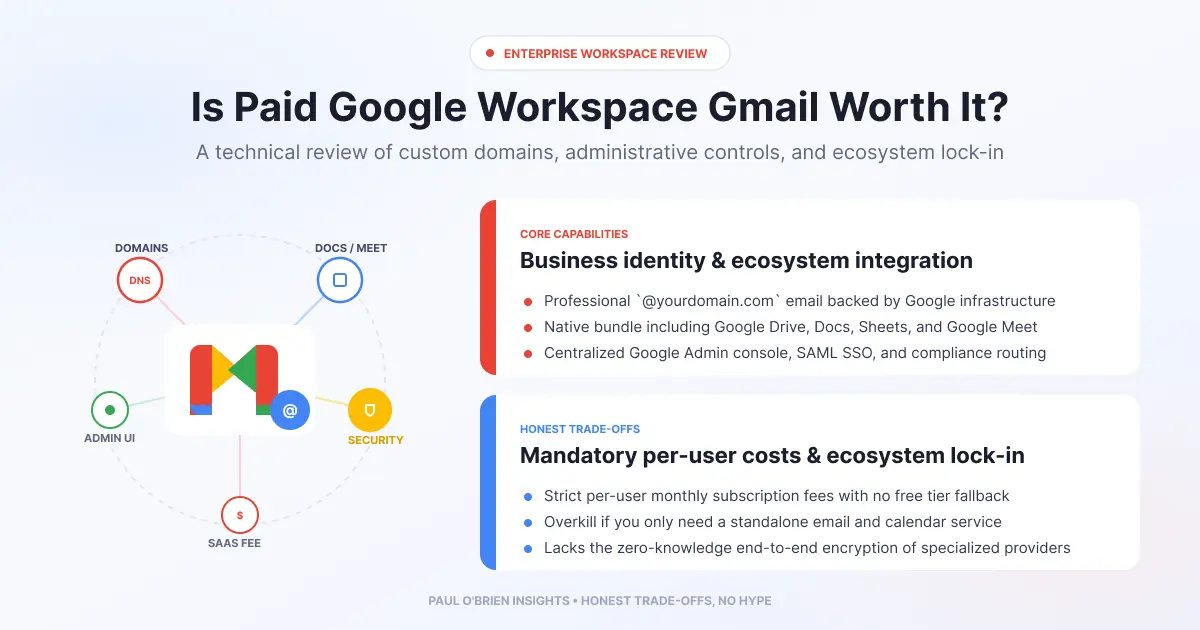
Short answer: Paid Google Workspace is worth it if you want email, calendar, meetings and documents in one managed suite, from £5.90 per user per month before VAT on flexible billing. It is not the right tool if all you need is a fast, private inbox: a dedicated provider such as Fastmail does that without the ad-company backdrop. One detail matters before you buy: several of the security features people associate with Workspace, including Vault, Gmail data loss prevention and S/MIME, are not on the cheapest plan.
At a Glance: Who Paid Google Workspace Is (and Isn’t) For
| User Profile | Best Fit? | Core Value Drivers / Key Trade-offs |
|---|
| Small business that wants email, calendar, Meet and documents together | Ideal | One admin console, shared calendars, Drive permissions and Gemini across the apps. Standard is the plan most small teams will want. |
| Regulated team that needs eDiscovery and retention | Strong fit | Vault is included from Business Plus. Gmail data loss prevention sits on the Enterprise tiers, so check the edition before you rely on it. |
| Solo professional who only wants custom-domain email | Workable | Starter does the job, but you pay for a suite you will not use and get 30 GB of pooled storage and limited Gemini. |
| Privacy-first user who wants minimal data exposure | Alternative needed | Google says Workspace content is not used for ads or to train its generative AI, but this is still a hyperscaler and not zero-access. |
| Someone who wants end-to-end encryption by default | Alternative needed | Mail is encrypted in transit and at rest, but Google can process it. S/MIME is an Enterprise feature. |
1. Custom Domains and Deliverability
Upgrade to a paid plan and Gmail stops being a consumer inbox. It becomes business mail on your own domain (you@yourcompany.com), managed from the Google Admin console. You publish SPF, DKIM and DMARC records for the domain, and Workspace walks you through them. If you want the background, my explainer on SPF, DKIM and DMARC covers what each record does.
Google sends from a very large, well-run global infrastructure, so legitimate business mail usually reaches the primary inbox, provided your DNS records are correct and you behave like a legitimate sender. Authentication will not rescue bad sending habits, but it removes the usual excuses. For a business that depends on sales and transactional mail, that baseline reliability is a large part of what you are paying for.
If you are still deciding whether a custom domain is worth the effort at all, I explain why in why using your own email domain makes sense.
2. Admin Controls, Security and Compliance
The administrative backend is where the paid product separates itself from consumer Gmail. The Admin console gives you control over your organisation’s whole data footprint: users, groups, sharing rules, device policies and audit logs.
The catch is that the headline security features are not spread evenly across the plans. This is where I would slow down before choosing a tier:
| Feature | Starter | Standard | Plus | Enterprise |
|---|
| Phishing and spam protection, 2-Step Verification, Advanced Protection Programme | Yes | Yes | Yes | Yes |
| Gmail security sandbox (attachments opened in an isolated environment) | No | Yes | Yes | Yes |
| Google Vault (eDiscovery, retention, legal holds) | Add-on | Add-on | Included | Included |
| Gmail data loss prevention (DLP) | No | No | No | Yes |
| S/MIME encryption | No | No | No | Yes |
| Endpoint management | Fundamental | Fundamental | Advanced | Enterprise |
- Security sandbox and phishing protection: on Standard and above, Gmail can open suspicious attachments in an isolated environment before they reach a user, which helps against malicious macros and zero-day files.
- Data loss prevention: DLP rules let administrators stop sensitive data such as card numbers or personal data leaving the domain by email. Google’s February 2025 announcement of Gmail DLP lists the Enterprise editions, not the Business plans.
- Google Vault: legal holds, retention rules and eDiscovery search across mail. It is included from Business Plus, and Google sells it as an add-on for other editions.
Know the limits: Google changes what each edition includes, and its edition lists are easy to misread. Before you rely on a feature for compliance, check the edition comparison in your own Admin console, and treat the table above as a guide to ask about rather than a contract.
If you are weighing up the security reputation of Workspace in general, I tackle the common worries in Google Workspace security myths.
3. The Ecosystem Integration
Where Workspace Gmail truly excels, and where no standalone email provider can realistically compete, is its integration with the rest of the suite. It is not just an email client. It is the operational hub for a whole business.
- Calendar and Meet: event invites update your calendar in real time, and a Meet link takes one click from the compose window. Meet allows 100, 150, 500 or 1,000 participants depending on the plan.
- Drive and Docs: instead of clogging inboxes with attachments, Workspace handles Drive permissions on the fly. If you attach a private Doc and the recipient cannot open it, Gmail warns you before sending and lets you fix the permissions.
- Chat and Spaces: for internal conversation that does not warrant an email, Chat sits in the sidebar and can turn a quick question into a team space or a video call.
For teams working entirely in the cloud, this saves dozens of context switches a day. It is smooth, fast and undeniably productive. If your team still lives in Word and Excel files, my comparison of why businesses choose Microsoft 365 over Google Workspace and my review of Outlook and Exchange are worth reading first.
4. Gemini, AI and Your Data
Gemini is now part of the plans rather than an add-on. On Google’s UK pricing page (checked 7 October 2026), Business Starter includes Gemini in Gmail with basic access to the Gemini app. Standard, Plus and Enterprise add Gemini in Docs, Sheets, Slides, Drive, Meet and Chat, plus expanded access to the Gemini app.
On data, Google’s Workspace documentation makes two commitments: it says it does not use Workspace data to train or improve the underlying generative AI models without permission, and that it does not collect, scan or use content in Workspace services for advertising. There is a caveat in the same documentation: if you choose to share Workspace data with the separate consumer Gemini or Search experiences, different terms apply.
Those are meaningful commitments, and they are the reason I am comfortable using Workspace to manage this blog. They are still commitments rather than something you can verify yourself, and your mail is not zero-access, so Google’s systems process it. If you would rather keep AI away from your compose window, note that Gemini comes with every Workspace plan, whereas Fastmail’s AI is optional (I have it switched off and will not pay extra for it). I made the wider case in AI and email, no thanks. For the difference between provider access and true zero-access, see zero-access encryption: what it really means.
Where Fastmail Still Wins the Day
Paid Workspace is an extraordinary business utility, but it is not the right tool for every philosophy or workflow. Independent providers like Fastmail still stand out in three areas.
1. Speed and Minimalism
Workspace is a large web application carrying several integrated services. Fastmail is built around email, runs on its own hardware and, in my use, opens, searches and processes mail faster. If you are an email purist who values interface speed over a bundled productivity suite, that matters.
2. Independence and Business Model
Google is an advertising and data company. Paid Workspace accounts carry strict privacy commitments, with commercial data excluded from ad targeting, but you are still operating inside a very large corporate ecosystem. Fastmail is independent and funded by subscriptions, with no ad business behind it. I cover who owns it and how legal requests are handled in my Fastmail security and privacy deep dive.
3. A Privacy-First Default
Fastmail offers an EU data region in Amsterdam (since August 2026), blocks remote images by default, and includes Masked Email through its 1Password integration. It does offer an optional AI assistant, but I have mine switched off and will not pay extra for it. For the reasoning behind remote image blocking, see my article on email tracking pixels.
Google Workspace Plans and Pricing in 2026
| Plan | Price per user per month | Storage | Meet | Gemini | Notable extras |
|---|
| Business Starter | £5.90 plus VAT | 30 GB pooled | 100 participants | Gemini in Gmail, basic app access | Custom email, 2-Step Verification, Admin console |
| Business Standard | £11.80 plus VAT | 2 TB | 150 participants | Gemini across the apps, expanded app access | Security sandbox, Meet recordings, appointment booking, eSignature |
| Business Plus | £18.40 plus VAT | 5 TB | 500 participants | As Standard | Vault included, attendance tracking, advanced endpoint management |
| Enterprise | Contact sales | 5 TB, more on request | 1,000 participants | As Standard | S/MIME, Gmail DLP, in-domain live streaming, enterprise endpoint management |
These are the flexible (monthly) prices shown on Google’s UK pricing page on 7 October 2026. The page says annual commitment saves 16%, and it advertises introductory discounts for new customers. The page does not say whether VAT is included, but in my own billing it is added on top, so budget for it. Business plans are limited to 300 users.
Comparative Matrix: Google Workspace vs. the Alternatives
| Feature | Google Workspace | Fastmail | Proton Mail | Mailbox.org |
|---|
| Entry price | £5.90 per user per month (Starter, flexible billing) | $5 per month (Individual, billed annually) | £3.19 per month (Plus, billed annually) | €3 per month (Standard, billed annually) |
| Storage at entry level | 30 GB pooled | 60 GB | 15 GB | 20 GB mail plus 10 GB drive |
| Custom domains | Yes, on every plan | Yes | 1 on Plus | Yes |
| Encryption model | Encrypted in transit and at rest, not zero-access, S/MIME on Enterprise | Encrypted in transit and at rest, not zero-access | Zero-access encryption | Not zero-access by default, with PGP and S/MIME options |
| Beyond email | Calendar, Meet, Drive, Docs, Chat and Gemini | Calendar, contacts and files | Calendar, Drive and other Proton apps | Calendar, drive and office tools |
| Company base | US, part of an advertising business | Australia, subscription-funded | Switzerland | Germany |
| Full Review | You are here, plus the resilience view | Fastmail review | Proton Mail review | Mailbox.org review |
| Try It | Google Workspace (10% off) | Fastmail (10% off, 30-day trial) | Proton Mail | No affiliate link |
Pros and Cons
| Strengths | Weaknesses |
|---|
| Complete suite: mail, calendar, Meet, Drive, Docs and Chat in one console | Vault is only included from Business Plus, and DLP and S/MIME are Enterprise features |
| Strong baseline protection: phishing and spam filtering, 2-Step Verification, security sandbox from Standard | Not zero-access: Google’s systems process your mail |
| Custom domain email on every plan, with a mature admin console | Starter has only 30 GB pooled storage and limited Gemini |
| Google commits not to use Workspace content for ads or generative AI training | Those are commitments you have to trust, and Gemini is built into the product whether you want it or not |
| Gemini included in the plans for drafting, summarising and search | Prices are per user and add up quickly for larger teams |
Frequently Asked Questions
Is paid Google Workspace Gmail different from free Gmail?
Yes. A paid plan gives you email on your own domain, an ad-free inbox, an Admin console, shared calendars and Drive, and business-level security settings. Storage is pooled across your organisation instead of being per account, and Google applies its Workspace data commitments to paid accounts.
How much does Google Workspace cost in the UK?
On Google’s UK pricing page on 7 October 2026, flexible monthly pricing was £5.90 per user for Business Starter, £11.80 for Business Standard and £18.40 for Business Plus, with Enterprise on request. An annual commitment saves 16%. VAT is added on top in my billing, so budget for it.
Does Google read my Workspace email for ads or AI training?
Google says it does not use Workspace content for advertising, and that it does not use Workspace data to train or improve the underlying generative AI models without permission. Your mail is still processed by Google’s systems to deliver it, filter spam and power features such as search and Gemini, because Gmail is not zero-access.
Which plan do I need for Vault and eDiscovery?
Vault is included from Business Plus and on the Enterprise editions. Google also sells it as an add-on for other editions, so you can add it to Standard if you do not need the rest of Plus.
Is Google Workspace better than Microsoft 365?
It depends on how your team works. Workspace suits cloud-first teams who collaborate in shared documents, while Microsoft 365 suits teams that depend on desktop Office files. I compare them in why businesses choose Microsoft 365 over Google Workspace.
Should a small business choose Workspace or Fastmail?
If you want one suite for email, meetings and documents, choose Workspace. If you mainly need reliable email on your own domain, with calendar and contacts, and you prefer an independent provider with a privacy-first default, choose Fastmail. I explain my reasoning in my Fastmail review.
The Bottom Line
If your business needs a complete operational suite where email, file storage, video meetings and document editing live under one roof, paid Google Workspace is arguably the best commercial package on the market. Its baseline security, deliverability and ecosystem are outstanding, and I use it myself. Just buy the plan on the features you need: Vault starts at Business Plus, and DLP and S/MIME are Enterprise features.
If you see email as a craft, and you value speed, independent ownership and a privacy-first default over a bundled suite, Fastmail shows that a dedicated inbox provider can still beat the giants at their own game. You can try Google Workspace with 10% off your first year or try Fastmail with a 30-day trial, and decide which suits your workflow.
Reader offer: 10% off your first year of Google Workspace. Applies to the Business Starter and Business Standard plans when you sign up through my referral link.
Claim 10% off
Disclosure: This article contains affiliate and referral links for Google Workspace, Fastmail and Proton Mail. If you sign up through them, I may earn a commission or credit at no extra cost to you, and the Google Workspace discount applies to your first year on eligible plans under Google’s terms. I only recommend services I personally use and trust.
Comments