
Is Google Workspace Private? Who Can See Your Email
I avoided Google for years over privacy fears. Now my business runs on Workspace. Here’s what Google, Gemini and your own admin can really see, and where the genuine risks sit.

For years I wouldn’t put my business email anywhere near Google. I’d heard the same warnings everyone has: Google reads your mail, Google sells your data, Google will train its AI on your contracts. Today my business runs on Google Workspace. So was I wrong then, or am I wrong now?
The honest answer is a bit of both. The fear I had was mostly aimed at the wrong person. Google, under the Workspace contract, is far more constrained than most people assume. The people who can actually see your email are closer to home, and almost nobody talks about them.
The change came during my annual review of business email and continuity plans. I went into a proper audit of Workspace expecting to confirm my biases, and came out on Business Standard. This is that audit, rewritten around the question I actually get asked: who can see what?
Reader offer: 10% off Google Workspace. Get 10% off your first year on Business Starter or Business Standard through my referral link.
At a Glance: Who Google Workspace Is (and Isn’t) Private Enough For
“Private” means different things to different people, so here’s where I’ve landed.
| User Profile | Best Fit? | Core Value Drivers / Key Trade-offs |
|---|---|---|
| Small businesses leaving free Gmail | Ideal | No ads, contractual data protections and proper admin controls, all in a tool your team already knows. |
| Freelancers and sole traders on their own domain | Strong fit | You’re your own admin, so the “who can see my email” question mostly answers itself. |
| Employees using a company Workspace account | Partial fit | Private from Google’s ad business, not from your employer. Treat it as company property. |
| Regulated firms (legal, finance, health) | Workable | Strong certifications, but you’ll want Vault and possibly client-side encryption, which means higher tiers. |
| Journalists, activists and high-risk users | Alternative needed | Google can technically decrypt standard Workspace data. Look at zero-access email instead. |
Who Can See Your Google Workspace Email?
This is the table I wish I’d had before I started. It covers a standard Business plan with default settings.
| Who | Can They See Your Email? | The Detail |
|---|---|---|
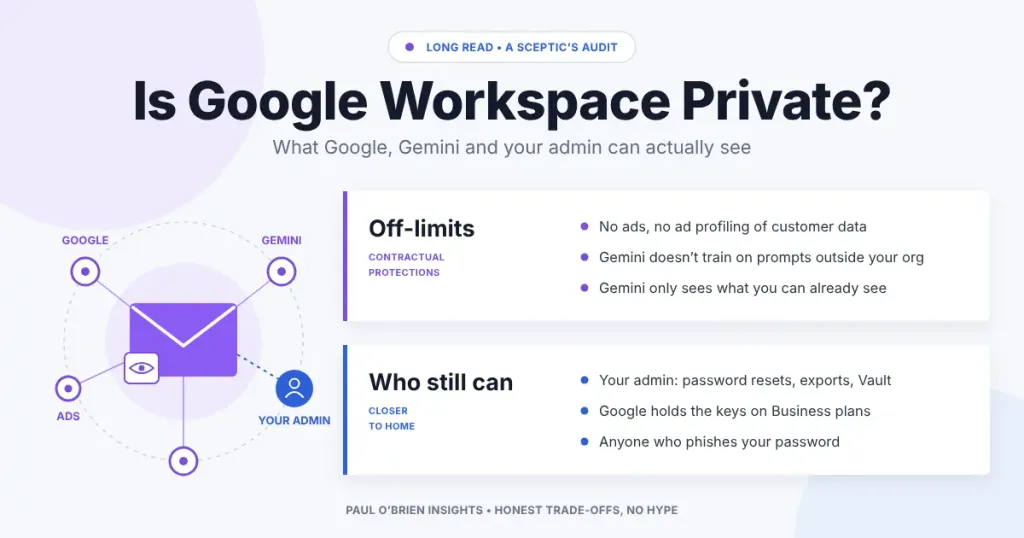
| Google’s advertising business | No | Google says it never uses Workspace customer data for ad targeting or to build ad profiles. |
| Google’s automated systems | Yes, by design | Spam, phishing and malware filtering scan every message. That’s the service you’re paying for. |
| Gemini | Only what you can see | Gemini follows your existing permissions, and Google says prompt content isn’t used to train models outside your domain without permission. |
| Google staff | Restricted | Access is governed by Google’s contractual data processing terms. You’re trusting the contract, not the maths. |
| Your Workspace admin | Yes | Admins can reset your password, export all users’ data and, on higher plans, search everyone’s mail with Vault. |
| Colleagues | Only if shared | Through delegation, shared inboxes or forwarded mail. |
| Law enforcement | With legal process | Google responds to valid legal requests and publishes a transparency report. |
| Attackers | If your account is weak | A phished password is still the most likely way a stranger reads your mail. |
Look at where the real access sits. It isn’t the ad business everyone worries about. It’s the admin, and anyone who gets hold of your password.
Does Google Read Your Workspace Email for Ads?
No. This is the myth I held longest, and it’s the easiest to put to bed. Google stopped scanning even free consumer Gmail to personalise ads back in 2017. For Workspace the commitment is stronger and written into the contract. Google’s Privacy Resource Center says it plainly: “We never use your data for ads targeting” and “We do not process your customer data to create ads profiles or improve Google Ads products.” Workspace apps don’t show ads either.
What Google does do is scan every message automatically for threats. People hear “scan” and think “read”, but I think of it like an airport luggage scanner. It’s looking for the dangerous thing, not reading your diary. Gateway checks such as SPF, DKIM and DMARC, link and attachment analysis, and phishing detection only work because the server can see the message. Turn that off and you’re not more private. You’re just easier to defraud.
Does Gemini Train on Your Workspace Data?
This is the question I get asked most now, and it deserves a careful answer rather than a reassuring one.
Google’s Generative AI in Workspace Privacy Hub makes three commitments that matter:
| Question | What Google Says |
|---|---|
| Is my data used to train Gemini? | “Prompt content is not used for training generative AI models outside of your domain without your permission.” |
| Can Gemini see files I can’t? | No. “If the user doesn’t have access to a document or email, Gemini will not retrieve that content.” |
| Do humans review my Gemini chats? | For the Gemini app in Workspace, chats and uploaded files “won’t be reviewed by human reviewers”. |
That’s a solid set of promises, and it’s a world away from the consumer Gemini app. But two things are worth knowing.
Know the limits: the Gemini app is turned on by default for Workspace users, and Google keeps Gemini app history for 18 months by default. If you’d rather decide those things yourself, check the Gemini settings in your Admin console rather than assuming they’re off.
The bigger risk with Gemini isn’t training. It’s that it faithfully respects your permissions, including the bad ones. If half the company can open the HR folder because someone shared it with “anyone in the organisation” in 2019, Gemini will happily summarise it for them. AI doesn’t create oversharing. It just makes it much easier to find.
Can Your Employer Read Your Google Workspace Email?
Yes. This is the part most “is Workspace private?” articles skip, and it’s the part that matters most if you’re an employee rather than an owner.
| Admin Tool | What It Allows | Which Plans |
|---|---|---|
| Password reset | Sign in as the user and see everything in the account | All plans |
| Data export | A super admin can export the entire organisation’s data, including every user’s Gmail | All editions |
| Google Vault | Search, hold and export mail across the whole domain for eDiscovery and retention | Business Plus, Enterprise and some others; not Starter or Standard |
| Delegation and audit logs | Grant mailbox access to others and see account activity | All plans |
None of this is sinister. A business needs to recover a departed employee’s mail, respond to a legal hold or investigate a breach. But it does mean the honest answer to “is my work email private?” is “private from Google’s ad business, not from your employer”. The same is true of Microsoft 365, and of almost any business email system worth using.
As a small business owner I’m my own admin, which neatly removes the problem for me. If you run a team, I’d suggest the opposite of secrecy: tell people in your IT or acceptable use policy what admins can access and when. That’s better ethics and, in the UK, it’s much easier to defend under data protection law.
Is Google Workspace Encrypted?
Yes, but it matters who holds the keys. By default Workspace encrypts data in transit and at rest, and Google manages the keys. That protects you against someone stealing a disk from a data centre. It doesn’t stop Google itself from processing your data, which is how spam filtering, search and Gemini work at all.
If you need Google not to be able to read your content, there’s client-side encryption, where your organisation holds the keys in an external key service. It’s a genuinely strong control, but it’s only available on Frontline Plus, Enterprise Plus and the Education Standard and Plus editions. It adds real admin overhead too: lose the keys and you lose the data, and features that depend on Google reading the content stop working on encrypted items.
One caveat on encryption: on the Business plans most small firms use, there’s no client-side encryption. If your threat model needs a provider that can’t read your mail, that’s a zero-access provider such as Proton Mail, not a Workspace setting.
Free Gmail vs Google Workspace: What Changes When You Pay
| Feature | Free Gmail | Google Workspace |
|---|---|---|
| Ads in the inbox | Yes, in the Promotions and Social tabs | None |
| Data used for ad targeting | Not from email content since 2017, but your wider Google account is an ad profile | No; contractually excluded |
| Governing terms | Google’s consumer privacy policy | A business contract and data processing terms |
| Gemini training | Governed by consumer Gemini settings | Prompts not used to train models outside your domain without permission |
| Your own domain | No | Yes |
| Admin controls | None | Full Admin console; Vault on higher plans |
| Who controls the account | You (and Google’s automated enforcement) | Your organisation’s admin |
Google Workspace Plans and Pricing in 2026
These are the flexible (monthly) prices from Google’s UK pricing page, as checked for my Workspace review on 7 October 2026. An annual commitment saves around 16%.
| Plan | Price (per user/month, ex VAT) | Storage | Privacy-Relevant Extras |
|---|---|---|---|
| Business Starter | £5.90 | 30 GB pooled | Limited Gemini; no Vault |
| Business Standard | £11.80 | 2 TB pooled | Full Gemini in Gmail, Docs and Drive; no Vault |
| Business Plus | £18.40 | 5 TB pooled | Vault included; advanced endpoint management |
| Enterprise Plus | Contact Google | As required | Client-side encryption |
How I’d Lock Down a Workspace Account
The infrastructure is the strong part. Where Workspace accounts get compromised, it’s almost always configuration. This is what I’d do on day one:
- Use phishing-resistant sign-in. Passkeys or hardware security keys for every admin at a minimum, and ideally everyone.
- Keep super admins to a minimum. Two is plenty: one in daily use and one break-glass account.
- Audit sharing. Check Drive for files shared with the whole organisation or “anyone with the link” before you roll Gemini out widely.
- Review the Gemini settings. Decide deliberately who gets it and how long history is kept.
- Get your mail authentication right. SPF, DKIM and DMARC at enforcement stop people spoofing your domain.
- Write down what admins can access. Put it in your IT policy so nobody is surprised later.
Pros and Cons
| Strengths | Weaknesses |
|---|---|
| No ads and no ad profiling of customer data, in writing | Google holds the keys on Business plans; no zero-access option |
| Gemini respects existing permissions and isn’t trained on your prompts outside your domain | Gemini is on by default and will surface anything that’s overshared |
| Excellent server-side spam, phishing and malware defence | Admins can access any user’s mail; employees should assume no privacy from their employer |
| Mature certifications and data processing terms | Vault and client-side encryption need pricier plans |
Frequently Asked Questions
Is Google Workspace private?
From Google’s advertising business, yes: Google says it never uses Workspace customer data for ad targeting. It isn’t private from your organisation’s admins, and on standard plans Google manages the encryption keys.
Does Google read Google Workspace emails?
Not for advertising. Google’s systems automatically scan mail for spam, phishing and malware, which is part of the service. Staff access is restricted by Google’s contractual terms.
Does Gemini use my Google Workspace data for training?
Google says prompt content is not used to train generative AI models outside your domain without your permission, and Gemini only retrieves content the user already has access to.
Can my employer read my Google Workspace email?
Yes. Admins can reset passwords and export all users’ data on every plan, and on Business Plus and above they can search everyone’s mail with Google Vault.
Is Google Workspace end-to-end encrypted?
Not by default. Data is encrypted in transit and at rest with keys Google manages. Client-side encryption, where you hold the keys, is available on Enterprise Plus, Frontline Plus and some Education editions.
Is Google Workspace more private than free Gmail?
Yes. Workspace has no ads, sits under a business contract with data processing terms, and excludes customer data from ad profiling. The trade-off is that your organisation’s admin controls the account.
The Bottom Line
I went looking for proof that Google was reading my business email, and I didn’t find it. What I found was a contract that keeps Workspace data out of Google’s ad machine, a clear set of promises about Gemini, and some of the best spam and phishing defence available. That’s why my business runs on it.
But “private” isn’t a yes-or-no question. Workspace is private from Google’s ad business, not from your admin, and not from Google in the way a zero-access provider is. If you understand that and set it up properly, I think it’s an excellent choice for most small businesses. If you need a provider that can’t read your mail even if it wanted to, Workspace isn’t it, and that’s fine. If it does suit you, my referral link takes 10% off your first year.
Reader offer: 10% off Google Workspace. Get 10% off your first year on Business Starter or Business Standard through my referral link.
Disclosure: This article contains affiliate links, including for Google Workspace and Proton Mail. If you sign up through them, I may earn a commission at no extra cost to you. I only recommend services I personally use and trust.

