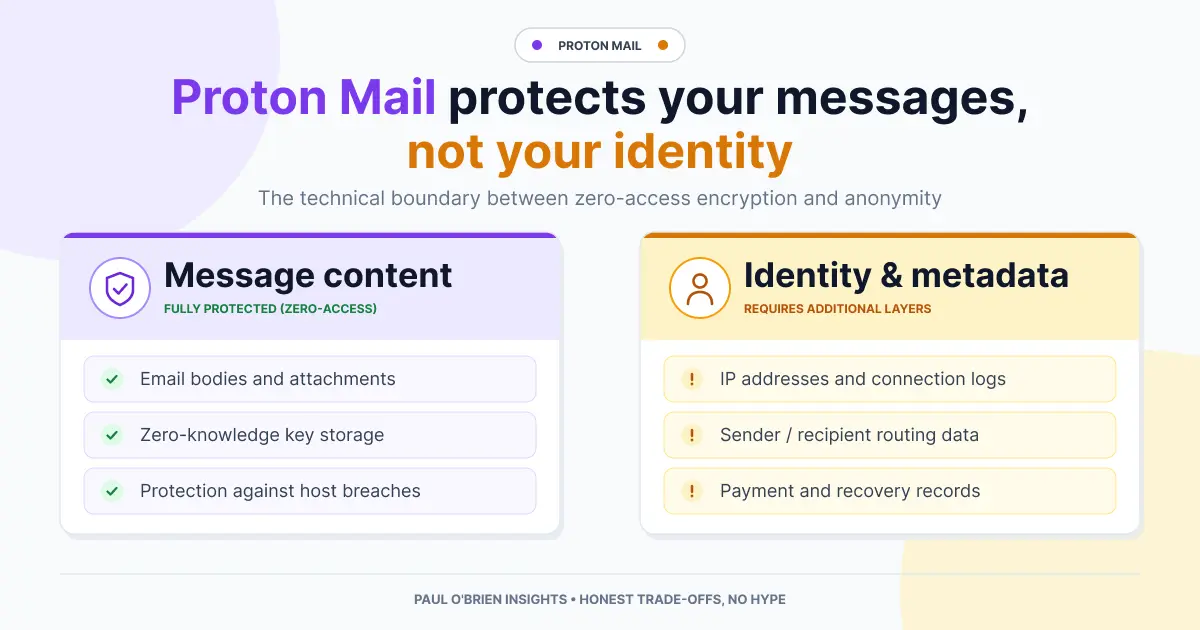
Proton Mail is excellent at keeping the contents of your messages private. It does not make you anonymous. Anyone whose safety or job depends on staying unidentified, such as a source, journalist or dissident, needs more than an encrypted mailbox, and a few common habits can undo the protection altogether.
Plenty of people mix up two different ideas: keeping your messages secret and keeping your identity secret. Proton is brilliant at the first. The second takes more effort from you, and it is harder than it was a few years ago. This guide explains what Proton protects, what it can’t hide, what Swiss law means in practice and the safer setup for high-risk use.
Short answer: Proton protects what you say, not the fact that you said it or who you are. For everyday privacy it is an excellent choice. For serious anonymity, pair it with Tor and a clean operating system, avoid custom domains and keep sensitive conversations Proton to Proton. If your safety depends on getting this right, take advice from a digital-security specialist as well. A blog post is not enough.
At a Glance: How Much Protection Do You Need?
| User Profile | Best Fit? | Core Value Drivers / Key Trade-offs |
|---|
| Everyday privacy from advertisers and data brokers | Ideal | Zero-access storage and no ad profiling. Metadata still exists. |
| Business or professional using a custom domain | Strong fit | Convenient and professional. The domain ties the mailbox to a paper trail. |
| Journalist taking tips from sources | Partial fit | Good for content if the source also uses Proton. Add Tor and careful sign-up habits for anonymity. |
| Whistleblower or dissident | Alternative needed | Proton can be one layer, not the whole answer. IP, sign-up and device traces all matter. |
| Someone who must email Gmail or Outlook users privately | Workable | Use password-protected messages or PGP so nothing travels readable. |
Messages vs Identity: Two Different Problems
| Keeping messages private | Keeping identity private |
|---|
| Question | Can anyone read what I wrote? | Can anyone work out who I am and who I talk to? |
| Main tools | Encryption: zero-access storage, end-to-end encryption, PGP | Network and account hygiene: Tor, a clean device, minimal sign-up details |
| Proton’s strength | Strong | Limited. Some of it is up to you |
What Proton Does Well
Proton uses what it calls zero-access encryption. According to Proton’s own explanation, messages in your mailbox are stored with zero-access encryption, and message bodies and attachments are fully encrypted. In practice that means Proton can’t read your stored mail, so even if someone seized its servers or arrived with a Swiss court order, your old messages would stay unreadable without your key. I explain the distinction between zero-access and end-to-end in what zero-access encryption really means, and the wider trade-offs in my Proton Mail review.
That is a big deal. But email was designed decades ago, and it has quirks encryption can’t fix. If you are weighing zero-access encryption against a more everyday setup, my Proton Mail vs Fastmail comparison shows the trade-offs side by side.
The Secret to Staying Protected: Keep It in the Family
When you email from one Proton address to another, Proton says the message is always end-to-end encrypted. It’s encrypted on your device and only unlocked on the recipient’s. Email an outside address and the position changes.
| Route | Protection | What to do |
|---|
| Proton to Proton | End-to-end encrypted | Best option for sensitive exchanges |
| Proton to Gmail, Outlook or other | TLS in transit where supported, but the receiving provider can read it | Use a password-protected message, or PGP, to keep it end-to-end encrypted |
| Non-Proton to Proton | TLS in transit, not end-to-end, unless the sender uses PGP. Proton says it “might be accessible to the sender’s email service” | Ask the other person to use a Proton address or PGP |
All of that comes from Proton’s own page. So if you’re a source sharing something sensitive, ask the person on the other end to use a Proton address too. It keeps both ends of the conversation locked down.
What Proton Can’t Hide
Even with all that encryption, some things are visible because email can’t be delivered without them.
| What | Why it’s exposed | What you can do |
|---|
| Who is talking to whom | Sender and recipient addresses are needed for delivery. Proton describes addresses and subject lines as “encrypted, but not end-to-end encrypted”, so they are not protected from Proton’s systems the way message bodies are | Minimise the number of correspondents. Keep sensitive talks Proton to Proton |
| Plain emails to outsiders | Anything sent to a non-Proton address leaves without end-to-end protection | Password-protected messages or PGP |
| Your IP address, if a court demands it | Proton says it stores no permanent IP logs by default but may have to comply with Swiss court orders to log specific users | Connect through Tor or a VPN |
| Sign-up details | A recovery email, a phone number or a card payment can leave a trail | Avoid them where you can. See the verification note below |
Timestamps and message sizes are also normally visible to the systems that carry mail. Proton’s page doesn’t address them, so assume they are not hidden.
IP addresses and Swiss law
Proton’s statement for activists says Proton Mail stores no permanent IP logs by default, keeps some temporary security and debug logs, temporarily retains the IP used to create an account, and logs IPs if you turn on advanced security logs. It also says it may have to comply with Swiss court orders to log specific users in criminal cases, and it recommends that anyone who also needs anonymity should use its Tor onion site or a VPN as well as Proton Mail. In 2021, after a Swiss court order covering one user, Proton stopped claiming it did not keep any IP logs.
Is Switzerland Still a Safe Harbour?
Many people choose Proton because it is Swiss. The picture is more complicated than it was. In August 2025, TechRadar reported that Proton was moving most of its physical infrastructure out of Switzerland, citing legal uncertainty over proposed surveillance rules. Its AI assistant Lumo moved first, to Germany, and Proton was developing facilities in Norway. Proton said investing in Europe did not mean leaving Switzerland.
The proposal is a revision to the Swiss surveillance ordinance. According to the reports I read, it would extend data retention, require larger providers to identify their users and make some requests for subscriber data and IP addresses easier. In February 2026, 19 organisations wrote to the Swiss government to object. I could not find a final decision, and I haven’t seen a clear statement of how it would apply to Proton Mail specifically, so treat the legal position as in flux and check for updates. For more on how Swiss and German providers compare, see Swiss vs German email privacy.
Why You Shouldn’t Use a Custom Domain (If You Need Anonymity)
Setting up your own domain, like @my-cool-name.org, sounds tidy and professional. For someone who needs anonymity, it is a trap. For everyone else it is often a good idea, as I explain in why using your own email domain makes sense.
- The paper trail. Domain registrars keep your payment details, billing address and login history. Even with “privacy protection” switched on, a subpoena to a registrar can unmask you, and that is far easier than going through the Swiss courts.
- It can be hijacked. Custom domains depend on DNS. If an attacker gets into your registrar account, they can quietly reroute your mail through their own server and read it before it reaches Proton.
- You stand out. A unique domain is a flashing sign. Anyone monitoring a network can spot traffic going to it. An ordinary
@proton.me address blends in with millions of others.
The Safest Setup
If you are up against a serious threat, this is the approach. Each step covers a different weakness, so skipping one leaves a gap.
- Use a live operating system such as Tails. It runs from a USB stick and is designed to leave no trace on the computer.
- Connect through Tor. It hides your real IP address. Proton offers a dedicated onion address for its service.
- Stick with a standard @proton.me address. No custom domain, no registrar and no billing trail.
- Leave out the personal details. Don’t add a recovery email, a phone number or a payment, if you can avoid it.
- Keep conversations Proton to Proton. If you must email someone outside Proton, use password-protected messages or PGP so nothing travels in the clear.
One caveat on signing up: I used to suggest creating a free account over Tor with no recovery email and no phone number. That has become harder. According to Proton’s human-verification page, you may be asked for a CAPTCHA or to verify a phone number or email address, and using Tor makes the email or SMS-only option more likely. Users in a Privacy Guides thread in April 2026 reported that Proton increasingly asks for a non-disposable email address. Those are anecdotes, but they point the same way. Proton says it stores only a hash of a verification email or phone number, but a hash can still be checked against a known address. Plan for this before you rely on an anonymous account.
What Each Layer Buys You
| Layer | Protects against | Doesn’t protect against |
|---|
| Proton zero-access encryption | Provider or seizure reading stored mail | Metadata, and a recipient who forwards or leaks |
| Proton to Proton | Interception in transit | The other person’s device or behaviour |
| Tor | Your IP address being tied to the account | What you write, or logging in from your normal network |
| Tails | Traces left on the computer | Mistakes you make in the session |
| Standard @proton.me address | Registrar and billing records | Verification details used at sign-up |
Pros and Cons for High-Risk Use
| Strengths | Weaknesses |
|---|
| Strong content protection with zero-access storage | Sender, recipient and subject data are not end-to-end encrypted |
| Always end-to-end encrypted between Proton users | Outside recipients need extra steps to keep mail private |
| No permanent IP logs by default | Can be ordered by a Swiss court to log a specific user |
| Onion access for Tor users | Anonymous sign-up is harder than it was |
| Long-established service that publishes transparency reports | Swiss legal environment is under review |
Frequently Asked Questions
Is Proton Mail anonymous?
Not by itself. It encrypts message content, but your IP address, sign-up details and who you correspond with can still identify you. Anonymity needs extra layers such as Tor.
Can Proton read my emails?
Not messages stored in your mailbox, which use zero-access encryption. Mail from or to outside providers can be readable in transit or at the other end, and Proton says subject lines and addresses are encrypted but not end-to-end encrypted.
Does Proton Mail keep IP logs?
By default it stores no permanent IP logs, but it keeps some temporary security logs and the IP used at sign-up, and it says it may have to log specific users if a Swiss court orders it.
Is a custom domain safe with Proton?
For everyday use, yes. For anonymity, no, because registrars hold payment and billing records and can be subpoenaed, and DNS can be hijacked.
Is it safe to email Gmail or Outlook users from Proton?
The content is protected in transit by TLS where supported, but the recipient’s provider can read it. Use a password-protected message or PGP when the content is sensitive.
Can I use Proton Mail over Tor?
Yes. Proton offers an onion site and recommends Tor or a VPN for people who need anonymity. Expect extra verification when signing up over Tor.
Is Proton Mail still a good choice given the Swiss law changes?
For most people, yes, but follow the story. Proton has been moving some infrastructure out of Switzerland, and the proposed rules were still being contested when I last checked.
The Bottom Line
Proton protects what you say. It doesn’t hide that you said it, or who you are. For everyday privacy it is excellent. For high-stakes anonymity, pair it with Tor, a clean operating system and a habit of leaving no personal breadcrumbs behind, and keep the conversation inside the Proton family wherever you can. If you are ready to try it, you can sign up for Proton Mail through my link.
Get started with Proton Mail. Proton often runs introductory offers on its paid plans, so check the current deal before you pay. It includes a 30-day money-back guarantee, as listed when this post was written.
See the current Proton Mail offer
Referral link: I may earn a commission, at no extra cost to you.
Disclosure: the Proton link is an affiliate link. If you sign up through it, I may earn a commission at no extra cost to you. This guide is general information, not advice for a specific threat situation. Sources: Proton: what is encrypted; Proton: protection for activists; Proton: human verification; TechRadar; Statewatch; Schneier. Checked 9 October 2026.

Comments