
How to Turn Off AI in Email: Gmail, Outlook, Apple Mail
AI is creeping into every email client. Here is how to switch off Gemini, Copilot and Apple Intelligence in Gmail, Outlook and Apple Mail, what you lose, and why I think email works fine without it.

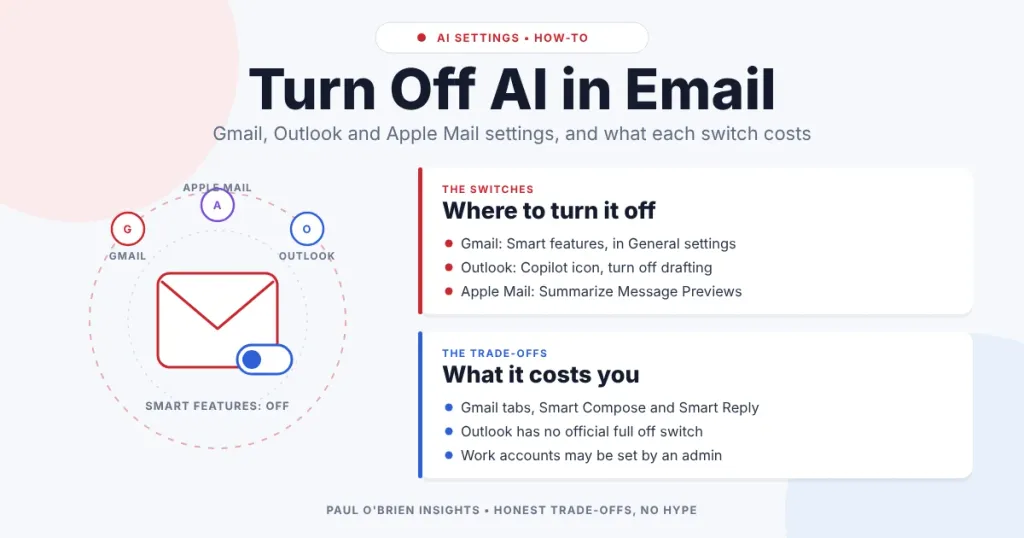
AI is creeping into every email client, from Gemini summaries in Gmail to Copilot drafts in Outlook and summarised previews in Apple Mail. You can turn much of it off, and I think you should ask whether you need it at all. Here are the settings, what you lose when you switch them off, and why I believe email works fine without it.
In my recent deep-dive into Fastmail, I touched briefly on the rise of artificial intelligence in modern inbox management. That review got me thinking, and the more I considered it, the deeper I wanted to dig into the topic. Settings below were checked against Google, Microsoft and Apple help pages on 9 October 2026.
Short answer: yes, you can switch off most inbox AI, but it takes different steps in each app and some switches also remove ordinary features such as inbox categories. Gmail and Apple Mail have clear settings. Outlook’s Copilot drafting is harder to remove fully.
How to Turn Off AI in Gmail, Outlook and Apple Mail
| App | How to turn it off | What you lose or what to know |
|---|---|---|
| Gmail (web) | Settings → See all settings → General → Smart features, and untick “Turn on smart features in Gmail, Chat, and Meet”. Then open “Google Workspace smart features” → Manage Workspace smart feature settings and turn off “Smart features in Google Workspace”, then Save. | Turning off the Gmail switch also removes inbox categories (Primary, Social, Promotions), Smart Compose, Smart Reply and summary cards above emails. Chat conversation summaries have their own separate setting. |
| Outlook (new Outlook) | In the email editor, click the Copilot icon and choose “Turn Copilot off for drafting”. | This comes from a Microsoft Community specialist (May 2025), who said there is no official way to remove “Draft with Copilot” fully. The prompt may come back, and menus change. Availability depends on your licence. |
| Apple Mail (Mac) | Mail → Settings → Viewing, then turn off “Summarize Message Previews”. In Composing, turn off “Personalize Smart Replies”. | Apple also lets you turn off notification summaries in System Settings → Notifications, and restrict Apple Intelligence overall. |
Know the limits: these steps are for personal accounts and the menus move around. If you use Google Workspace or Microsoft 365 for work, your administrator may control which AI features appear. I haven’t tested every plan, so check Google’s smart features page and Apple’s Apple Intelligence controls for the current wording.
Do We Actually Need AI in Email?
The core question I keep asking myself is simple: is AI really a feature we need embedded directly into our email?
Have we genuinely become so uncomfortable using our own written voice, something most of us have done successfully thousands of times, that we need an algorithm to step in? Does AI in an email client actually save you meaningful time? And aren’t a few minor typos just a universally accepted part and parcel of human communication?
I understand that some businesses might feel nervous about staff sending poorly worded messages to important clients. But if an enterprise feels compelled to have a machine vet, draft or rewrite an employee’s correspondence before it leaves the outbox, you have to ask a broader operational question: are they employing the right people in the first place?
It sounds harsh, I know, but AI is creeping into every digital corner. More and more websites now force you through aggressive chatbots to answer basic questions that could be solved in five seconds on an FAQ page or support portal. I’ve always been perfectly happy with self-serve documentation.
I’m not anti-technology
Don’t get me wrong, I am far from anti-technology. I am pro-AI when used appropriately. I use Google’s Gemini daily, and I run my own articles through it to double-check grammar and spelling before I hit publish.
Email, however, feels different. As I argued in Email Is Still a Craft — Even When We Pretend, effective written communication relies on genuine intent, nuance and personal style. Replacing that human touch with automated text generation completely misses the point of what makes email valuable in the first place.
Are other people really using email so differently from me? Just how long and complex are the day-to-day communications being sent via your inbox? If you are sharing tons of detailed, highly structured information, wouldn’t you simply attach a document rather than cramming thousands of words into the body of an email?
My business uses Google Workspace, which comes with Gemini deeply integrated into Gmail. Have I ever used it? Nope. Will I ever use it? I highly doubt it. Do I really need a daily machine-generated summary of my inbox, or a suggested automated reply to a message from my wife? That feels like a recipe for disaster.
Reading Out Loud and Over-Engineering
Then there is the push toward text-to-speech AI assistants reading your inbox aloud to you. Unless you have a visual impairment or an accessibility requirement, where assistive technology is genuine and vital, why on earth do you need an AI to read out a written message?
If that’s genuinely your preference, send a voice note. Or, dare I say it, pick up the phone and call someone. What’s the next logical step in this endless cycle? Having your live phone calls dictated into text so you can read them instead of listening? We are over-engineering simple human interactions.
Email Works Just Fine
The fundamental point is this: email works just fine. Leave it alone. It doesn’t need AI’s help.
Let’s direct compute power toward saving the world, curing diseases or solving climate change, not drafting three-line status updates.
I will never get bored of hitting the send button on a message I have taken the time to write myself. It might contain the occasional typo; so what? It could perhaps have been phrased slightly more elegantly; again, so what?
Outsourcing your email drafting to an AI means losing your actual voice. Every time I’ve tested AI email assistants, the end result sounds completely sterile and nothing like me. Friends and colleagues can spot a grammatically flawless, overly structured, AI-generated message in seconds. It strips out personality and replaces it with corporate noise.
Arguments For Inbox AI, Fairly Stated
| The case for | My response |
|---|---|
| Summaries save time on long threads | If a thread is too long to read, the problem is the thread. Pick up the phone. |
| Drafting helps people who find writing hard | A short, plain message in your own words beats a polished one that isn’t yours. |
| Reading aloud helps accessibility | Agreed. This is where assistive technology is genuine and vital. |
| It saves five minutes a day | Quite frankly, I don’t care. Email is personal communication. |
Providers and AI: What to Check
If you would rather not have inbox AI, check your provider’s position before you move. Proton, for example, offers an AI writing assistant called Scribe. When it launched in 2024 it was a paid add-on for business plans that could be disabled, and by default processed text locally on your device, according to It’s FOSS. Check Proton’s current plans before you rely on that. Independent providers tend to market the absence of AI, but I haven’t checked every provider’s current position, so read each provider’s own pages. My Fastmail review, Proton Mail review and Outlook and Exchange review cover each provider in more depth.
Frequently Asked Questions
How do I turn off Gemini in Gmail?
Open Gmail settings, go to General, and untick “Turn on smart features in Gmail, Chat, and Meet”. Then turn off “Smart features in Google Workspace” under Manage Workspace smart feature settings. Google says the Workspace setting covers Gemini features that summarise content and create drafts, and that Chat summaries have their own control.
Will I lose inbox categories if I turn off Gmail smart features?
Yes. Google lists Primary, Social and Promotions categories, Smart Compose, Smart Reply and summary cards as features that go when the Gmail switch is off.
Can I turn off Copilot in Outlook?
You can turn off drafting from the Copilot icon in the email editor, but a Microsoft Community specialist said there is no official way to remove “Draft with Copilot” fully. Check with your administrator if you use Microsoft 365 for work.
How do I turn off email summaries in Apple Mail?
On a Mac, choose Mail → Settings → Viewing and turn off “Summarize Message Previews”. Apple lists the setting in its Apple Intelligence controls.
Is there an email provider with no AI?
Some providers avoid AI features, but policies change. Check the provider’s own pages, and see my reviews for how each one handles it.
Does AI in email put my privacy at risk?
It can, because features that read your messages to summarise or draft replies process your content. Where that processing happens depends on the provider, so read the privacy documentation.
The Bottom Line
Email is personal communication. Don’t let AI take it over. If you want it gone, the settings above remove most of it, and if you want to see how a calmer inbox feels, my guide to free vs paid email is a good place to start looking at the alternatives.
Note: this article contains no affiliate links. Sources: Google: smart features and controls; Apple: turn off and restrict Apple Intelligence; Microsoft Community: Draft with Copilot; It’s FOSS: Proton Scribe. Checked 9 October 2026.

