Email
iCloud Mail Needs a Redesign: A Webmail Concept
Apple’s hardware is world-class, but iCloud Mail on the web feels abandoned. Here is what iCloud Mail offers today, why it needs a rebuild, and a concept UI I mocked up.
Email used to be the product. Now it is bundled into productivity suites and buried under notifications. But for many of us it remains a deliberate craft, slower, clearer and more intentional than the tools that replaced it.
 Paul O'Brien
I remember when email was simply an inbox. You connected to the internet, downloaded your messages and disconnected again. Broadband made everything faster and permanently connected, but the fundamentals of email did not really change. It remained a subject line, a message, a reply and a record.
What changed was the context around it. This post looks at how email went from being the product to being one surface inside much larger suites, why I still treat it as a craft, and what that means if you are choosing how to run your own email.
Short answer: email has been repositioned, not replaced. For many people it is now a dumping ground for receipts and alerts. Used deliberately, it is still the best tool I know for thinking clearly, writing carefully and keeping a record. You do not need a sprawling suite to do that well, but if your business genuinely needs one, buy it for the right reasons.
Reader offer: 10% off Google Workspace. If you do need the full suite of mail, Drive, Docs and Meet, my referral link takes 10% off your first year on Business Starter or Business Standard.
Claim 10% off Google WorkspaceReferral link: I may earn a commission, at no extra cost to you.
| Stage | What changed | What it did to email |
|---|---|---|
| Dial-up inboxes | Connect, download, disconnect | Email was something you visited |
| Exchange and Outlook | Shared calendars, global address lists, central servers | Email became part of the operating system of office life |
| BlackBerry | Real-time push email went mainstream in business | Email stopped waiting for you and started following you |
| Gmail (2004) | Search over folders, 1GB of free storage, threaded conversations | Webmail stopped feeling temporary |
| Productivity suites | Mail bundled with storage, chat, video, AI and identity | The inbox became the login for a whole ecosystem |
In corporate environments, Microsoft had already embedded email deeply through Exchange and Outlook. Shared calendars, global address lists and centralised servers made email feel institutional. It was no longer just a communication tool. It became part of the furniture of office life.
BlackBerry did not invent mobile email, but it made real-time, push-based email mainstream in business. It did not alter the structure of email itself, but it changed how it fitted into daily life. You were no longer tied to a desk to check your inbox; messages arrived instantly, wherever you were. Email stopped being something you visited and became something that followed you.
Around the same time, Google reshaped expectations with Gmail, which launched on 1 April 2004 with 1GB of free storage when rivals offered a tiny fraction of that. Search replaced rigid folder hierarchies. Generous storage reduced the need to delete. Conversation threading changed how exchanges were read and organised. Webmail stopped feeling temporary and began to feel permanent.
Over time, platforms like Google Workspace pushed the shift further by folding email into broader productivity suites. You were no longer buying an inbox. You were buying storage, chat, video meetings, AI features and identity management. Email became the login credential for an entire ecosystem, and somewhere in that evolution its role quietly changed.
For many people today, email is where receipts land, where password resets arrive and where notifications pile up. It has become a clearing house for digital residue.
Real-time chat feels more dynamic. Video calls feel more decisive. Collaborative documents feel more modern. Email, by contrast, can seem slow and procedural.
But that perception says more about our habits than about the tool itself.
When I describe email as a craft, I do not mean it nostalgically. I mean that it demands intention.
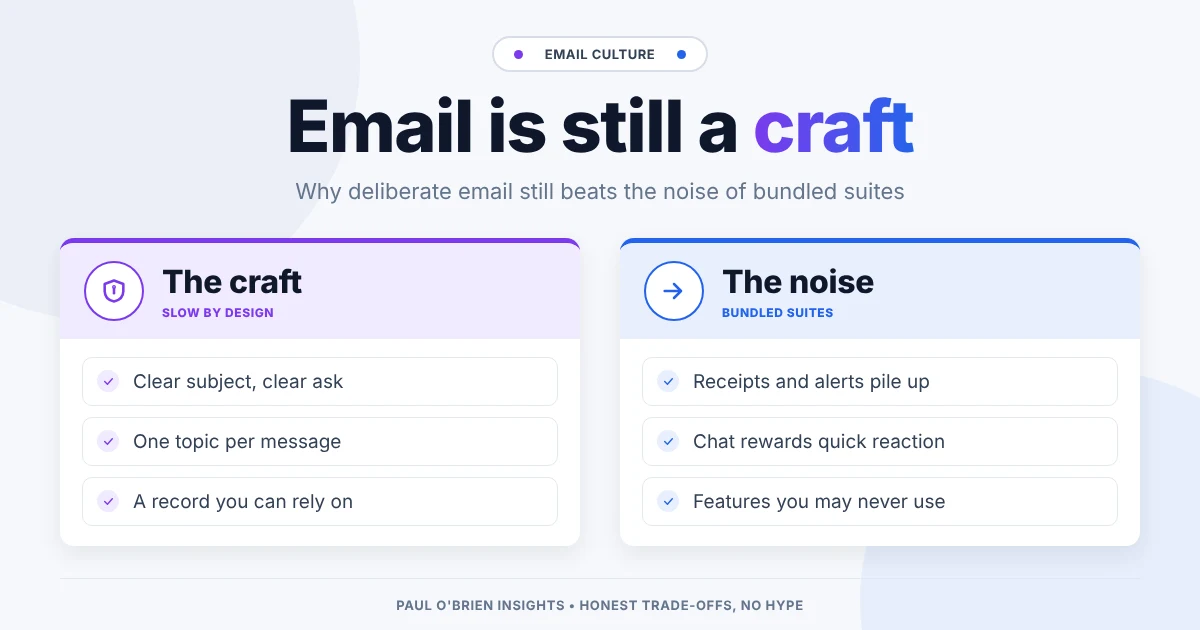
A good email needs a clear subject line, a structured argument, a considered tone and a deliberate close. It asks you to think before you send. Chat encourages reaction. Email encourages reflection.
Collaborative tools are essential. Messaging and quick calls keep teams moving through the day, and I cannot imagine modern team work without them. But for me, email remains my core tool. It is where conversations begin, where agreements are shaped and where decisions are documented.
Email creates record, context and accountability in a way few other tools do. Its slower pace is not a flaw. It is a discipline. In practice, that discipline looks like this:
Most business email products are no longer sold as standalone services. They are bundled into suites: Microsoft 365, Google Workspace (referral link), Zoho Workplace. The inbox is now one surface within a much larger commercial offering.
That raises a practical question. Do most small and medium businesses genuinely need everything that now comes attached to business email? AI meeting summaries, layered chat, whiteboards, automation engines and dozens of integrations can be useful. They can also become subscription gravity rather than genuine productivity.
Modern software marketing quietly implies that if you are not using the full stack, you are behind. Sometimes that is true. Often it is not. Productivity is rarely about the number of tools available. It is more often about clarity of use. If you are weighing the big two, I have written about why some businesses choose Microsoft 365 over Google Workspace.
The continued existence of standalone providers says something too. Services like Fastmail do not sell sprawling ecosystems. They sell email, calendars and contacts.
I use Fastmail because, in some respects, it offers a more focused and refined email experience than the bundled options attached to larger platforms. That choice is deliberate. It is not about rejecting ecosystems; it is about recognising that sometimes the core tool deserves attention in its own right.
If email had truly become just a notification layer, standalone providers would have faded away. The fact that they continue to attract paying users suggests that, for many people, email remains a primary instrument rather than a background utility.
When I first wrote this piece, I pointed to Amazon WorkMail as a revealing example. Amazon is not primarily a productivity company; it builds infrastructure. Offering a restrained service focused on email, calendar and directory suggested there was still demand for email as a foundational layer rather than a feature showcase.
That signal has since turned the other way, and I should say so plainly. AWS stopped accepting new WorkMail customers on 30 April 2026 and will end support on 31 March 2027, after which the console and WorkMail resources can no longer be accessed. Its own migration guidance points customers to other providers.
I do not think that undermines the wider argument, but it sharpens it. Standalone email survives where email is the whole business, as it is for Fastmail. It struggles as a side product inside a company whose priorities lie elsewhere. If you value a focused inbox, choose a provider for whom that inbox is the point.
Years ago, the British journalist Caitlin Moran wrote in The Times about how email, compared with the intrusiveness of a ringing phone, felt civilised. Messages, she said, queued up in silent peace “like swans.”
That image still resonates. A phone call demands attention. A chat notification interrupts. An alert insists on being handled immediately. Email waits.
In a culture that increasingly equates speed with productivity, that restraint can feel unfashionable. But speed and productivity are not the same thing.
I am not anti-ecosystem. I am deeply embedded in Apple’s world, and I use collaborative tools daily in professional settings. Those systems work well. But when it comes to thinking clearly, writing carefully and communicating with intent, I continue to reach for email.
Email did not disappear. It was repositioned. For some it became a dumping ground for receipts and alerts. For others it remains a disciplined space for serious communication. You get to choose which one yours is.
Email is still a craft. We simply stopped recognising it as one.
Not in my experience. Chat has taken over quick, reactive conversation, but email is still where agreements, records and conversations with people outside your organisation live.
Some do. Many only need reliable email, calendars and shared storage. Work out what you will actually use before paying for a bundle.
Not for new deployments. AWS stopped taking new customers on 30 April 2026 and ends support on 31 March 2027, so existing users need to plan a migration.
A subject that says what it is for, one topic, the ask near the top, explicit dates and owners, and a quick read-through before you send.
Note: checked and updated 17 October 2026. Sources: AWS: Amazon WorkMail end of support, Wikipedia: Gmail, The Times: Caitlin Moran.
Get the next post by email. Free, no ads, and you can leave any time.
Apple’s hardware is world-class, but iCloud Mail on the web feels abandoned. Here is what iCloud Mail offers today, why it needs a rebuild, and a concept UI I mocked up.
A technical look at paid Outlook and Exchange Online: which security features need which plan, how it compares to Google Workspace and Fastmail, and who should pick each.
AI is creeping into every email client. Here is how to switch off Gemini, Copilot and Apple Intelligence in Gmail, Outlook and Apple Mail, what you lose, and why I think email works fine without it.
Comments