Email
iCloud Mail Needs a Redesign: A Webmail Concept
Apple’s hardware is world-class, but iCloud Mail on the web feels abandoned. Here is what iCloud Mail offers today, why it needs a rebuild, and a concept UI I mocked up.
A technical look at paid Outlook and Exchange Online: which security features need which plan, how it compares to Google Workspace and Fastmail, and who should pick each.
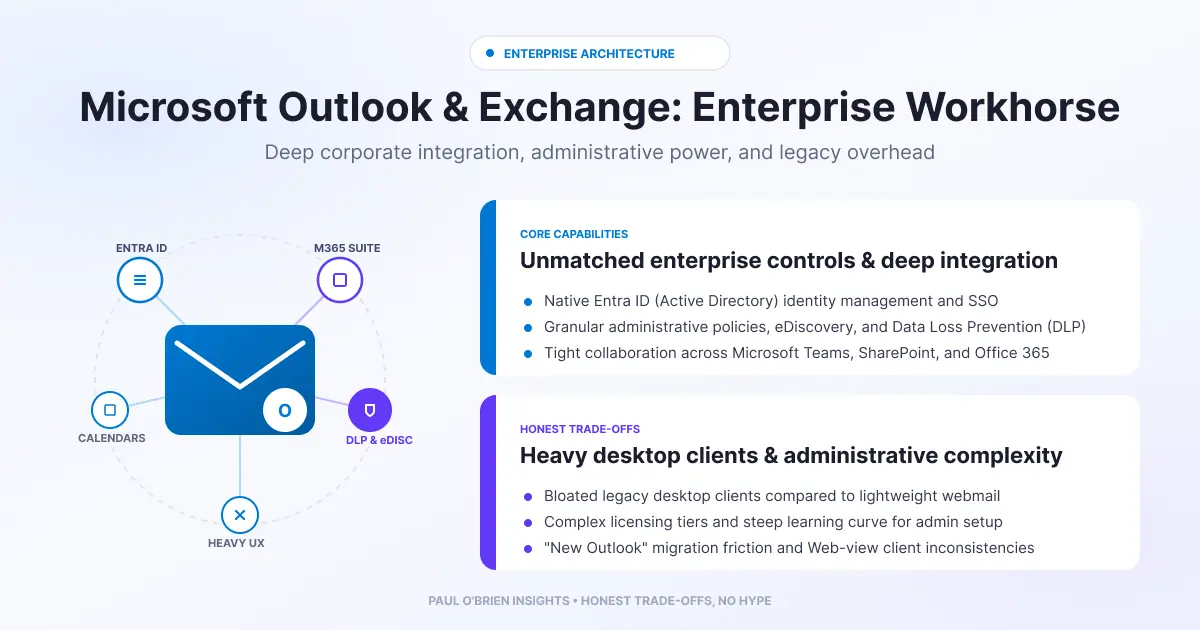
Microsoft Outlook with Exchange Online is the industrial foundation of business email. Its security stack, compliance tools and desktop client are hard to beat, but paid Outlook is heavy, the licensing is fiddly, and it sits in a large telemetry-driven ecosystem. Here is an honest, technical look at where it wins and where Fastmail and Google Workspace do better.
Having recently taken a deep dive into Fastmail and reflected on how we interact with email as a craft, I wanted to turn my attention to the indisputable corporate heavyweights: Microsoft Outlook and Exchange Online. If Google Workspace is the modern cloud native and Fastmail is the benchmark for independent privacy, Microsoft 365 is the industrial foundation of global enterprise. Millions of businesses run on Exchange Online without giving it a second thought.
Short answer: choose paid Outlook and Exchange Online if you need corporate compliance, strong admin controls and the classic Office desktop stack. Choose Google Workspace for browser-first collaboration. Choose Fastmail if you want speed, independence and privacy. Check which Microsoft plan you are buying, because some of the security features below are only in the top business tier.
| User Profile | Best Fit? | Core Value Drivers / Key Trade-offs |
|---|---|---|
| Business already on Office, Teams and OneDrive | Ideal | Tight desktop integration, central admin and compliance. Licensing takes care to get right. |
| Regulated organisation needing archiving, DLP and eDiscovery | Strong fit | Purview and Defender tooling, with features depending on the licence tier. |
| Browser-first team | Partial fit | Outlook on the web works, but Google Workspace is built for the browser. |
| Privacy-minded individual or small team | Alternative needed | No inbox ads on paid plans, but you are inside a large data and AI ecosystem. |
The free @outlook.com webmail is fine for everyday personal use, but upgrading to a paid Microsoft 365 subscription changes the underlying infrastructure completely. Your inbox is backed directly by Exchange Online, giving you access to commercial-grade mail transfer agent (MTA) routing.
Microsoft routes enormous volumes of legitimate corporate traffic, so its sending IP reputation is strong. When your custom domain (@yourcompany.com) has SPF, DKIM and DMARC correctly configured, your mail lands reliably in business inboxes. Reputation does not replace configuration, so read my guide to SPF, DKIM and DMARC before you move a domain.
Defender for Office 365 gives you detonation sandboxing for attachments in isolated environments and Safe Links, which inspects a link at the moment you click it and so helps against delayed phishing redirects. On the business plans these are not equal:
| Business plan | Mailbox | Defender for Office 365 |
|---|---|---|
| Business Basic | 100 GB primary, 50 GB archive | URL time-of-click protection only |
| Business Standard | 100 GB primary, 50 GB archive | URL time-of-click protection only |
| Business Premium | 100 GB primary, 1.5 TB archive | Plan 1 included, plus Purview data loss prevention for email and files |
These details are from Microsoft’s UK business plans page, checked 9 October 2026. Mailbox sizes were 50 GB until Microsoft added 50 GB in 2026, so older write-ups may differ.
Know the limits: the sandboxing and Safe Links described here belong to Defender for Office 365 Plan 1, which Microsoft lists in Business Premium but not Basic or Standard. Prices also differ by region, billing term and Copilot or Teams bundle, so check Microsoft’s own page. The UK page I checked listed Business Basic at £5.40 per user a month excluding VAT on an annual plan, with the other tiers priced much higher where Copilot is bundled.
Microsoft offers message-level encryption and rights-management options, which can restrict what a recipient does with a message. It also offers Purview tooling for retention, litigation hold and eDiscovery. Which of these you get depends on your licence, so confirm the specific feature against your plan before you rely on it. For regulated organisations this compliance tooling is a real strength that few competitors match.
Where paid Outlook truly stands apart from Google Workspace is in its approach to desktop productivity. Google Workspace was built from day one for the browser. While Workspace Gmail excels at web-based collaboration, seamlessly linking Docs, Drive and Google Meet in a single tab, it can feel lightweight for power users managing dense, multi-account workflows offline.
Outlook, by contrast, still owns the desktop client standard. For professionals who manage massive local archives, complex folder structures, nested calendars and multiple shared mailboxes, the native Outlook desktop app remains an operational powerhouse. The tight loop between Outlook, Excel, Word, Teams and OneDrive creates a deeply integrated desktop workspace that millions of businesses rely on daily.
While Microsoft Outlook dominates corporate governance and Google Workspace leads cloud collaboration, both carry significant baggage when compared to a specialised, independent provider like Fastmail.
| Feature | Outlook and Exchange | Google Workspace | Fastmail |
|---|---|---|---|
| Best for | Corporate compliance and the Office desktop stack | Browser-first collaboration | Fast, private, independent email |
| Strength | Admin controls, Purview and Defender tooling | Docs, Drive and Meet in the browser | Speed, open standards, no ad model |
| Weakness | Legacy weight, licensing complexity, telemetry | Lighter for offline power users | Fewer enterprise compliance features |
| Data residency | Tenant-based, check your agreement | Check your agreement | US or EU, chosen by you |
| Full review | You are here | Google Workspace review | Fastmail review |
| Strengths | Weaknesses |
|---|---|
| Exchange Online backing and strong sender reputation | Heavy interface with decades of legacy code |
| Defender and Purview tooling on higher tiers | Best security features sit in Business Premium |
| Deep integration with Word, Excel, Teams and OneDrive | Licensing is complex and prices vary |
| No inbox ads on paid plans | Telemetry and Copilot push in a large ecosystem |
No. Outlook is the email client. Exchange Online is the mail server behind a paid Microsoft 365 mailbox.
No. Microsoft’s UK page lists Defender for Office 365 Plan 1 in Business Premium, and only URL time-of-click protection in Basic and Standard.
Microsoft’s page lists 100 GB of primary mailbox on Basic, Standard and Premium, with a 50 GB archive on Basic and Standard and 1.5 TB on Premium.
It depends on your tools. Outlook suits desktop-heavy Office teams, while Gmail suits browser-first teams. See my comparison of why businesses choose Microsoft 365.
Paid accounts have no inbox ads, but you are inside a large ecosystem with telemetry and AI features. If privacy is your top priority, compare it with Fastmail or an independent provider.
When choosing an email provider, the right choice depends on what you value most in your daily workflow:
Note: this article contains no affiliate links. Sources: Microsoft 365 Business plans and pricing (UK); Fastmail: choosing your data residency. Checked 9 October 2026.
Get the next post by email. Free, no ads, and you choose which newsletters you get.
Apple’s hardware is world-class, but iCloud Mail on the web feels abandoned. Here is what iCloud Mail offers today, why it needs a rebuild, and a concept UI I mocked up.
AI is creeping into every email client. Here is how to switch off Gemini, Copilot and Apple Intelligence in Gmail, Outlook and Apple Mail, what you lose, and why I think email works fine without it.
When ransomware or an identity outage takes down your email and chat, how do you run the response? This guide covers out-of-band communications, real incident lessons and where Proton for Business fits.
Comments