Email
iCloud Mail Needs a Redesign: A Webmail Concept
Apple’s hardware is world-class, but iCloud Mail on the web feels abandoned. Here is what iCloud Mail offers today, why it needs a rebuild, and a concept UI I mocked up.
Free email feels effortless, but the real cost often shows up later. This piece looks at the hidden trade-offs between free and paid email, from incentives and lock-in to control, support, privacy and long-term trust.
 Paul O'Brien
Email is one of the few digital tools we rely on every single day yet rarely question. Most of us picked an address once, often years ago, and built our online lives around it. Messages, logins, archives, recovery details and personal history quietly pile up in one place.
When people discuss free vs paid email, the conversation usually stops at price: why pay when Gmail works fine? What do you really get for a monthly fee?
Cost is the least interesting difference. The real question is what you pay with when you don’t pay with money.
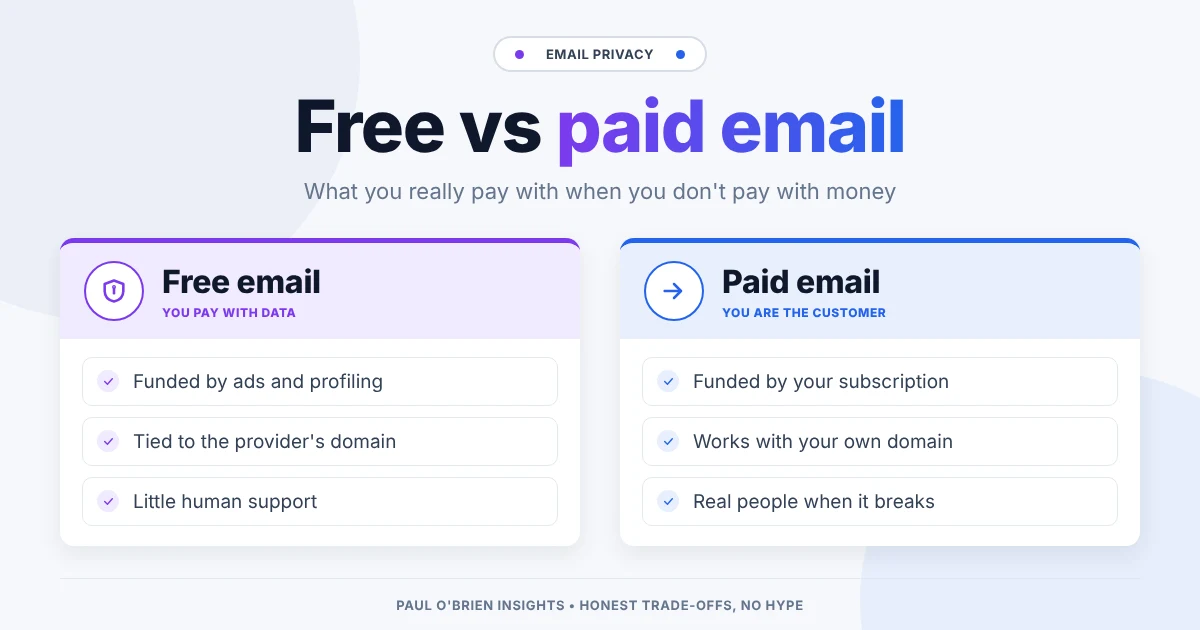
Short answer: free email is paid for with your attention, your data or your loyalty to an ecosystem, and you usually get little human help when something goes wrong. Paid email costs a few pounds a month and makes you the customer. If your inbox is the recovery key to your life or your business, paying is worth it, and pairing it with your own domain is what actually sets you free.
| What matters | Free email providers | Paid email providers |
|---|---|---|
| Main revenue model | Advertising, data profiling, ecosystem lock-in | Direct subscriptions |
| Who the customer is | Advertisers, or the wider ecosystem | You |
| Independence | Low: tied to the provider’s domain, such as @gmail.com | High: custom domains are usually supported |
| Customer support | Automated tools, community forums, help pages | Accountable human support |
| Product focus | Engagement and platform integration | Privacy controls, stability and usefulness |
| Cost | Nothing in money | Typically a few pounds or dollars a month |
Running a global email service is expensive. Infrastructure, storage, spam filtering, abuse prevention, uptime, security teams and compliance all cost real money. When users aren’t paying directly, the provider has to recover those costs some other way.
That doesn’t automatically mean anyone is acting in bad faith, but it changes the incentives:
To be fair to Google, it announced in 2017 that it would stop using the content of consumer Gmail messages to personalise ads. But free Gmail still shows ads, personalised using other signals such as your searches and browsing, and your mail is still processed for spam filtering and smart features. The free 15 GB allowance is also shared across Gmail, Google Drive and Google Photos, so it fills up faster than many people expect, at which point the upsell begins.
Not every free plan is ad-funded. Some are a shop window for a paid tier; for a business-focused example, see my Zoho Mail free plan review.
Paying for email creates a direct customer relationship. The service is accountable to you: if it fails, gets worse or heads somewhere you don’t like, you can take your business elsewhere.
The cost is usually modest. When I last checked, for my Proton Mail vs Fastmail comparison in October 2026, Fastmail Individual was listed at $5 a month on yearly billing and Proton Mail Plus at about £3.19 a month on 12-month billing. Prices change, so check the providers’ own pricing pages.
Paying for an inbox removes the commercial pressure to squeeze value out of your attention, metadata or behaviour. Paid providers still face trade-offs, but their business depends on keeping your trust rather than monetising your activity.
One caveat on lock-in: taking your email address with you is only possible if you use your own domain. If you use a provider’s domain, such as @fastmail.com or @proton.me, you are still locked in, whether you pay or not. An address owned by the provider rather than by you is one of the quietest and most effective forms of lock-in there is. I go into this in why using your own domain for email makes sense.
An email address collects decades of history: account logins, subscriptions, professional relationships and personal archives. The longer you keep it, the more it costs, socially and practically, to change.
Free email can quietly become a permanent dependency, even after it stops matching your privacy expectations. Paid email makes the deal explicit: you know exactly what you pay, what you get and what happens if you cancel.
One of the biggest differences only becomes visible in an account emergency: customer support.
I saw this advantage for myself recently with Google Workspace: on two separate occasions when I contacted support, I was on a live screen share with a real person in under ten minutes, and my issue was sorted.
For a system that acts as the main recovery key to your entire digital identity, having no human to turn to is a real operational risk. I’ve written more about this in why email provider support needs a rethink.
| Your situation | Free is fine? | Why |
|---|---|---|
| A spare address for sign-ups and newsletters | Yes | Low stakes; losing it would be an inconvenience, not a disaster |
| Your main personal address, used for banking and recovery | Paying is worth it | You want real support and a provider whose incentives match yours |
| Freelancer or small business | Pay | Continuity, support and a professional address on your own domain |
| Privacy is a priority | Pay | Subscription-funded providers have no reason to profile you |
Free email works best when convenience outweighs long-term consequences. Paid email makes sense when your inbox is an indispensable tool where continuity, accountability and control of your identity matter most. For most people, that describes their main address.
If you are thinking of switching, my Fastmail review and Proton Mail review are good places to start, and the deals I have are on my email deals page.
Google said in 2017 that it would stop using consumer Gmail content to personalise ads. Free Gmail still shows ads based on other signals, and your mail is still scanned automatically for spam, malware and features like smart replies.
Typically a few pounds or dollars a month for one person. Fastmail Individual was $5 a month on yearly billing and Proton Mail Plus about £3.19 a month on 12-month billing when I checked in October 2026.
Only if you use your own domain. With a provider’s domain, your address stays with them even if you pay.
Not automatically. The difference is incentives and support: a paid provider answers to you, and you are more likely to reach a human quickly if your account is locked or compromised.
Note: checked and updated 17 October 2026. Sources: Android Authority: Google to stop scanning Gmail for ads, TechCrunch: Google’s shared 15 GB storage, Fastmail pricing, Proton Mail pricing.
Get the next post by email. Free, no ads, and you can leave any time.
Apple’s hardware is world-class, but iCloud Mail on the web feels abandoned. Here is what iCloud Mail offers today, why it needs a rebuild, and a concept UI I mocked up.
A technical look at paid Outlook and Exchange Online: which security features need which plan, how it compares to Google Workspace and Fastmail, and who should pick each.
AI is creeping into every email client. Here is how to switch off Gemini, Copilot and Apple Intelligence in Gmail, Outlook and Apple Mail, what you lose, and why I think email works fine without it.
Comments