Email
iCloud Mail Needs a Redesign: A Webmail Concept
Apple’s hardware is world-class, but iCloud Mail on the web feels abandoned. Here is what iCloud Mail offers today, why it needs a rebuild, and a concept UI I mocked up.
Most people think nothing of paying for everyday comforts, yet hesitate to spend a few pounds on the email account that underpins their whole online identity. Here is why, and what paying actually buys.
 Paul O'Brien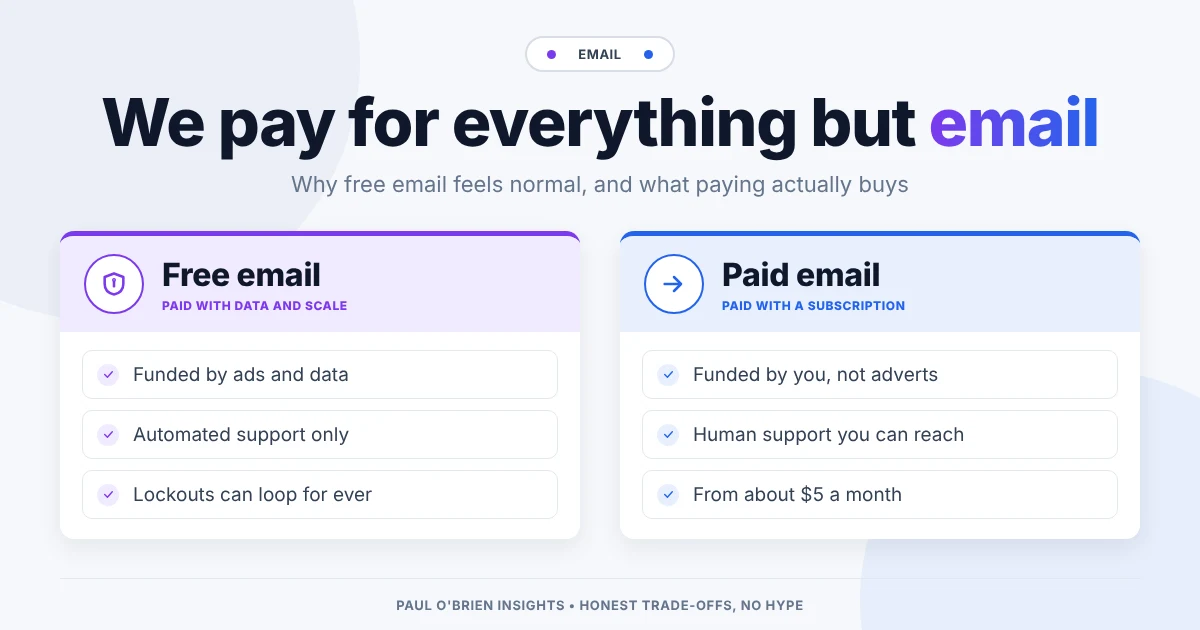
Email is the single point of failure for most of our online lives, yet almost everyone expects it to be free. We happily pay for web hosting, cloud storage, domain renewals and password managers, but paying for an email provider is still unusual.
Nobody really chose this. It is just the default we all inherited. The issue is rarely that people weigh up paid email and reject it. It is how seldom paying for email is ever considered as a serious option at all. This post looks at why that is, what free email actually trades away, and what a few pounds a month buys.
Short answer: free email isn’t free to run; the cost is paid through advertising, data or scale, and the price of that model shows up when something goes wrong and there is no human to talk to. Paying for email mostly buys accountability: support you can reach and a provider whose income depends on keeping you happy.
| Dimension | Free mass-market provider (e.g. Gmail, Yahoo) | Independent paid provider (e.g. Fastmail, HEY) |
|---|---|---|
| Business model | Advertising, data use and keeping you in the wider platform | Direct subscription revenue |
| Support | Mostly automated self-service, with little or no route to a person | Human support with a way to escalate |
| What it optimises for | Consistency across a huge number of users | Sorting out individual accounts and edge cases |
| When an account breaks | Lockouts can end in automated recovery loops | Issues are raised with, and fixed by, real people |
| Typical price | Free | Roughly $5 a month to $99 a year (see below) |
Most people never actively choose their main email provider. It arrives as a side effect of setting up a phone, activating a laptop or creating an account with Google or Apple.
Because email comes bundled with other things, it feels like part of the internet’s invisible background rather than a product with its own costs.
Device Setup / Ecosystem Onboarding
              │
              ▼
    Bundled "Free" Email (Gmail / iCloud)
              │
              ▼
   Identity Anchor (Auth, Recoveries, Banking)
              │
              ▼
   High Switching Cost / Low Economic Scrutiny
When email does carry a price tag, as it does with HEY, Fastmail or Proton, the first reaction is often scepticism. People pay for software when the benefit is visible and the comparison feels familiar. Because email is treated as basic plumbing, few people compare providers the way they compare mobile contracts, streaming services or insurance.
The sums involved are small. These are the prices I checked for my recent reviews:
| Plan | Price as listed | Checked |
|---|---|---|
| Fastmail Individual | $5 a month on yearly billing ($60 a year), $6 monthly, excluding tax | October 2026 |
| Proton Mail Plus | £3.19 a month, billed £38.28 per 12 months | October 2026 |
| HEY | $99 a year for a personal account | October 2026 |
Prices change, so check each provider’s own pricing page before you buy. The point is the scale: this is about the cost of a couple of coffees a month, for the account that every other account depends on. I go into what you trade with free services in more detail in free vs paid email: what you really pay with.
Free email doesn’t remove the cost of running a mail service. It moves it somewhere else.
Providers running at global scale, such as Gmail or Yahoo, work on the logic of mass efficiency. At that size, staying viable means relying heavily on automation across an enormous number of accounts.
For the vast majority of everyday interactions, automated filtering, abuse detection and self-service recovery work well. The limits of the free model show up when something falls outside the rules the automation expects: a false-positive spam flag, an automated security lockout, or a recovery process that loops back on itself.
In a free system, each user is one unit in a standardised machine built for overall stability rather than for sorting out individual problems. Support routes are kept narrow because human review can’t be offered cost-effectively to a huge base of non-paying accounts.
Nobody judges email on support until there is an outage or a lockout. Because your address is the anchor for your bank, your work tools and your personal records, losing access spreads to everything connected to it.
A lockout can cut you off from banking, business accounts or personal backups in one go. A compromised account can trigger recovery cycles that are very hard to unwind when there is no person to speak to.
               [ Account Lockout / Delivery Failure ]
                                  │
         ┌────────────────────────┴────────────────────────┐
         ▼                                                 ▼
  Free Platform Path                               Paid Platform Path
Automated Recovery Loop                          Direct Human Escalation
         │                                                 │
         ▼                                                 ▼
Account Loss / Extended Outage                   Resolution & Root-Cause Explanation
The difference becomes clear in technical edge cases such as email forwarding:
Seen this way, payment isn’t a fee for nicer buttons. It is about aligned incentives. The money comes straight from the subscriber, so the provider’s survival depends directly on its service being reliable.
Email sits under your identity, your two-factor authentication, your contracts and your long-term records. It is the control layer for the rest of your online life.
                  ┌──► Financial & Banking Portals
                  ├──► Domain & Web Hosting Controls
Primary Email ────┼──► Password Manager Recovery
(Identity Layer)  ├──► Legal & Contractual Records
                  └──► Two-Factor Authentication (2FA)
We choose hosting carefully. We compare financial products. We read the small print on insurance. Yet email, which connects and protects all of those, is treated as an afterthought.
Most people only rethink their email after something has gone badly wrong, and by then switching feels like hard work. I would do it the other way round. Pick a paid provider while things are calm, put it on your own domain so you can move again later, and move your important accounts across over a few weeks. Treating email as a deliberate, paid utility means the account protecting your identity has someone accountable behind it when something fails.
No. For most everyday use it works well. The weakness is what happens in the rare case when something goes wrong and there is no human route to fix it.
Mainly reachable support and a provider funded by you rather than by advertising. Many paid services also include custom domains, aliases and no ads.
At the time of writing, roughly $5 a month for Fastmail on yearly billing, £3.19 a month for Proton Mail Plus on a 12-month plan and $99 a year for HEY. Check the providers’ pages for current prices.
If you move from one provider’s address to another’s, yes. Using your own domain avoids that next time, because the address stays the same whichever provider you use.
Note: checked and updated 17 October 2026. Sources: Fastmail pricing, Proton Mail pricing, HEY.
Get the next post by email. Free, no ads, and you can leave any time.
Apple’s hardware is world-class, but iCloud Mail on the web feels abandoned. Here is what iCloud Mail offers today, why it needs a rebuild, and a concept UI I mocked up.
A technical look at paid Outlook and Exchange Online: which security features need which plan, how it compares to Google Workspace and Fastmail, and who should pick each.
AI is creeping into every email client. Here is how to switch off Gemini, Copilot and Apple Intelligence in Gmail, Outlook and Apple Mail, what you lose, and why I think email works fine without it.
Comments