I set out to review Mail.co.uk’s free email and found a webmail wrapped in display ads. Here is what the terms, privacy statement and PlusMail plan actually say.
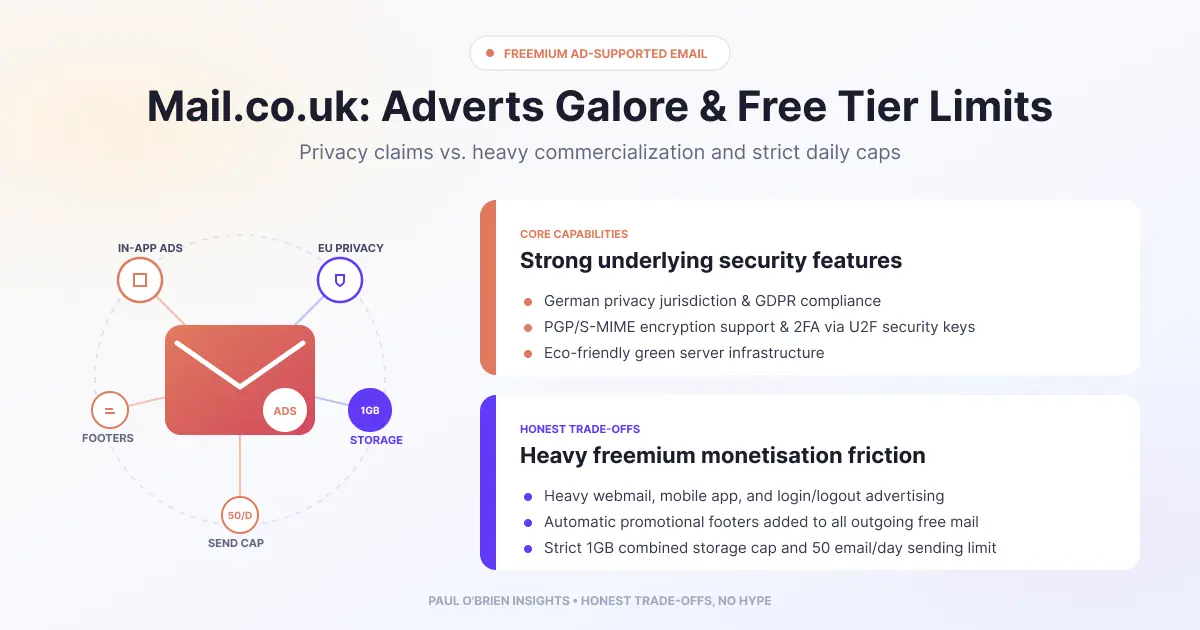
An infographic breaking down Mail.co.uk's FreeMail tier, contrasting its German privacy features against heavy advertising and restrictive sending limits.
Mail.co.uk’s FreeMail tier is free in the way a billboard is free. When I logged in, the welcome email titled “We stand for more privacy and security” was surrounded by display ads, the sign-up asked for a phone number, and the privacy policy says free users receive an advertising newsletter they can’t unsubscribe from. The ad-free PlusMail plan costs £2.49 a month.
I originally set out to write a standard review of Mail.co.uk’s free email service before evaluating its paid tiers. As soon as I logged into the webmail and saw the wall of display advertising around that welcome email, I realised this service wasn’t for me. Details below were checked against Mail.co.uk’s own terms, privacy statement and product pages on 9 October 2026.
Short answer: avoid FreeMail if privacy is your reason for choosing a provider. If you like the German hosting and want an inexpensive mailbox, the paid PlusMail plan removes the ads, but read the contract terms first. If you want a free mailbox without the ad machinery, look at the alternatives at the end.
At a Glance: Who Mail.co.uk FreeMail Is (and Isn’t) For
User Profile
Best Fit?
Core Value Drivers / Key Trade-offs
Someone who wants a free throwaway or secondary address
Workable
Free, and two domains are bundled. You accept ads, tracking consent prompts and a newsletter you can’t cancel.
Privacy-minded user
Alternative needed
Network-level ad tracking and ad-heavy pages undercut the privacy pitch.
Someone who wants cheap, ad-free German-hosted mail
Partial fit
PlusMail at £2.49 a month removes the ads. Check the 12-month contract and German payment terms.
Anyone who dislikes phone verification
Alternative needed
My sign-up required a phone number and an automated call.
The Promise vs the Pitch
We all understand that free email comes with trade-offs. Most people accept an unobtrusive text ad or banner in exchange for a free inbox. What you don’t expect is for advertising to render the webmail interface nearly unusable.
The sign-up friction started early. The service markets itself on minimal data requirements, yet registration required a mobile phone number. There was no option to verify with a quick SMS code. Instead I had to accept an automated phone call to receive a PIN. I understand it is an anti-spam check, but Mail.co.uk’s privacy statement says you can register without entering any personal data, and a phone call sits awkwardly with that.
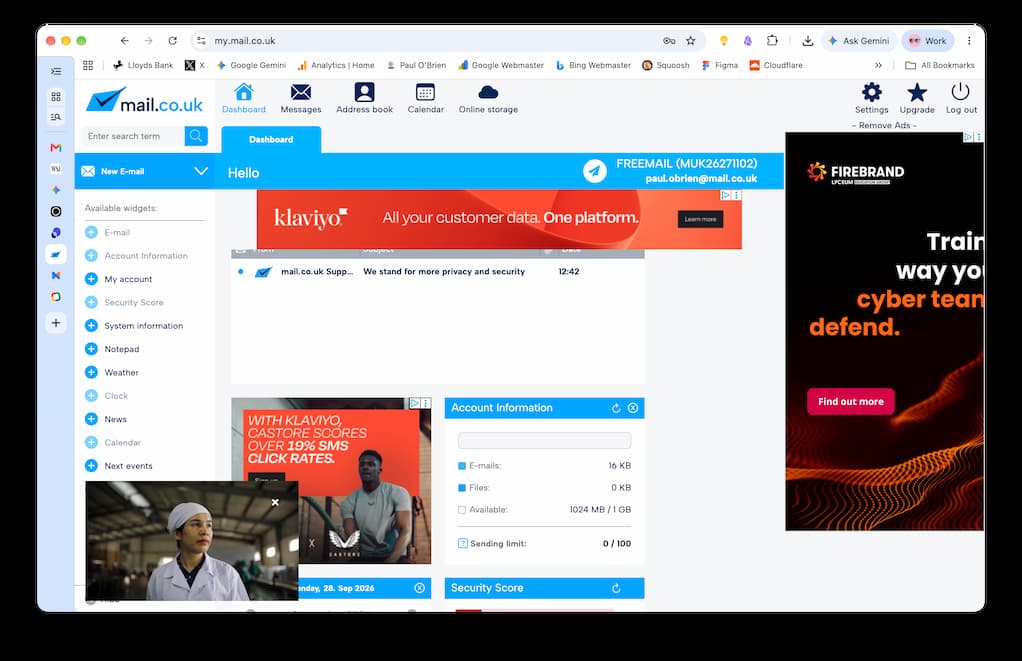
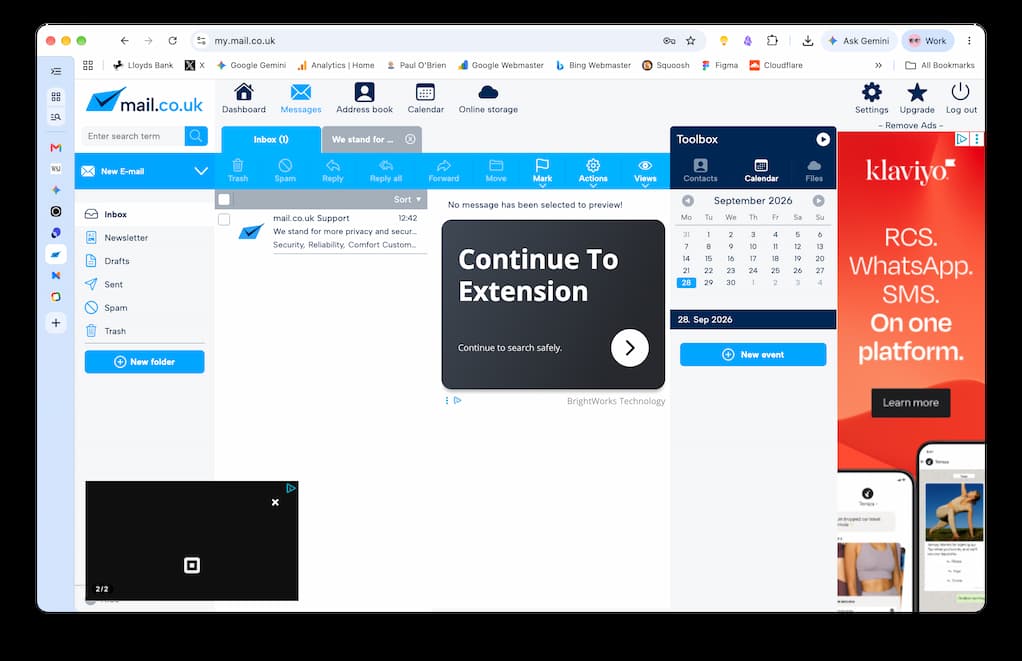
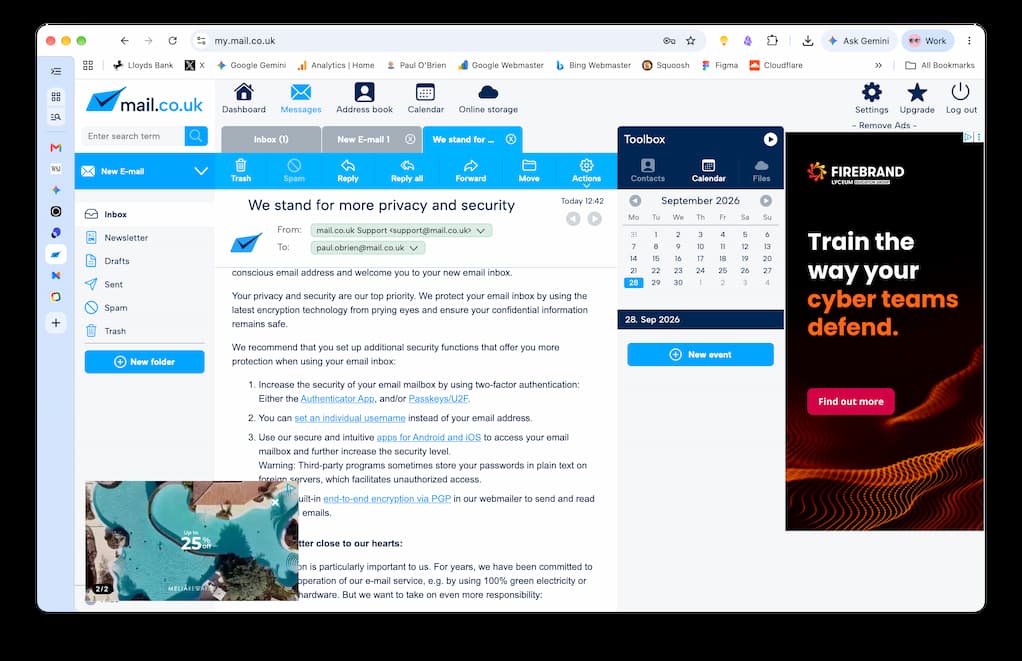
The FreeMail reality: From dashboard ad banners to reading pane overlays, opening a welcome email titled “We stand for more privacy and security” demonstrates how display networks and tracking prompts hijack the webmail interface.
On paper, Mail.co.uk, operated by German provider mail.de GmbH, looks like a compelling offer:
Dual domain access. @mail.co.uk and @mail.uk addresses bundled together.
No contract and zero cost for the base account tier.
Privacy framing. The marketing highlights pseudonyms over real names, minimal data requests, anonymous payment methods for upgrades and green energy credentials.
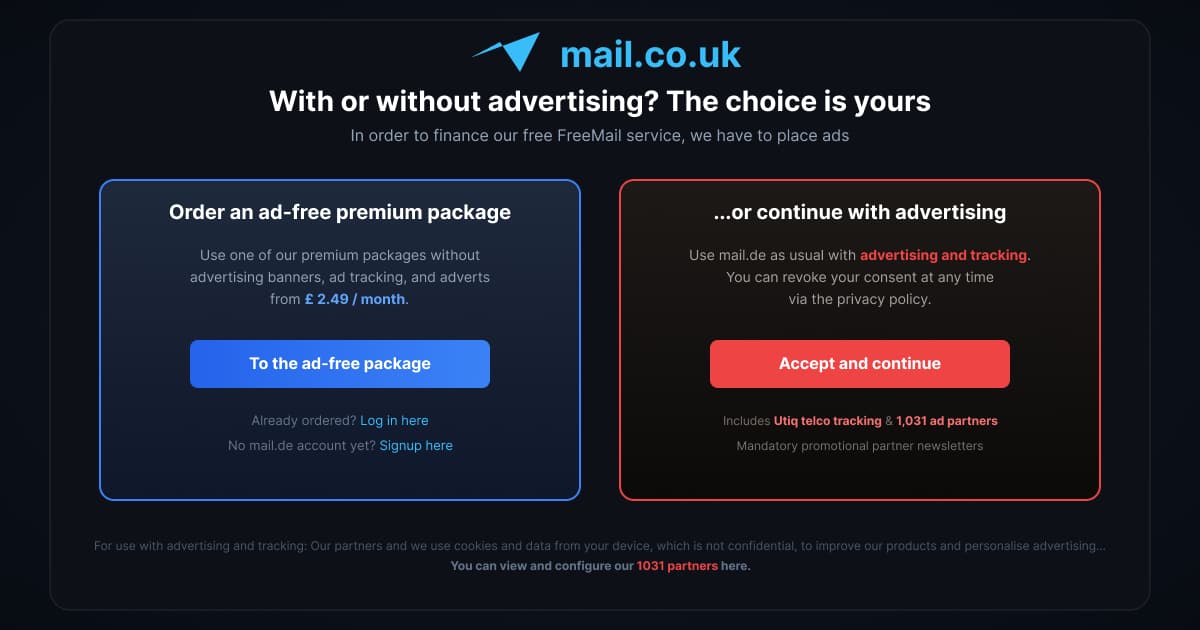
There is an option to test or upgrade to an ad-free experience, but it means jumping into the paid PlusMail plan. Mail.co.uk’s product page lists PlusMail at £2.49 a month, after a 30-day free test, on a 12-month contract with the full amount due at the start, and says it is free of advertising. If you stick with FreeMail, you get an explicit choices prompt: accept ad tracking across more than 1,000 adtech partners, including network-level Utiq identifiers, or pay up.
Pay or give up your privacy: Mail.co.uk presents free users with a binary choice—upgrade to a paid subscription or consent to network-level tracking across more than 1,000 adtech partners.
FreeMail vs PlusMail
Feature
FreeMail (base tier)
PlusMail
Price
Free
£2.49 a month including VAT, 12-month contract, 30-day free test
Ads
Yes, display advertising and tracking consent prompts
None. The product page says it is free of advertising
Storage and aliases
The product page lists a 1 GB tier with 1 alias and a 50-a-day send limit
5 GB for mail and online storage, 10 aliases, attachments up to 100 MB
Newsletters
Mandatory “mail.co.uk recommends” newsletter, no unsubscribe
The mail.co.uk newsletter stops
Contract terms
No payment terms to breach
German-law payment terms apply. See below
UI Teardown: “Privacy” Surrounded by Adtech
Nothing exposes the FreeMail model faster than opening the webmail. The contrast between the marketing claims and the interface is striking:
The visual irony. The welcome email proudly declares “We stand for more privacy and security”, yet its text is virtually swallowed by a massive right-hand vertical banner (Firebrand / Klaviyo), a floating bottom-left video ad unit and a centre overlay banner.
Aggressive layout hijacking. Rather than subtle placement, the dashboard dedicates well over half the screen to display advertising, pop-up promotional widgets and extension prompts.
Ad-blocker and privacy conflict. With this much embedded display-network code, your browser is constantly running third-party scripts from ad networks, such as Ströer and Klaviyo, just to render your inbox.
A provider can’t realistically claim to offer a clean, privacy-focused environment when the webmail itself works like a high-frequency ad network publishing platform.
The Reality of Free Email Economics
Running a webmail service is far from free. Storage, bandwidth, spam filtering and round-the-clock maintenance need serious money. To offer email without a monthly fee, providers typically rely on one of two models. I explain the broader trade-off in free vs paid email: what you really pay with.
Model
How it pays
Typical result
Conversion (freemium)
A restricted free tier as a loss leader, converting heavy users to paid plans for storage, custom domains or security
A clean but limited free inbox
Monetisation (ad-financed)
Display ads, sponsored content or behavioural ad tracking across free inboxes
Anything from a tolerable banner to an unusable page
An occasional banner on a free tier is the fair trade for a service given away at zero cost. There is a fundamental difference between unobtrusive ad subsidy and invasive overload that hijacks the screen, injects third-party tracking networks and makes the inbox practically unusable.
Privacy Dissection: the Reality Behind Mail.co.uk
Mail.co.uk’s privacy statement shows several gaps between the marketing and the data practices:
Issue
What the privacy statement says
Why it matters
Utiq tracking
Utiq is off by default and activated only with consent. It gives marketing identifiers to mail.de GmbH and Ströer, linked to the internet connection rather than a single person. mail.de and Ströer act as joint controllers with Utiq for certain processing
A network-level identifier is a different order of tracking from a cookie. Utiq’s own documentation says its identifiers are generated only after consent, with a one-click way to withdraw it
Forced newsletter
FreeMail registration requires agreeing to advertising use of your data. Free users receive the “mail.co.uk recommends” newsletter and the statement says unsubscribing is not possible. PlusMail stops it
Unsubscribing is a feature you pay to unlock
Traffic logging
Access logs record date, time, time zone, requested page, status code, IP address, referring site, browser, operating system and language, deleted after fourteen days
Typical of web servers, but notable next to a privacy pitch
Partner sharing
Partner advertising platforms are listed in the consent prompt. The text names Ströer as advertising marketer
Consenting free users have their activity shared across ad partners
The verdict: the paid packages offer standard German legal protections and anonymous payment methods, but the FreeMail tier relies on heavy adtech monetisation and forced promotional emails. That makes it much closer to conventional commercial webmail than to a privacy service. If you want to understand what a genuinely zero-access service looks like, see what zero-access encryption really means.
Fine Print Warning: German Contract Rules vs Global SaaS
Read before you pay: behind the privacy marketing sits a contract shaped by German law. Mail.co.uk’s terms are a translation, and the German version is the legally binding one. I’m not a lawyer, so check them yourself.
Term
What the terms say
Penalties on unpaid bills
If a direct debit fails for a reason the customer is responsible for, the customer pays default interest of 5 percentage points above the European Central Bank base rate, and a flat €8.11 for the declined debit unless they can prove the damage did not occur
Account compromise
The customer pays fees from use of the account by third parties unless they aren’t responsible for it, and the terms say the customer is responsible for proving they are not
Inactivity
Mail.co.uk reserves the right to block access to free offers after more than 180 consecutive days without active use. Data and settings are deleted when termination takes effect
Governing law
German law applies
How it compares across jurisdictions
Many US and Australian SaaS providers, such as Fastmail or Google Workspace, typically handle failed payments with grace periods before pausing service or downgrading, rather than statutory default interest. Dedicated privacy providers such as Proton (Switzerland), Tuta (Germany) and Fastmail (Australia) generally prioritise account recovery and grace periods over debt-recovery clauses. I haven’t reviewed every provider’s terms line by line, so check before you assume.
Takeaway: Mail.co.uk enforces traditional German debt-collection mechanisms rather than modern software subscription norms. If you choose it, keep your payment details up to date and your credentials tightly secured.
Pros and Cons
Strengths
Weaknesses
Free base tier, two domains bundled
Heavy display advertising and tracking prompts on FreeMail
PlusMail is cheap, ad-free and has a 30-day free test
12-month contract with the full amount due upfront
German operator, with standard German legal protections
Forced advertising newsletter with no unsubscribe on FreeMail
Anonymous payment options are advertised for upgrades
German default interest, €8.11 debit fee and burden of proof on compromise
Frequently Asked Questions
Is Mail.co.uk free?
There is a free base tier, FreeMail, funded by advertising. The ad-free PlusMail plan costs £2.49 a month on a 12-month contract.
Does Mail.co.uk track you?
Its privacy statement says Utiq, a network-level identifier, is off by default and activated only with consent, but free users are asked to accept ad tracking across a large number of ad partners. Server logs are kept for 14 days.
Can I unsubscribe from the Mail.co.uk newsletter?
Not on FreeMail, according to the privacy statement. Upgrading to PlusMail stops it.
Does Mail.co.uk need a phone number?
It did in my sign-up, with an automated call delivering a PIN. The privacy statement says you can register without entering personal data, so your experience may differ.
What happens if I stop using a free Mail.co.uk account?
The terms allow Mail.co.uk to block access to free offers after more than 180 consecutive days without active use. Data is deleted when termination takes effect.
Is Mail.co.uk good for privacy?
The paid tiers have standard German legal protections, but the free tier relies on adtech monetisation. It isn’t end-to-end encrypted by default, so for strong privacy look elsewhere.
Conclusion
Free email needs a viable business model, but Mail.co.uk shows the line between reasonable ad subsidy and invasive adtech monetisation. By surrounding a privacy-focused welcome email with skyscraper banners, floating video units and pop-up prompts, while requiring phone verification and enforcing strict German debt-collection terms in the fine print, the service fails to deliver on its core promise. If you want real inbox privacy, a provider that trades network-level tracking and forced advertising newsletters for a free account is a compromise not worth making. Transparent options such as Proton, Tuta or a custom domain setup remain far better choices, and you can compare more email providers on my deals page.

Comments