
Does a UK Business Have to Publish an Email Address?
For most UK online businesses, the answer is yes: the 2002 E-Commerce Regulations require an email address that is easily and permanently accessible. Even where the law doesn’t reach, hiding your support email behind a chatbot moves the cost onto your customers.

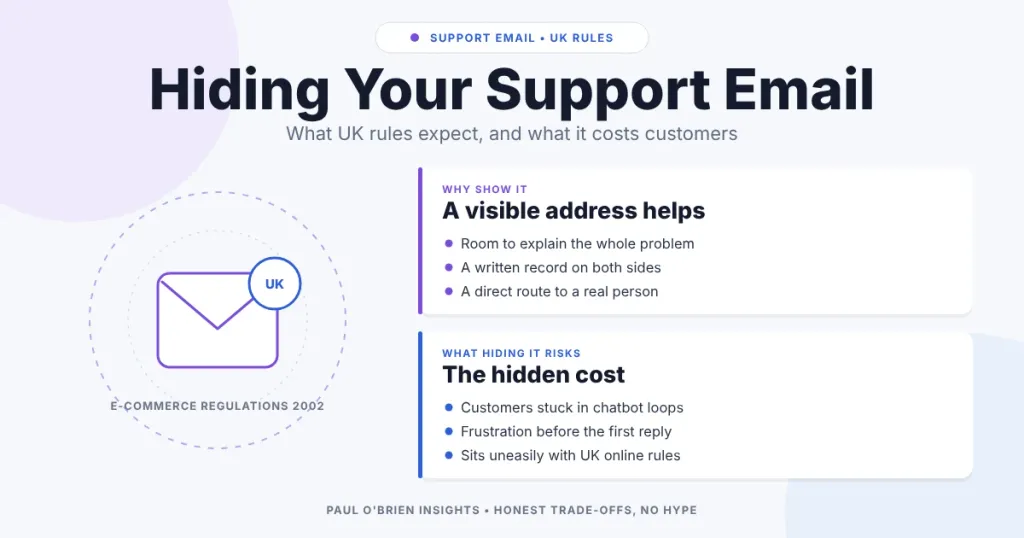
If you run an online business or service in the UK, the answer is generally yes. The Electronic Commerce (EC Directive) Regulations 2002 require you to make an email address available in a form that is easy to find and always accessible. Even where the law doesn’t reach, hiding your support email behind a chatbot saves you money by moving the cost onto your customers.
I notice it on company websites now. I scroll to the footer, click “Contact” and brace for a chatbot bubble, a knowledge base and a sequence of questions that seems designed to stop me speaking to anyone. Then, occasionally, I see an email address, and I genuinely breathe a sigh of relief.
Short answer: generally yes, for UK online businesses. Regulation 6 of the 2002 E-Commerce Regulations requires an email address that lets customers contact you rapidly, provided “easily, directly and permanently”. Whether a business is covered, and whether a contact form is enough, depends on the circumstances, and this isn’t legal advice. Chat and self-service are fine as options. They become a problem when they are the only door.
Does a UK Business Have to Publish an Email Address?
For most online businesses, yes. Under the Electronic Commerce (EC Directive) Regulations 2002, a service provider must make certain details available to customers, including contact details “including his electronic mail address, which make it possible to contact him rapidly”. According to regulation 6, those details must be provided in a form that is “easily, directly and permanently accessible”. The regulation also requires the provider’s name and geographical address, among other things.
| Question | What the regulation says | What it leaves open |
|---|---|---|
| Is an email address required? | Contact details must include an email address | Which businesses count as service providers in each case |
| How visible must it be? | Easily, directly and permanently accessible | Exactly how many clicks is too many |
| Can a chatbot replace it? | Not stated. The test is whether you can be contacted rapidly by email | Whether a chat widget alone would satisfy a regulator |
| Is a contact form enough? | Not stated. The wording refers to an electronic mail address | Treatment of forms is a question for a solicitor |
I’m not a lawyer, so treat this as a pointer rather than advice. The regulation applies to online services, and I haven’t covered other disclosure rules that apply to limited companies, such as showing the registered name, number and office. If it matters to you, check with a solicitor or the relevant regulator. What I can say is that an email address buried behind five screens of triage, or locked behind a chatbot, sits uneasily with “easily, directly and permanently accessible”.
At a Glance: Which Support Channel Suits Which Problem?
| Type of problem | Best channel? | Core Value Drivers / Key Trade-offs |
|---|---|---|
| Simple, predictable request (change bank details, track an order) | Chatbot or self-service: Strong fit | Fast and available at any hour. Works because the request is essentially a form with a friendly wrapper. |
| Wrong bill, policy question, something broken for unclear reasons | Email: Ideal | Room for the full story, screenshots and order numbers. Reply is not instant. |
| Urgent, time-critical fault | Phone or live chat: Workable | Immediate, but you need a queue slot and may repeat your story. |
| Complaint or dispute you may need to prove later | Email: Ideal | Leaves a written record with dates you can refer back to. |
| Customer who can’t or won’t use live channels | Email: Strong fit | Asynchronous and widely accessible. No shared window of availability. |
Email Is Still the Calmest Way to Explain a Problem
Most problems aren’t simple. Even when they are, they still need context, and context needs room.
Email gives you that room. It lets the full story sit in one place: what happened, what was tried and what’s needed, with screenshots attached and the details tidy enough that the first human reply has a chance of actually solving it. A message can be started, left in drafts, refined and expanded with the order numbers, the timeline and the exact wording of an error.
That is asynchronous communication that respects time. You send the message when you’re ready. They reply when they can. There’s no live queue and no pressure to stay “online” long enough to earn a response.
The Problem Isn’t Chat. It’s Being Forced Into It
I’m not anti-chatbot, and I’m not anti-automation. When I needed to change my bank details with my insurance company, the chatbot did a fine job. That’s a narrow, predictable request, and for that kind of task it works.
But support isn’t always that neat. A lot of the time the job isn’t “complete this transaction”, it’s “explain what’s going on”. It’s a policy that needs clarifying, a bill that’s wrong, or something that isn’t working when you don’t yet know why. That’s where chat-first support starts to feel less like convenience and more like behaviour control: the business decides the shape of your question before you’re allowed to ask it.
If you’ve tried to explain a real issue to a chatbot, you’ll recognise the pattern. It nudges you toward pre-set options, you keep rewording your situation to match them, you hit a wall, and you get some version of “All live operators are currently offline.” At that point you weren’t being supported. You were being contained until the humans came back.
This Is About Choice
I’m not arguing that chatbots should disappear. I’m arguing that customers should be allowed to choose how they communicate. If a business wants to offer chat for simple queries, or use AI to triage requests, suggest articles or capture basic details, that’s fine. Those tools can be genuinely useful when they’re offered as options.
The issue is when the chatbot becomes the gatekeeper. Once it’s the only door, it stops being a tool and becomes a filter. I wrote about my wider unease with automation in AI and email: no thanks, and this is a practical example: nobody objects to the tool, they object to having no alternative.
I Don’t Even Mind Ticketing Systems
If a company wants structure on its side, such as routing, priorities and SLAs, that’s its job. The problem isn’t that support teams use tools. It’s when the tool becomes a barrier.
The ideal version is straightforward. You email the company in plain language, their system turns it into a ticket behind the scenes and a real person replies. The customer gets the convenience of email, and the business still gets the organisation it needs to run support at scale. It keeps the conversation human without pretending every problem can be reduced to buttons in a chat window.
Why Companies Hide Their Email Address
None of this is hard to understand from the business side. Email is messy for them because it isn’t structured, and the plumbing is messy too (authentication alone is a rabbit hole; see how SPF, DKIM and DMARC work). It’s harder to triage, and it produces longer messages with context that takes time, and therefore money, to read and answer properly. Chat can be managed like a queue. Chatbots absorb first-line volume, and knowledge bases divert a chunk of requests before they reach a person.
In other words, steering people away from email is a cost-saving strategy. It’s the same move as self-scanning at supermarkets: the shop saves on staff because customers take on part of the job. Most of the time it’s fine, until something doesn’t scan, a discount won’t apply or the system flags you for “assistance”, and the queue appears anyway.
That’s what a lot of modern support feels like. Customers do the early legwork, troubleshooting first and searching the help centre, then squeeze a real situation into the chatbot’s multiple-choice path. If it still doesn’t fit, they wait for a window when live support is available, and when it finally reaches a person the story often has to be repeated from scratch. I looked at what good support involves, and why it breaks at scale, in why email provider support needs a rethink.
The Hidden Cost of Hiding Your Support Email
The saving is real, but it is not the whole picture, because the cost doesn’t vanish. It moves.
| Who pays | Cost when the email address is hidden |
|---|---|
| The customer | Time spent rewording, repeating the story and waiting for live support to open |
| The business | Lost trust, abandoned purchases and escalations, because the customer arrives at a human already frustrated |
| Both | The first human reply has less context, so it’s more likely to start another round of back-and-forth than to fix the issue |
I don’t have figures for how much this costs any individual company, and I wouldn’t trust a vendor’s statistics on it. But the mechanism is easy to see. A hidden address doesn’t reduce the number of problems. It makes people more annoyed by the time they reach you.
What an Email Address Signals
When a company publishes a clear email address, it signals a willingness to accept a real message, not just a series of clicks. There’s space to write normally, explain the odd situation that doesn’t match the script and use words instead of a form.
It doesn’t guarantee great support. Plenty of companies list an email address and still reply with templates. But it’s a better starting point than being trapped in a chatbot loop or hunting for contact details just to reach a person. I miss the time when a company website would simply list an email address and someone would reply like a person: not instantly, just a normal response that dealt with the issue and moved things along.
What Good Looks Like for a Business
| Do | Avoid |
|---|---|
| Publish a plain support address in the footer and on the contact page | Hiding it behind a chatbot that decides whether you deserve a human |
| Turn incoming email into tickets behind the scenes | Auto-replies that only link back to the help centre |
| State a realistic reply time, even if it isn’t instant | Promising speed you can’t deliver |
| Keep chat and self-service as options for simple tasks | Making them the only route |
| Authenticate the domain so replies land in the inbox | Sending support replies that fail SPF, DKIM or DMARC |
Frequently Asked Questions
Does a UK business have to publish an email address?
Generally, if it provides an online service, yes. Regulation 6 of the Electronic Commerce (EC Directive) Regulations 2002 requires contact details including an email address, easily, directly and permanently accessible. It can be a support address rather than a personal one. Check your own position with a solicitor.
What if a company has no email address on its website?
Look in the footer, the terms and conditions, the privacy policy and the company registration details. If you still can’t find one, you can raise it with the business or with Citizens Advice, which handles consumer complaints.
Won’t a public email address attract spam?
Some, yes. A support address will be scraped, so it needs decent filtering. That is a manageable cost and better than shutting out genuine customers. A contact form can reduce spam but shouldn’t be the only route.
Is a contact form the same as an email address?
Not quite. A form can work, but customers can’t see what was sent, don’t keep a copy and may not get a confirmation. A visible address leaves a record on both sides.
Are chatbots bad for customer support?
No. They work well for narrow, predictable requests. The problem is when they are the only way to reach a person.
Isn’t email too slow for support?
For urgent faults, it can be. For explaining a complicated problem or keeping a record, it is often better. It doesn’t need to be instant, it needs to be answered by a human.
How do businesses keep email support manageable?
By using a ticketing system that turns incoming messages into tracked tickets, with routing and priorities. The customer still writes in plain language.
The Bottom Line
If a business wants to offer chat, that’s fine. If it wants to publish a knowledge base and encourage self-service for simple issues, also fine. What I don’t want is for those tools to become the only route. A clear email address should still exist as a first-class option: visible, usable and not locked behind a chatbot. It doesn’t need to promise instant responses. It just needs to be a door that remains open.
When I see an email address on a company website, I don’t read it as old-fashioned. I read it as a sign there’s still a direct route to a person, with no gatekeeping and no “prove you qualify” first.
Note: this article contains no affiliate links, and it is not legal advice. Source: The Electronic Commerce (EC Directive) Regulations 2002, regulation 6 (legislation.gov.uk), checked 9 October 2026.

