Email
iCloud Mail Needs a Redesign: A Webmail Concept
Apple’s hardware is world-class, but iCloud Mail on the web feels abandoned. Here is what iCloud Mail offers today, why it needs a rebuild, and a concept UI I mocked up.
Messaging apps didn’t replace email. Here’s why email still matters for identity, recovery and trust online, and why no chat app is likely to take that job.
 Paul O'Brien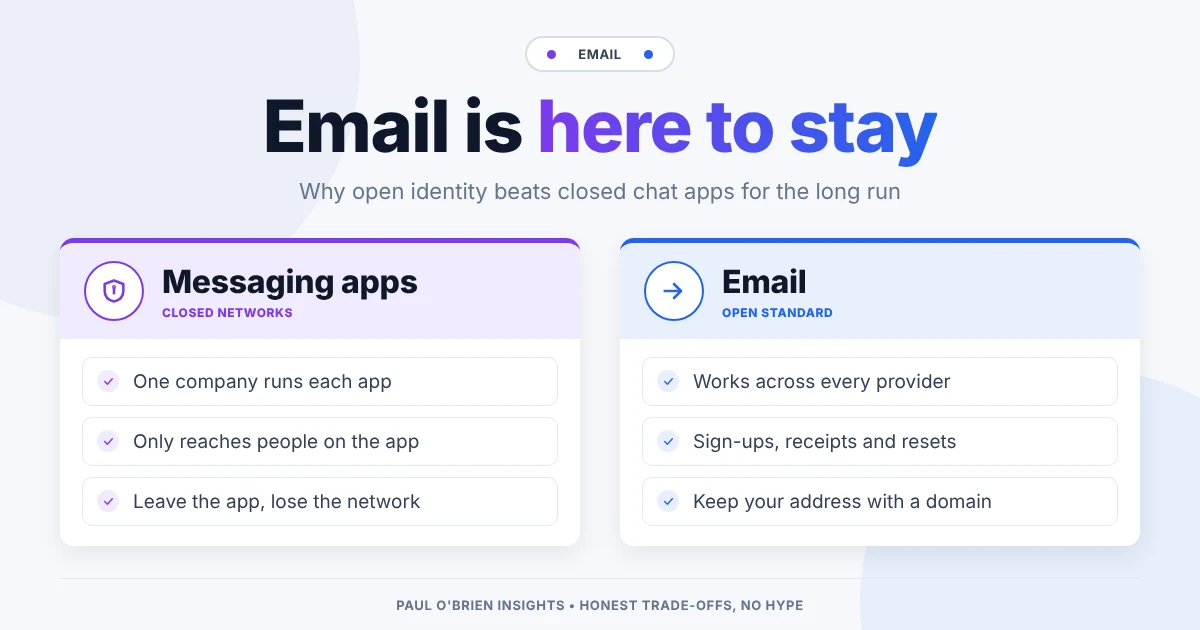
Email has been pronounced “dead” so many times it is practically a tradition. Every time a new messaging app arrives, it feels faster and friendlier, and someone predicts that email is finally finished.
Yet email is still here. Not because people are excited by their inboxes or enjoy spam, but because it does a structural job that centralised platforms cannot easily replace. Email is the open internet’s default identity and proof system: it handles receipts, security warnings, official confirmations and account recovery.
This post looks at what people really mean when they say email is dying, why chat apps haven’t replaced it, and what that means for how you treat your own address.
Short answer: yes, email is here to stay. Chat apps win for quick conversation, but email is the only open, universal address system that works across every company and platform. That makes it the web’s identity and recovery layer, which is exactly why it is worth owning and protecting properly.
| What matters | Messaging apps | |
|---|---|---|
| Who runs it | Open standards; thousands of independent providers | One company per app |
| Reach | Anyone with an address, on any provider | Only people who joined the same app |
| Pace | Asynchronous: messages wait until you are ready | Real-time, with read receipts and typing indicators |
| Records | Timestamps, attachments, searchable history you can export | History tied to the app and your account there |
| Portability | Change provider and keep your address (with your own domain) | Leave the app and you leave the network |
| Role online | Sign-up, receipts, password resets, security alerts | Conversation |
When people claim email is dying, they usually mean inbox fatigue rather than the technology itself. An inbox becomes exhausting when it is overloaded with high-volume marketing, false urgency and automated follow-ups designed to grab attention. That frustration is real, but it reflects how the inbox is used, not a fundamental flaw in email.
Email works best when it is allowed to be asynchronous. It was designed for messages that can wait, benefit from context, and can be answered without the social pressure of real-time read receipts. When organisations treat email like a chat app or a cheap marketing megaphone, the experience degrades, and people blame their inbox rather than the way it is being used.
If communication tools were judged purely on chat interface design, email would lose to specialised messaging apps. Modern chat platforms are excellent at fast, real-time conversation, particularly on phones.
Email persists because it is a universal address system, not a feature of a single platform:
Providers like Gmail have shaped what people expect from an inbox, but email itself is not a commercial service. It runs on open, published standards. The core sending protocol, SMTP, dates back to 1982, and its current specification, RFC 5321, is free for anyone to implement. That is why thousands of independent providers, from Gmail and Outlook to Fastmail, Proton and self-hosted servers, can all talk to each other. I cover how it got here in the history of email.
Centralised platforms depend on one company’s servers, policy changes and business priorities. If that platform changes its terms, blocks an account or shuts down, your network goes with it. Email works differently: providers come and go, domains can be moved, and the system keeps running. No single company has the authority or the technical means to switch it off.
The core reason email persists is that it has become the internet’s main registry for proof. It is where you:
Even centralised messaging platforms commonly ask for an email address at sign-up or for recovery. Over time, email has shifted from a place for casual chat into an archive for personal identity and record-keeping.
Messaging tools prioritise speed and immediate connection. Email prioritises durability and documentation.
Much of the frustration with email comes from two opposing uses sharing one interface:
Because email is cheap to send at scale, it invites aggressive commercial use. Most people don’t dislike email itself. They dislike low-effort marketing pushing into the place where their identity lives.
The technical response to inbox abuse has been to tighten the rules for senders. Getting mail delivered now depends on authentication, such as SPF, DKIM and DMARC, moving email away from open delivery and towards verified sender reputation. The clearest example is Google and Yahoo’s bulk sender rules, in force since February 2024: anyone sending more than 5,000 messages a day to their users must authenticate their mail, publish a DMARC policy and offer one-click unsubscribe. If you want the background, see how SPF, DKIM and DMARC work together.
At the same time, expectations around privacy are changing. Rather than accepting free, ad-supported inboxes, more people are choosing privacy-focused providers like Proton Mail or using their own domain so they keep control of their address whichever provider hosts it.
Because email is the master key for online identity and account recovery, it is a high-value target. Someone who gets into your inbox can often get into everything linked to it, simply by requesting password resets. That makes inbox security, such as strong, unique passwords, multi-factor authentication and an eye for phishing, an essential part of looking after yourself online. I go into this in your email is your weakest privacy link.
For email to be replaced, a new system would need to offer open, cross-platform identity, asynchronous delivery, durable records and portability between independent providers worldwide. Anything that met all of those requirements would end up looking a lot like email.
Email has evolved from an informal messaging tool into the foundations of the web. Messaging apps handle day-to-day conversation; email keeps its role for identity, long-term records and commitments you can prove.
If email is going to be your identity for decades, treat it that way:
No. What people are tired of is inbox overload, mostly marketing. The technology itself is still how the web handles sign-ups, receipts and account recovery.
Because each messaging app is a closed network run by one company. Email is an open standard that works across every provider, so anyone can reach anyone without joining the same service.
Nobody in particular. Email runs on published standards such as SMTP, and thousands of providers implement them independently. Individual providers control their own service, not the network.
Because most online accounts use email for password resets. Whoever controls your inbox can often take over the accounts linked to it.
Note: checked and updated 17 October 2026. Sources: RFC 5321 (SMTP), Bird: Gmail and Yahoo bulk sender requirements.
Get the next post by email. Free, no ads, and you can leave any time.
Apple’s hardware is world-class, but iCloud Mail on the web feels abandoned. Here is what iCloud Mail offers today, why it needs a rebuild, and a concept UI I mocked up.
A technical look at paid Outlook and Exchange Online: which security features need which plan, how it compares to Google Workspace and Fastmail, and who should pick each.
AI is creeping into every email client. Here is how to switch off Gemini, Copilot and Apple Intelligence in Gmail, Outlook and Apple Mail, what you lose, and why I think email works fine without it.
Comments