Email
iCloud Mail Needs a Redesign: A Webmail Concept
Apple’s hardware is world-class, but iCloud Mail on the web feels abandoned. Here is what iCloud Mail offers today, why it needs a rebuild, and a concept UI I mocked up.
Why so many marketing emails force a binary choice between staying and leaving, and how unsubscribe-only design misses what subscribers actually want.
 Paul O'Brien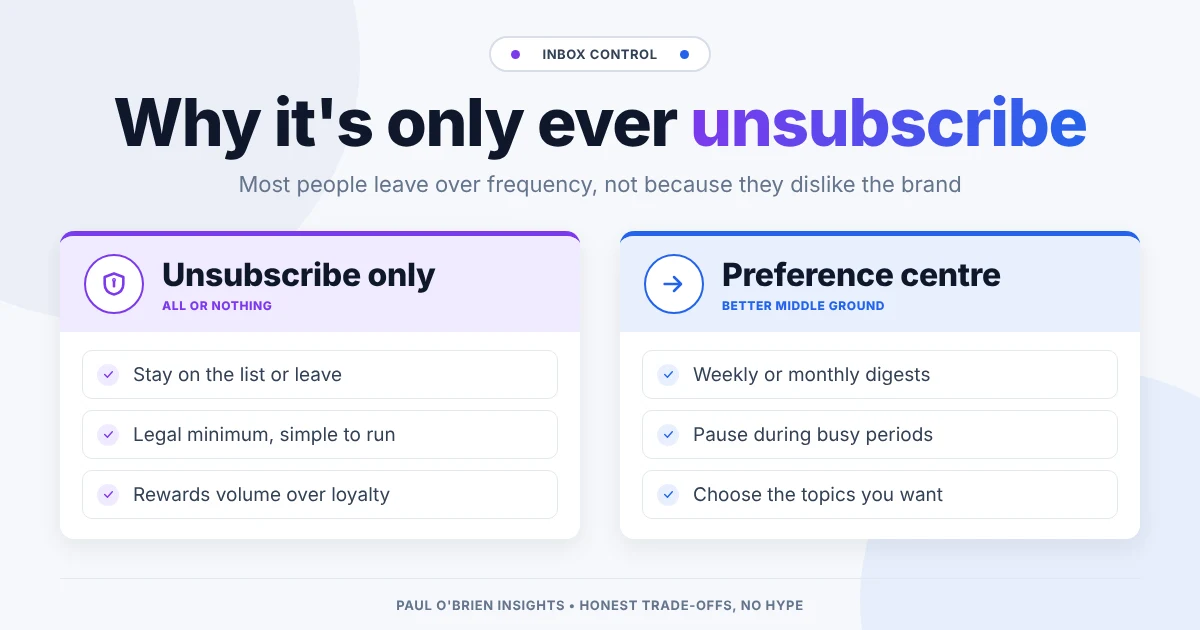
Most marketing emails end the same way: a small footer link offering one clear option, unsubscribe. What is increasingly missing is any way to reduce how often they arrive, pause them for a while, choose what kind of content you get, or update your details. The choice is binary: stay on the list, or leave entirely.
This is one of my biggest bugbears with modern email. I often want to hear from a brand, stay informed about new products or keep an eye out for the occasional offer. I just don’t want to hear from them every single day.
You can set up inbox rules to send high-frequency senders to a separate folder, but it rarely works for long. Once messages are filed away out of sight, nobody remembers to go back and check that folder. The mail might as well be going straight to the bin.
Before anyone jumps into the comments: yes, I know I could check a brand’s social media or visit its website whenever I feel like browsing, and I realise marketing teams are often limited by whichever email platform they happen to use. But from the subscriber’s point of view, forcing an all-or-nothing choice is a missed opportunity to keep a customer.
Short answer: brands offer only an unsubscribe link because it is the legal minimum, it is simple to run, and their metrics reward volume. Subscribers mostly leave because of frequency, not because they dislike the brand, so a simple “send me less” option would keep many of them.
| What the subscriber wants | Unsubscribe-only footer | Preference centre |
|---|---|---|
| Fewer emails | Not possible: leave or put up with it | Switch to weekly or monthly |
| A break | Not possible | Pause for a few weeks |
| Only certain topics | Not possible | Pick categories, such as sales or new products |
| New email address | Leave and sign up again | Update details in place |
| Stop everything | Yes | Yes, still one click away |
A decade ago, preference centres were fairly common. Readers could change how often they heard from a brand, opt in to particular categories, or take a break without cutting ties completely. Today, brands increasingly offer a single outcome: leave the list.
This is rarely an accident. It is a deliberate choice for simplicity: one link, one compliance audit trail and no edge cases. But that simplicity strips out the nuance of how people actually manage their inboxes.
Inbox providers have unintentionally reinforced the binary. Since February 2024, Google and Yahoo have required anyone sending more than 5,000 messages a day to their users to support one-click unsubscribe, using a standard email header (RFC 8058), and to honour those requests within two days. In July 2025 Gmail added a Manage subscriptions view that lists senders by how often they email you and unsubscribes with a click. Both are good for users, but they skip the brand’s own page entirely. If a brand’s only option is “leave”, the inbox now makes leaving even easier.
Subscribers rarely dislike a brand outright. They dislike relentless volume. The controls people look for include:
When none of these are available, unsubscribing becomes the only practical way to regain control, even when the subscriber would have been happy to stay in touch on a less demanding schedule.
Industry research consistently puts frequency at the top of the list of reasons people leave marketing lists, ahead of irrelevant content, hard-sell pitches or switching to a competitor. The exact figures vary a lot depending on how the question is asked, but the ranking holds:
| Survey | Finding |
|---|---|
| Mailchimp and Ascend2 (about 6,000 consumers, five countries) | 68% said receiving too many messages is the top reason they unsubscribe from marketing emails and texts; most did not want more than two a week from one brand |
| Baymard Institute (2,473 US online shoppers) | 51% cited emails coming too often from a specific retailer as a reason to unsubscribe |
| MarketingSherpa (2,400 consumers, 2017) | “Too many emails in general” was the most common reason, at 26% |
In other words, many of the people leaving a list were not unhappy with the content. They were unhappy with the schedule.
This pattern is widespread among big brands:
From an operational point of view, a single opt-out link is easy to justify:
The stakes for getting opt-outs wrong in the UK have also gone up. The Data (Use and Access) Act 2025 raised the maximum PECR fine from £500,000 to UK GDPR levels: £17.5 million or 4% of global annual turnover. That is another reason legal teams like the simplest possible mechanism.
Taking away control erodes long-term engagement. When readers can’t adjust their preferences, they find their own workarounds:
Unsubscribe links are necessary, both legally and ethically, but they don’t have to be the only option. Good email design treats the unsubscribe link as an emergency exit rather than the main control panel.
Offering preference management, frequency choices and a pause option lets subscribers stay in touch on their own terms. That means less churn, fewer spam complaints and more trust over the long run.
If you send marketing email: add a “send me less” option next to unsubscribe, even if it is just weekly or monthly. Keep one-click unsubscribe working, because that is now a requirement for bulk senders anyway, but give people a reason not to need it.
If you receive it: check the footer for a “manage preferences” link before you unsubscribe. If there isn’t one, unsubscribe rather than marking it as spam, and consider giving brands a separate alias so you can cut them off cleanly if they ignore you.
No. In the UK and US, the law requires a clear, simple way to opt out. Frequency controls and topic choices are optional.
Under CAN-SPAM in the US, within ten business days. Google and Yahoo expect bulk senders to process one-click unsubscribes within two days. UK rules require you to stop promptly once someone opts out.
For mail you signed up for, unsubscribe. Marking it as spam damages the sender’s reputation and can affect everyone else’s deliverability. Save the spam button for mail you never asked for.
Gmail sends the unsubscribe request to the sender on your behalf. Large senders are required to support it, so it generally does, though a sender can take up to a couple of days to process it.
Note: checked and updated 17 October 2026. Sources: Google: Manage subscriptions in Gmail, Bird: Gmail and Yahoo bulk sender requirements, FTC: CAN-SPAM opt-out report, Mayer Brown: Data (Use and Access) Act and PECR, MarketingProfs: Mailchimp and Ascend2 survey, Baymard Institute: newsletter frequency, MarketingSherpa: why consumers unsubscribe.
Get the next post by email. Free, no ads, and you can leave any time.
Apple’s hardware is world-class, but iCloud Mail on the web feels abandoned. Here is what iCloud Mail offers today, why it needs a rebuild, and a concept UI I mocked up.
A technical look at paid Outlook and Exchange Online: which security features need which plan, how it compares to Google Workspace and Fastmail, and who should pick each.
AI is creeping into every email client. Here is how to switch off Gemini, Copilot and Apple Intelligence in Gmail, Outlook and Apple Mail, what you lose, and why I think email works fine without it.
Comments