Email
iCloud Mail Needs a Redesign: A Webmail Concept
Apple’s hardware is world-class, but iCloud Mail on the web feels abandoned. Here is what iCloud Mail offers today, why it needs a rebuild, and a concept UI I mocked up.
Email mistakes at work are common, but when do they lead to discipline? Here’s how UK employers weigh intent, risk and impact, what a fair process looks like, and what to do in the first hour after you hit send.
 Paul O'Brien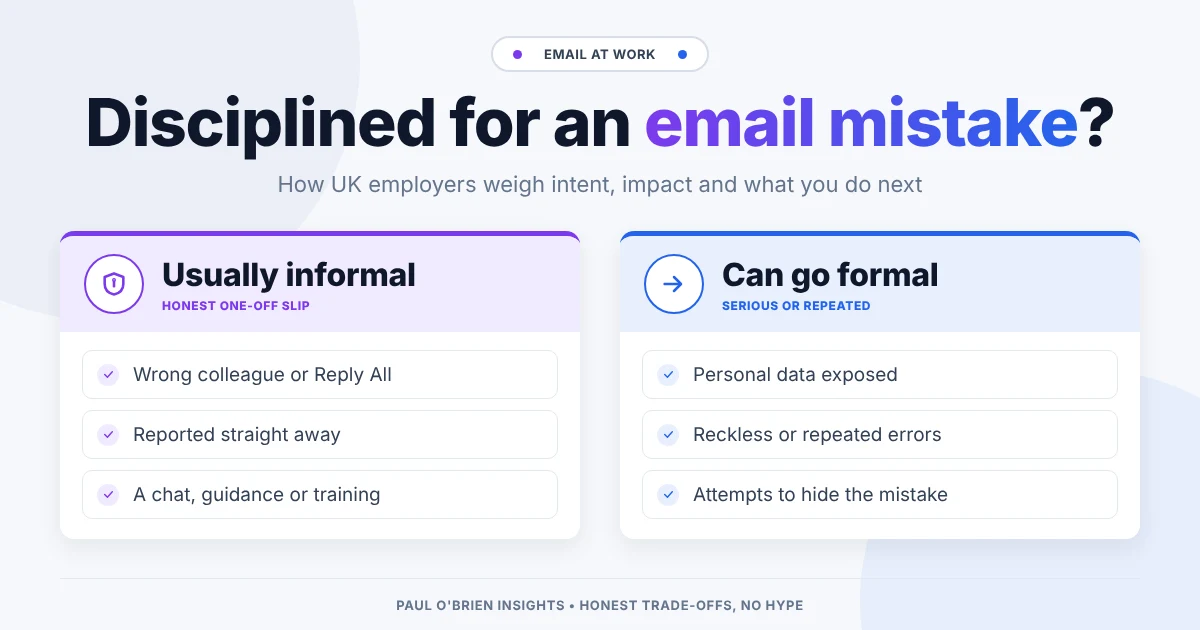
Sending email at work is so routine that it’s easy to forget how much responsibility sits behind it. A rushed reply, the wrong recipient or the wrong attachment can turn an ordinary afternoon into something far more stressful.
An email mistake does not automatically mean disciplinary action. In most workplaces, what happens next depends less on the mistake itself and more on context, intent and impact. A genuine human error is treated very differently from reckless behaviour or repeated carelessness. This post looks at how that plays out in UK workplaces, what a fair process involves, and what to do if it happens to you.
Not legal advice: this is general information about UK workplace norms, written by someone who works with email, not an employment lawyer. Your contract, your employer’s policies and the facts of your case all matter. It covers England, Scotland and Wales; Northern Ireland has its own employment rules. If you’re facing a formal process, talk to Acas, a trade union or a qualified adviser.
Short answer: yes, you can be disciplined for an email mistake, but a single honest slip is usually handled informally. Formal action becomes more likely when sensitive personal or confidential data is exposed, when the error was reckless or repeated, or when someone tries to hide it. Reporting it quickly is the single best thing you can do.
| Situation | Typical response | What tips it up a level |
|---|---|---|
| Minor slip (wrong colleague, accidental Reply All) | Informal chat or guidance | Sensitive content in the message |
| Repeated oversight | Management note, training, process changes | Ignoring earlier guidance |
| Reckless breach or personal data leak | Possible formal warning | Real harm, or a clear policy breach |
| Deliberate misuse or concealment | Possible gross misconduct; dismissal is rare | Intent, dishonesty or a fundamental breach of trust |
An “email mistake” can range from a minor, embarrassing slip to something genuinely serious:
Most day-to-day slips are ordinary human errors: uncomfortable, but fixable. Seriousness escalates when sensitive information is involved, particularly personal data, confidential business material, or messages that create legal or reputational risk. The mistake itself is only one part of the equation; the consequences matter too.
Employers don’t usually jump straight to formal discipline over a single slip. They tend to weigh several factors:
| Factor | Key question |
|---|---|
| Sensitivity | Was the information confidential, commercially sensitive or personal data? |
| Intent and conduct | Was it an honest oversight, or reckless disregard for policy? |
| Actual impact | Did real financial, legal or reputational harm follow? |
| Pattern | Is this a one-off, or part of a repeated pattern? |
| What happened next | Did the sender report it straight away, or try to cover it up? |
Where personal data is involved, procedures get stricter because the organisation has legal duties of its own. Under UK GDPR, an organisation must report a personal data breach to the Information Commissioner’s Office within 72 hours of becoming aware of it, unless the breach is unlikely to put anyone’s rights and freedoms at risk. Not every misdirected email meets that bar, but your employer needs to know quickly to make that call. The ICO’s breach reporting guidance and the Acas disciplinary procedure guide shape how HR teams handle these incidents.
Tone and wording can escalate an incident quickly. In Jones v Vale Curtains and Blinds Ltd, an employment tribunal case reported in 2024, a part-time administrator meant to forward a customer’s complaint to a colleague with an insulting comment about the customer, but replied to the customer instead. She was dismissed.
The tribunal found the dismissal unfair. It decided the main reason was the customer’s threat of a bad online review rather than her conduct, and it criticised the process: the same person investigated, ran the disciplinary hearing and decided the appeal, and she was given little notice of the hearing. According to case commentary, she was awarded compensation, reduced to reflect her own part in what happened. The lesson cuts both ways: the email was a genuine mistake with consequences, but a rushed process made things worse for the employer.
Yes, it’s possible, but context is everything.
Most one-off mistakes are handled informally. Disciplinary action becomes far more likely when the mistake involves a serious data breach, a breach of confidentiality, severe reputational damage or evidence of persistent carelessness. The first response is usually an informal discussion, a process change or extra training rather than a formal sanction. Immediate dismissal for a single accidental email is rare, and generally reserved for cases involving deliberate misconduct or a fundamental breach of trust.
If it does go formal, the Acas Code of Practice on disciplinary and grievance procedures sets the baseline that employment tribunals take into account. In broad terms, you should expect:
Tribunals can increase or reduce compensation by up to 25% where either side unreasonably fails to follow the Code. Acas consulted on a revised draft Code between July and September 2026; at the time of writing it has not come into force, so the current Code still applies. GOV.UK also has a plain-English guide to disciplinary procedures and action at work.
One caveat on unfair dismissal: most employees currently need two years’ service to bring an ordinary unfair dismissal claim. Under the Employment Rights Act 2025, the government plans to cut that to six months from 1 January 2027. Some protections, such as those linked to whistleblowing or discrimination, apply from day one. Check GOV.UK or Acas for the position that applies to you.
Real-world responses tend to be graduated rather than dramatic:
Organisations are generally far more concerned with managing risk and spotting patterns than with punishing honest slips.
If you realise you’ve sent something in error, speed and transparency matter most:
Trying to hide an error almost always does more damage than the error itself. A prompt, honest report shows accountability, whereas silence or minimising it creates doubt.
Small habits make a noticeable difference:
If I sent the wrong thing to the wrong person, I’d tell my manager within minutes, not hours, with a plain note of what went where. Then I’d set up a send delay so it’s less likely to happen again. If it turned into a formal process, I’d ask for the allegations in writing, take a companion to the meeting and get advice from Acas or my union before saying anything I might regret.
Usually not. A single genuine mistake, reported promptly, is unlikely to lead to dismissal. Dismissal is generally reserved for deliberate misconduct, a severe confidentiality breach, or repeated carelessness after earlier warnings, and even then the employer has to follow a fair process.
Yes. Investigations distinguish between human error, poor judgement, recklessness and deliberate misuse. An honest mistake made under pressure is handled very differently from knowingly ignoring policy.
Almost always. Prompt reporting limits harm, helps your employer meet its own legal deadlines and shows accountability. Concealing an error raises the risk and damages trust.
No. If personal data went to the wrong person it is a personal data breach, but it only has to be reported to the ICO if it is likely to put someone’s rights and freedoms at risk. Your employer makes that judgement, which is why they need to hear about it quickly.
If the meeting could lead to a formal warning or other disciplinary action, you have a legal right to be accompanied by a colleague or a trade union representative, provided you make a reasonable request.
Note: checked and updated 17 October 2026. This is general information, not legal advice. Sources: Acas Code of Practice, Acas disciplinary procedure, GOV.UK: disciplinary procedures, ICO: report a breach, Browne Jacobson on Jones v Vale Curtains and Blinds, Browne Jacobson on the Employment Rights Act 2025.
Get the next post by email. Free, no ads, and you can leave any time.
Apple’s hardware is world-class, but iCloud Mail on the web feels abandoned. Here is what iCloud Mail offers today, why it needs a rebuild, and a concept UI I mocked up.
A technical look at paid Outlook and Exchange Online: which security features need which plan, how it compares to Google Workspace and Fastmail, and who should pick each.
AI is creeping into every email client. Here is how to switch off Gemini, Copilot and Apple Intelligence in Gmail, Outlook and Apple Mail, what you lose, and why I think email works fine without it.
Comments