
Proton Mail vs Fastmail 2026: Privacy or Productivity?
Proton Mail or Fastmail? I've used both. Here's how they compare on encryption, custom domains, support, design and jurisdiction, and who should pick which, from someone who values privacy but not at any cost.

The short answer
Choose Fastmail if you want email that simply works: fast, polished, standards-based and backed by support that actually replies. Choose Proton Mail if your threat model genuinely demands zero-access encryption and you accept the trade-offs that come with it.
I've used both. For everyday email, Fastmail wins for me every time. If that sounds like what you need, you can try Fastmail free for 30 days, and my referral link gets you 10% off your first year. For people who absolutely need top-level security and privacy, Proton is the de facto choice. If you want the detail behind each verdict, read my full Fastmail review and Proton Mail review.
That's a referral link, so I may earn a commission if you sign up, at no extra cost to you. My opinions are my own, and Proton gets a fair hearing here.
Proton Mail vs Fastmail at a glance
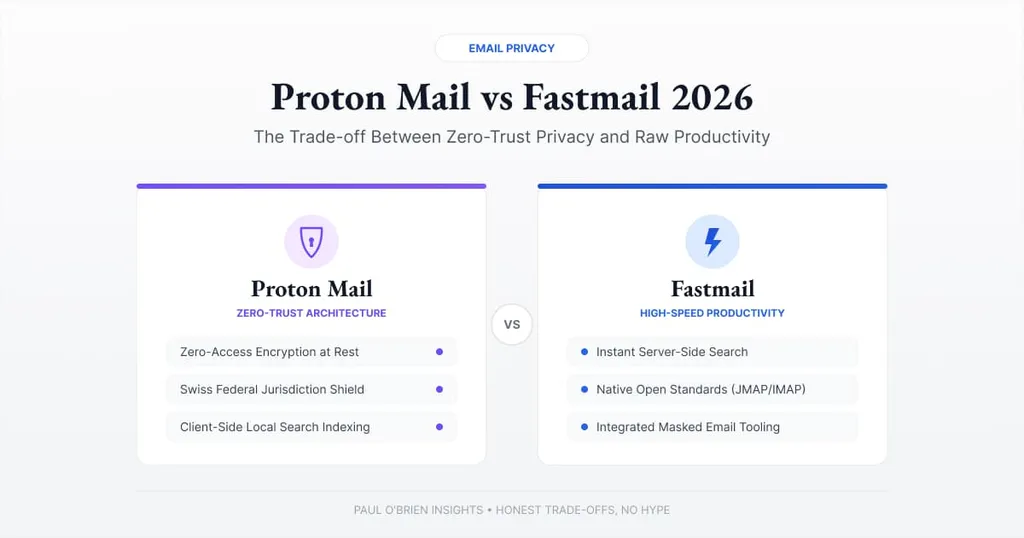
The two services solve different problems: Proton is built to keep your mail unreadable to the host, Fastmail is built to make email fast and dependable.
The encryption debate: is Fastmail's position fair?
Fastmail is blunt about end-to-end encryption (E2EE): it doesn't offer it in its own apps because it doesn't believe E2EE meaningfully improves security for most users, and the trade-offs are significant. It does support PGP and S/MIME in many third-party apps, and its security page points anyone who truly needs end-to-end encryption towards Signal rather than email. Is that honest engineering or a convenient excuse? I think it's mostly the former. Here is Fastmail's reasoning, plus one point of my own.
1. The webmail trust problem. When you use encrypted webmail, your browser downloads the code that does the decrypting from the provider's server every time you open the page. So you still have to trust the provider not to send you altered code. If a provider were compromised, or legally forced, it could quietly swap in a version that captures your password, keys or messages before they're encrypted. That's why Fastmail says browser-based E2EE adds little protection if you don't already trust the server. Software installed on your own device, such as PGP in Thunderbird, avoids this because its code is verified independently of the provider's servers.
2. Email's design limits (my own point). Email dates from the 1970s without built-in privacy. OpenPGP can protect the body and attachments, but not the sender, recipient, routing hops or timestamps, because servers need those to deliver the message. And if you email someone on Gmail or an unencrypted corporate server, the protection ends the moment the message lands there.
3. Real usability costs. Because Fastmail's servers can read your mail, they can index a very large archive and return full-text results almost instantly. Zero-knowledge designs push indexing onto your device, which costs CPU, storage and battery. Lose your password and recovery keys in a true zero-knowledge setup and your history is gone for good. Native IMAP and SMTP also become harder.
My verdict: Fastmail's reasoning holds up for most people, especially if your goal is escaping ad-driven profiling. Where it undersells things is bulk, passive risk: zero-access encryption does protect you from a server breach or a bulk data dump in a way Fastmail's model can't.
Proton's answer: zero-access encryption
Where Fastmail sees friction, Proton sees an engineering problem to solve. Its design tackles the same trade-offs head on:
- Zero-access encryption at rest. Even mail arriving in plain text from Gmail is encrypted with your public key as it reaches your inbox. After that, Proton's staff and administrators can't read the stored message bodies.
- Encrypted local search. Proton downloads and decrypts messages on your device to build an encrypted index. It takes time and storage to set up, but you keep full-text search without giving up zero-knowledge.
- Proton Bridge. To use Apple Mail, Outlook or Thunderbird, a small app on your computer handles decryption and presents a normal IMAP interface to your mail client.
That is a serious piece of engineering, and for the right person it is exactly what's needed. Proton is the default choice for whistleblowers, journalists and activists for good reason.
But zero-access isn't for everyone, and it has limits. It doesn't hide your metadata, and it doesn't hide your identity. I covered that in Proton Mail Protects Your Messages, Not Your Identity, and I go further on who actually benefits in Who Is Zero-Access Email Actually For?.
I'm also not convinced Bridge is a good everyday answer. It works, but needing an extra app installed just to make my email work doesn't sit well with me. I understand the reasoning. I just prefer how Posteo handles it: zero-access is an option you switch on, and it spells out clearly what you give up when you do.
Everyday use: where Fastmail pulls ahead for me
For day-to-day email, Fastmail wins on the things I notice every day.
Design and speed. I take UI design seriously. If an interface doesn't give me the wow factor, no feature list will win me over. Fastmail is modern, very fast and intuitive. Proton has come a long way since its early days, but it still feels a little clunky to me, and in my browser it often doesn't alert me to new messages until I refresh the page.
Support. Fastmail wins here. Only on rare occasions did I wait longer than a few hours for a reply. Proton's support has been hit or miss.
Focus. Proton has expanded into a full ecosystem, and I haven't always agreed with that direction. Most people don't need or use all those extra products, and in my view more products means more to support, more that can fail and more that ends up reflected in the price. Fastmail concentrates on its core business, which is email, and everything just works as it should.
Custom domains, pricing and aliases
If you run several domains, this is where the gap is widest. Fastmail lets you add up to 100 domains to one account, with users and aliases on any of them, and up to 600 aliases per account. Proton's personal plans are much tighter: Mail Plus supports one custom domain and Unlimited supports three, according to Proton's own plan announcement and recent pricing listings.
Those listings put Mail Plus at about $3.99 a month billed yearly ($4.99 monthly) and Unlimited at about $9.99 a month billed yearly ($12.99 monthly). Unlimited also bundles VPN, Drive, Pass and more, so if you only want email you pay for a lot you won't use. Prices change, so check both providers' pricing pages before you buy.
Both offer email masking. Fastmail calls it Masked Email, and Proton calls its version hide-my-email aliases. If you're weighing masked addresses against throwaway inboxes, I compare them in Why Masked Email Beats Disposable Email for Most People.
Jurisdiction and threat models
Fastmail is based in Australia, a member of the Five Eyes intelligence alliance, whose laws include the Assistance and Access Act. Because Fastmail holds the keys to mail encrypted at rest, a valid legal order for a specific account could compel it to produce readable inbox contents.
Proton is based in Switzerland, outside both the US and the EU. With zero-access encryption, a Swiss court order can only get stored message bodies in encrypted form, plus account metadata. That is a real advantage, but not an absolute one. Proton has said itself that under Swiss law it can be forced to collect information, such as an IP address, on an account under criminal investigation, and it has done so in the past. Encryption can't hide who you are from a provider that logs it. Rules and infrastructure also change, so check Proton's current policies before relying on a specific claim.
Both companies publish transparency reports, and I'd encourage you to read them. Fastmail's report lists the law enforcement requests it receives each year. For 2025 it reports 16 valid requests, of which 5 were actioned, and it says it only responds to requests made through Australian law enforcement. Proton's report covers legal orders from Swiss authorities. For 2025 it lists 9,301 legal orders for Proton Mail, of which Proton contested 988 and complied with 8,313. The two aren't directly comparable, because the companies count differently and have very different numbers of users. What they do show is that both providers respond to valid legal orders, which is why it matters what each is technically able to hand over.
The practical question is who you are defending against. If it's advertisers and data brokers, both providers do the job. If it's a breach of the provider's servers, or legal pressure from a state, zero-access gives you more protection.
Why Proton still has a special place with me
None of this is a knock on Proton. I followed its early journey closely, including the prolonged DDoS attack that left the service unusable for days. The lengths its engineers and founder went to in order to get back online were admirable. Plenty of companies would have collapsed. Proton bounced back, and that resilience is a big part of why so many people trust it.
It's also why I'd never tell someone with a genuine need for zero-access to look elsewhere. My preference for Fastmail is about everyday use, not about doubting Proton's mission.
Which should you choose?
Choose Fastmail if:
- You want email that just works, with a fast, modern interface
- You use several custom domains
- You want native IMAP, JMAP, CalDAV and CardDAV support in any client, with no helper app
- You value quick, reliable support
- Your main aim is leaving Big Tech's ad-driven ecosystem
Choose Proton Mail if:
- Your threat model includes server breaches, legal pressure or state surveillance
- You need zero-access encryption and accept the trade-offs: local search indexing, Bridge for desktop clients and a more limited feature set
- You want the wider Proton suite (VPN, Drive, Pass) under one subscription
Neither is objectively better. For true email power users, Fastmail wins for me. For people who absolutely need top-level security and privacy and accept the trade-offs, Proton is the de facto choice. Still unsure? Read my Fastmail review and Proton Mail review, or see who zero-access email is actually for.

Try Fastmail & Save 10% on Your First Year
If you're ready to take back control of your inbox, you can try Fastmail risk-free with a 30-day trial. If you decide to stay, signing up through my referral link below gives you 10% off your subscription for your entire first year
Affiliate disclosure: this is a referral link. If you sign up through it, I may earn a commission at no extra cost to you. In this article I have tried to include Fastmail's weaknesses as well as its strengths.
Sources and further reading
- Fastmail: Domains, up to 100 domains per account, 30-day free trial
- Fastmail Help: features, up to 600 aliases
- Proton: Unlimited plan announcement, 3 custom domains on Unlimited
- Email Explained: Proton Mail pricing, Mail Plus and Unlimited prices and domain limits
- Fastmail: Security, Fastmail's stance on end-to-end encryption
- Fastmail: Data Transparency Report, 2025 request figures
- Proton: Transparency report, Swiss legal orders and 2025 Proton Mail figures
- Proton: Important clarifications regarding arrest of climate activist. legal obligations under Swiss law