Email
iCloud Mail Needs a Redesign: A Webmail Concept
Apple’s hardware is world-class, but iCloud Mail on the web feels abandoned. Here is what iCloud Mail offers today, why it needs a rebuild, and a concept UI I mocked up.
Spam didn’t disappear, it was pushed out of sight. Reputation systems like Spamhaus reshaped email abuse at internet scale, trading noisy volume for quieter, more dangerous attacks. This is the infrastructure that keeps email usable, and the compromises it relies on.
 Paul O'Brien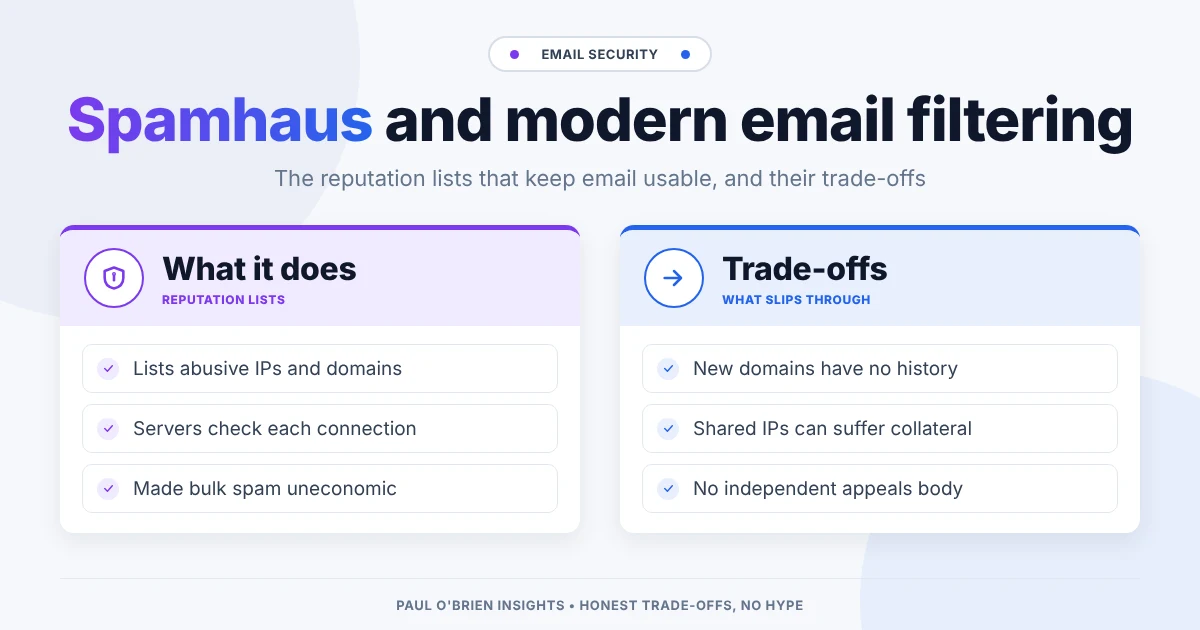
Spam didn’t disappear. It was pushed out of sight.
For most people, spam filtering feels automatic. Junk doesn’t arrive, inboxes stay usable, and email appears to “just work”. What’s less visible is the infrastructure that makes this possible, and the trade-offs built into it. (For the bigger picture, see my earlier piece on why spam isn’t disappearing.)
One of the most influential players in that hidden layer is Spamhaus. Founded in London in 1998 by Steve Linford, the Spamhaus Project began as a response to early mass-email abuse. Over more than two decades it has grown from a fairly simple blocklist into one of the most widely used sources of IP and domain reputation data on the internet. Its work cut the volume of obvious bulk spam dramatically, but it also pushed spam towards something quieter, more targeted and harder to classify. That wasn’t accidental; it was structural.
Short answer: Spamhaus publishes reputation lists of IP addresses and domains linked to spam, malware and abuse. Mail servers check incoming connections against those lists and decide for themselves whether to reject, tag or accept. That made bulk spam from dirty infrastructure uneconomic, which is why today’s spam tends to come in small, clean-looking batches from fresh or compromised infrastructure that has no bad history yet.
| Question | Answer |
|---|---|
| What is it? | A reputation intelligence organisation: a non-profit project based in Andorra, with commercial data services run by Spamhaus Technology in London |
| Is it an email provider? | No |
| Does it see my email? | No. A server checking a sender asks about an IP address or domain, not the message |
| Does it block mail? | Not directly. The receiving server’s operator decides what to do with a listing |
| What does it judge? | Observed infrastructure behaviour, not intent or message content |
| Who uses it? | Email providers, ISPs, corporate mail gateways and hosting companies |
Spamhaus’s job is reputation intelligence. It tracks and publishes continuously updated data on:
When a server receives a connection, Spamhaus data helps answer one question: is this sender likely to be abusive? The data is published as several lists, each with a different job:
| List | What it covers | How aggressive |
|---|---|---|
| SBL (Spamhaus Block List) | IPs linked to sending or hosting spam and spam operations | Conservative; Spamhaus says it has few false positives |
| XBL (Exploits Block List) | Hijacked and malware-infected machines | More aggressive |
| PBL (Policy Block List) | Address ranges, such as home broadband, that shouldn’t send mail directly to other servers | Policy-based, not an accusation of abuse |
| CSS | IPs sending low-reputation mail, often from snowshoe spam setups | Part of the combined list |
| ZEN | A combined IP list bundling SBL, CSS, XBL and PBL in one lookup | The usual choice for mail servers |
| DBL (Domain Block List) | Domains with poor reputation, checked against links and addresses in mail | Domain-based rather than IP-based |
Technically, these are DNS blocklists. A mail server looks up the connecting IP address as a special DNS query against a Spamhaus zone, and the answer is either “not listed” or a code saying which list it’s on. The administrator then chooses whether to reject the mail outright or accept it and pass the result to the rest of the filter.
Know the limits: Spamhaus’s free public lists are meant for small-scale, non-commercial use. Queries sent through big public DNS resolvers such as Cloudflare’s or Amazon’s get an error code rather than a real answer, and a badly configured server can end up rejecting good mail because of it. Spamhaus points those users to its free Data Query Service, which uses a personal key.
Early spam relied on raw volume: millions of identical messages sent cheaply from disposable infrastructure. Reputation systems like Spamhaus made that model fragile.
| Model | How it works | What happens |
|---|---|---|
| Bulk spam (legacy) | Millions of messages from a small set of IPs and domains | The IPs and domains get listed, and delivery collapses |
| Precision phishing (modern) | Low-volume, often AI-assisted messages from fresh or legitimate infrastructure | Blends in with normal traffic, with no history for a blocklist to catch |
Once IP ranges could be burned quickly and bulk domains flagged soon after they started sending, high-volume campaigns stopped paying off. Spam adapted by shifting to lower volumes, cleaner formatting, realistic language and legitimate infrastructure. When obvious abuse becomes expensive, attackers move towards subtlety, timing and trust exploitation.
In the 1990s, prolific spammers such as Sanford Wallace, often called the “Spam King”, sent millions of unsolicited emails a day through his company Cyber Promotions. What dismantled those early bulk operations wasn’t content filtering. It was loss of infrastructure access: network blocklists, lawsuits and providers cutting them off. In 1997 the backbone provider AGIS disconnected Cyber Promotions and other bulk senders. Wallace later turned to spamming Facebook users and was sentenced to 30 months in prison in 2016.
The structural lesson still holds: spam becomes unsustainable when sending it stops being possible.
No reputation system can block all abuse without causing heavy collateral damage. Filtering faces an unavoidable trade-off:
| Design choice | System behaviour | Practical risk |
|---|---|---|
| Aggressive blocking | Blocks nearly all suspicious activity immediately | False positives: legitimate business mail dropped and workflows broken |
| Conservative blocking | Needs strong evidence of bad reputation before dropping mail | False negatives: targeted phishing and low-volume abuse sometimes reach the inbox |
Spamhaus’s core lists lean towards avoiding false positives, because dropping legitimate email erodes trust in email itself. The result is that brand-new domains, low-volume spear phishing and compromised legitimate accounts often slip past reputation checks. That isn’t a bug; it’s a design decision that prioritises keeping real mail flowing, and it’s why your provider layers content filtering and authentication checks on top. The other side of that coin is why real emails still end up in spam.
Modern filters infer sender credibility from a mix of technical verification and history:
None of these guarantees inbox placement on its own, but together they establish baseline credibility. My guide to SPF, DKIM and DMARC shows how they fit together.
Spamhaus listings can affect whole IP ranges, hosting providers or mail relays when abuse is found. Where one customer abuses shared infrastructure, legitimate senders on the same network can see their delivery disrupted straight away.
Because Spamhaus is a private organisation, there’s no court process or independent appeals body. Spamhaus offers a public lookup and, for some lists, self-service removal, but getting off a serious listing generally depends on the network owner fixing the problem and cooperating with Spamhaus.
This creates a structural tension: open, decentralised email protocols depend on a handful of centralised reputation services to stay usable.
Spamhaus puts constant pressure across the industry:
That offers a lesson for alternative and decentralised protocols, from federated social networks to projects like Nostr-based mail. Decentralisation doesn’t remove the need for abuse control. Sooner or later, open networks have to reintroduce reputation, coordination and enforcement to survive at scale.
Spamhaus didn’t fail to stop spam. It changed what spam could afford to be.
By making mass abuse of infrastructure expensive, it pushed attackers towards impersonation, identity exploitation and targeted phishing. The outcome is a system where email stays open and usable, but where individual trust and identity are under constant pressure. For most of us, that means the filter handles the bulk and we have to handle the rest: separate addresses, strong account security and a healthy suspicion of anything urgent.
No. When a mail server checks Spamhaus, it asks about the sending IP address or a domain. The message itself isn’t sent to Spamhaus.
Look the IP or domain up on Spamhaus’s own checker, find out which list it’s on and why, and fix the cause first: an infected machine, an open relay, a compromised account or a sending pattern. Delisting without fixing the problem rarely lasts.
Because the lists judge infrastructure history, and modern spam is designed to have none: new domains, small batches and compromised legitimate accounts. Content filtering and authentication have to catch what reputation can’t.
Yes. Small, non-commercial setups can use the free public lists, ideally through the free Data Query Service, and through a DNS resolver Spamhaus will answer. Larger or commercial users need a paid feed.
Note: checked and updated 17 October 2026. Sources: Spamhaus: ZEN, Spamhaus: who we are, Spamhaus: help for public mirror users, Wikipedia: Sanford Wallace, FBI: Sanford Wallace indicted.
Get the next post by email. Free, no ads, and you can leave any time.
Apple’s hardware is world-class, but iCloud Mail on the web feels abandoned. Here is what iCloud Mail offers today, why it needs a rebuild, and a concept UI I mocked up.
A technical look at paid Outlook and Exchange Online: which security features need which plan, how it compares to Google Workspace and Fastmail, and who should pick each.
AI is creeping into every email client. Here is how to switch off Gemini, Copilot and Apple Intelligence in Gmail, Outlook and Apple Mail, what you lose, and why I think email works fine without it.
Comments