Email
iCloud Mail Needs a Redesign: A Webmail Concept
Apple’s hardware is world-class, but iCloud Mail on the web feels abandoned. Here is what iCloud Mail offers today, why it needs a rebuild, and a concept UI I mocked up.
Spam hasn’t disappeared, it has adapted. Mass junk gave way to quiet impersonation that blends into routine digital life. Here is how it changed, why fewer messages now do more damage, and what actually limits the harm.
 Paul O'Brien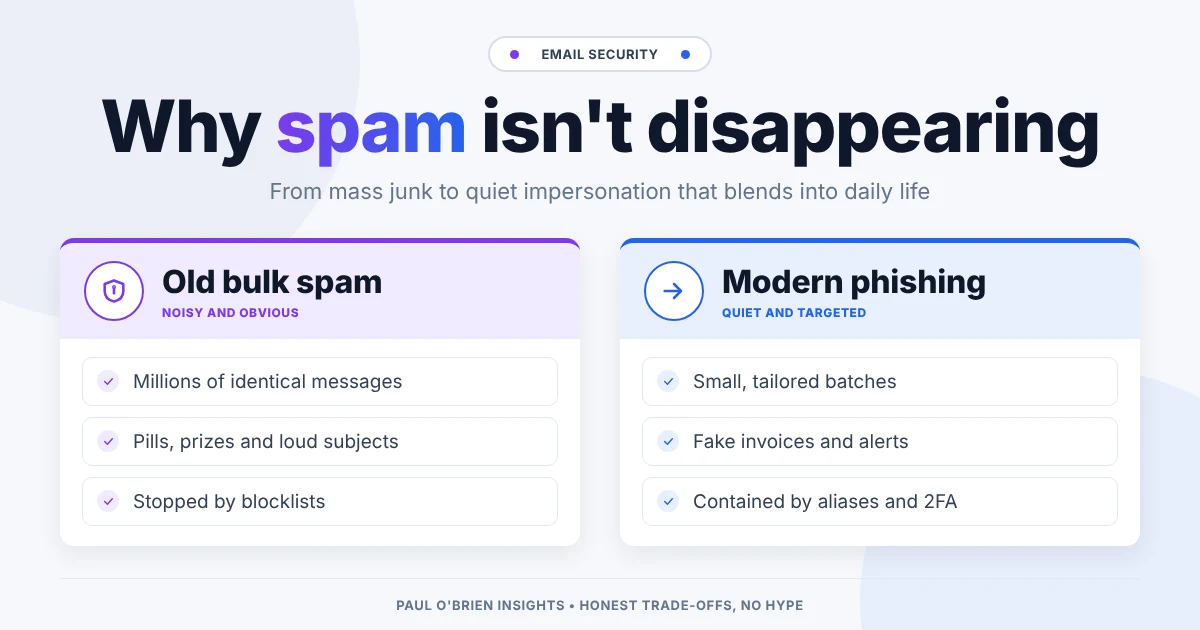
Spam feels like it should be disappearing by now. Filters are smarter, inboxes are more aggressive, and most people know not to click obvious junk. Yet spam hasn’t vanished. It has changed, and the overall volume is no longer the whole story.
What has declined is the obvious, mass-market spam that once flooded inboxes by the thousand. What has grown instead is quieter, more targeted and often far harder to separate from legitimate email. That shift matters because it changes what spam costs: not just annoyance, but trust, attention and the way inboxes are designed to cope with risk.
Short answer: spam persists because sending is cheap, receiving is open and human attention can still be exploited. Filters and sender authentication killed off most crude bulk junk, so attackers moved to fewer, cleaner, more convincing messages. You can’t filter your way to zero, so the practical goal is containment: limit what any one message, or any one address, can cost you.
| Dimension | Old bulk spam | Modern spam and phishing |
|---|---|---|
| Volume per campaign | Millions of identical messages | Smaller, often tailored batches |
| Look and language | Obvious junk, poor spelling, loud subject lines | Clean copy that mirrors real transactional email |
| Typical lure | Pills, prizes, get-rich offers | Delivery updates, security alerts, invoices, password resets |
| Infrastructure | Disposable IPs and domains | Fresh domains, compromised accounts and legitimate services |
| Main cost to you | Irritation | Account takeover, data exposure, fraud |
| What stops it | Blocklists and volume filters | Authentication, layered filtering and your own containment |
As email providers got better at blocking high-volume junk, the economics of spam shifted. Sending millions of identical messages stopped working: deliverability dropped, domains were burned faster, and IP addresses were blocked before campaigns even got going. Reputation services such as Spamhaus played a big part in that, and I cover how in Spamhaus and the shape of modern email filtering.
So spam adapted. Instead of trying to reach everyone, it started trying to reach the right someone, and that shift defines modern phishing. Modern spam is less about flooding inboxes and more about slipping through them:
Today’s spam rarely looks like spam. It looks like routine digital life. Deception at scale is not new either: see the history of 419 scams. Marketing mail has its own version of the problem too: see why marketing emails only offer unsubscribe links.
The old model of spam was noisy and inefficient. Most people ignored it, filters caught the rest, and the main cost was irritation.
The newer model is targeted, and far more damaging when it succeeds. A single well-timed phishing email can lead to an account takeover, expose personal data and cascade into other compromised services through automated password resets, because so many accounts recover through the same inbox. I go into that chain in your email is your weakest privacy link.
The harm is no longer proportional to volume. One successful message outweighs thousands that never land, which turns spam from a numbers game into a trust game.
| Metric | Widely quoted estimate | What it shows |
|---|---|---|
| Global spam volume | Roughly 160 billion emails a day | Spam remains viable at massive scale. |
| Share of email traffic | Around 45 to 47% | Close to half of all email is still unwanted or abusive. |
| Phishing volume | Around 3.4 billion emails a day | Phishing is lower volume, but higher impact. |
| Phishing share | Roughly 1 to 2% of all mail | A small slice causing disproportionate damage. |
| Quality trend | Increasingly AI-assisted | Messages are harder to tell apart from legitimate mail. |
Treat the numbers as rough: these figures circulate widely in industry reports and vendor round-ups, and different sources measure different things, so they don’t always agree. The direction is what matters: the spam share of email has fallen from the 70%-plus levels of the early 2010s, while the damage from the phishing that gets through has not.
Breach research points the same way. Verizon’s Data Breach Investigations Report has for years listed phishing and stolen credentials among the main ways attackers get in, and the two overlap, because phishing is one of the main ways credentials get stolen.
Tools like DuckDuckGo Email Protection exist precisely because spam and phishing haven’t disappeared. They’ve adapted.
It’s tempting to read this evolution as proof that email is broken, but the opposite is true. Providers have spent years tightening filters, authenticating senders and isolating suspicious traffic. Much of that hardening happens through three authentication standards:
| Standard | What it does | What it doesn’t do |
|---|---|---|
| SPF | Lists which servers may send mail for a domain | Check the From address you actually see |
| DKIM | Signs messages so receivers can tell they weren’t altered in transit | Prove the sender is who they claim to be |
| DMARC | Ties SPF or DKIM to the visible From domain and tells receivers what to do on failure | Stop lookalike domains that pass their own checks |
The big mailbox providers now insist on them. Since February 2024, Gmail and Yahoo have required anyone sending around 5,000 or more messages a day to their users to authenticate with SPF, DKIM and DMARC, offer one-click unsubscribe on marketing mail and keep spam complaint rates below 0.3%. My explainer on how SPF, DKIM and DMARC work together covers the details.
These tools don’t make email private, but they make impersonation of real domains and large-scale abuse much harder and more expensive. Attackers changed tactics because email hardened, not because it was weak. The flip side is that strict filtering catches some real mail too; see why real emails end up in spam.
The biggest mistake is still thinking of spam as “bad messages”. Modern spam is better understood as unauthorised attempts to borrow trust.
Sometimes that trust comes from a familiar sender name, a known brand, a realistic scenario, or simply the fact that the message arrived in your main inbox at all. A message that passes every technical check can still be a lie, because authentication proves where mail came from, not whether the person behind it is honest. As long as digital trust exists, attackers will try to counterfeit it.
Spam isn’t disappearing because sending remains cheap, receiving remains open and human attention remains exploitable. Filters reduce exposure, but they don’t remove the incentives. The most effective response isn’t chasing perfection, it’s containment:
I don’t try to win the spam war at the filter. Whichever provider I use will do a decent job on bulk junk. What I control is how much a single successful message can reach: separate addresses for separate parts of life, strong second factors on the accounts that matter, and a habit of never acting on an email’s own link when money or a password is involved.
Spam isn’t a phase the internet will grow out of. It’s a permanent pressure that shapes how inboxes evolve, how accounts are secured and how trust is managed online.
As a share of all email, yes: widely quoted estimates put it at a little under half of traffic, down from well over two-thirds a decade or so ago. But the absolute numbers are still huge, and the messages that get through are more convincing.
Because filters are tuned to avoid blocking real mail, and modern spam is built to look like real mail. Low-volume messages from fresh domains or compromised legitimate accounts have little bad history for a filter to spot.
They stop a lot of direct spoofing of real domains, which is a big deal. They don’t stop a scammer registering a lookalike domain and authenticating it properly, so you still need to read the sender address and think about the request.
It removes some of the old giveaways, such as clumsy grammar, and makes tailored messages cheaper to write. That makes containment and out-of-band checks more important than spotting typos.
Note: checked and updated 17 October 2026. Sources: Verizon Data Breach Investigations Report, Google email sender guidelines.
Get the next post by email. Free, no ads, and you can leave any time.
Apple’s hardware is world-class, but iCloud Mail on the web feels abandoned. Here is what iCloud Mail offers today, why it needs a rebuild, and a concept UI I mocked up.
A technical look at paid Outlook and Exchange Online: which security features need which plan, how it compares to Google Workspace and Fastmail, and who should pick each.
AI is creeping into every email client. Here is how to switch off Gemini, Copilot and Apple Intelligence in Gmail, Outlook and Apple Mail, what you lose, and why I think email works fine without it.
Comments