Why Using Your Own Domain for Email Makes Sense
Email addresses tend to outlive the services behind them. This piece explores why using your own domain for email reduces lock-in, ages better than free inboxes, and gives you long-term control over an identity most people never think to own.

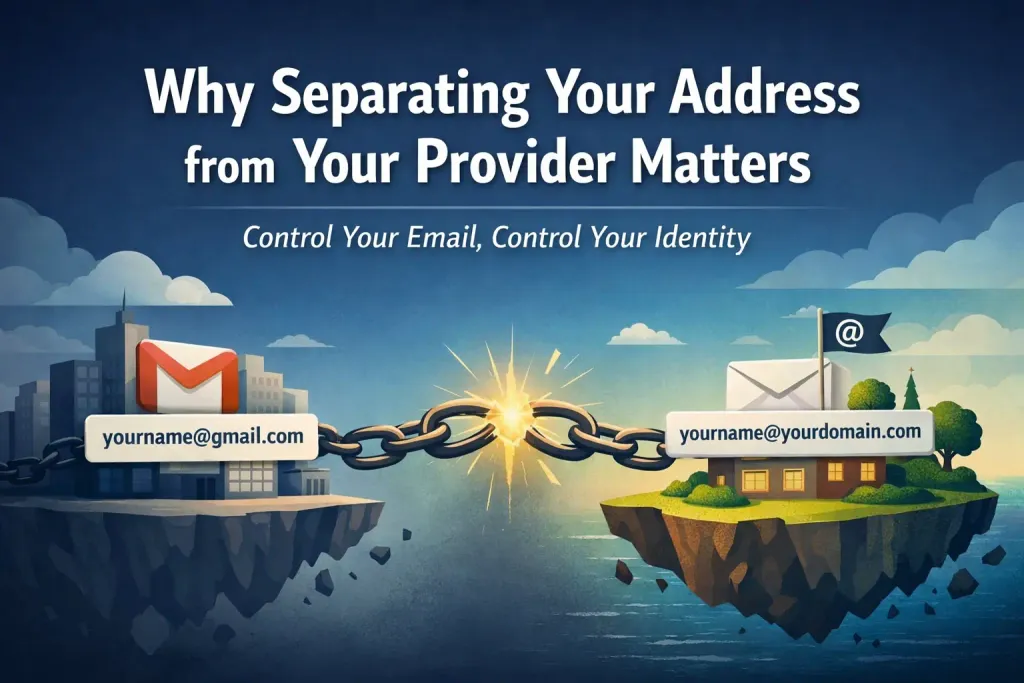
Email addresses tend to feel permanent, even though the services behind them rarely are. Most of us choose an address early — often a free one — and then build years of accounts, relationships, and personal history around it. Over time, that address becomes less like a tool and more like an identity.
Most email addresses are issued by the company that runs the service. A Gmail address is created and controlled by Google. A Proton address is created and controlled by Proton.
That means your email address isn’t just a way to receive messages — it’s tied to a specific provider’s rules, policies, and long-term decisions. If you ever want to move, or if your account is locked, suspended, or closed, the address itself stays with the provider — meaning it’s usually left behind.
In practice, this makes changing email providers harder than it needs to be. You’re not just switching a service — you’re often forced to change the address that everything else in your digital life depends on.
This dynamic shows up clearly in modern email services — something I explore in more detail in Free vs Paid Email: What You’re Really Paying With.
Using your own domain for email breaks that link. Instead of your identity being anchored to a company’s product, it’s anchored to something you control. The address stays the same, while the service behind it becomes interchangeable.
That separation — address from provider — affects things that features don’t: how easily you can move, how much leverage you have, and how resilient your email identity is over time.
For people who rely on email as part of their digital life rather than a casual inbox, that distinction matters. It reduces lock-in, lowers the cost of change, and gives you leverage when services evolve, degrade, or disappear. And over long periods of use, those quiet advantages compound.
What makes this especially relevant today is how rarely people change email providers — not because they’re happy, but because the cost feels too high. Email addresses are woven into logins, subscriptions, two-factor recovery, and long-standing contacts. Even small frustrations can be tolerated for years if the alternative feels like disruption.
Email isn’t always the right tool — and that’s part of the problem. Too many conversations happen over email by default, while others that should be written get pushed into chat or calls. Understanding when email is the right tool matters, because many of the issues people have with email aren’t caused by email itself, but by using it in the wrong contexts.
Why separating your address from your provider matters
A custom domain changes that calculation. When the address stays fixed, switching providers stops being a social or identity problem and becomes a technical one. You can move from one service to another without asking people to update contacts, without rewriting logins everywhere, and without starting over. The friction doesn’t disappear, but it drops dramatically.
That flexibility also shifts power. When your address is portable, providers know you’re no longer locked in by inertia alone — by the effort and disruption of changing addresses.
This is where using a domain for email quietly intersects with broader questions about incentives. Services that control both your inbox and your address have little reason to make leaving easy. When you own the domain, that imbalance softens. The provider becomes a service you evaluate — not a gatekeeper you depend on.
None of this requires running a business, publishing publicly, or presenting a professional brand. It’s about resilience. A domain-backed address is less about how email looks today, and more about how well it survives change over time.
If you want to see how these trade-offs play out in practice, I’ve written separately about Gmail, Proton Mail, StartMail, Tuta Mail and Fastmail
Address scarcity and why domains age better
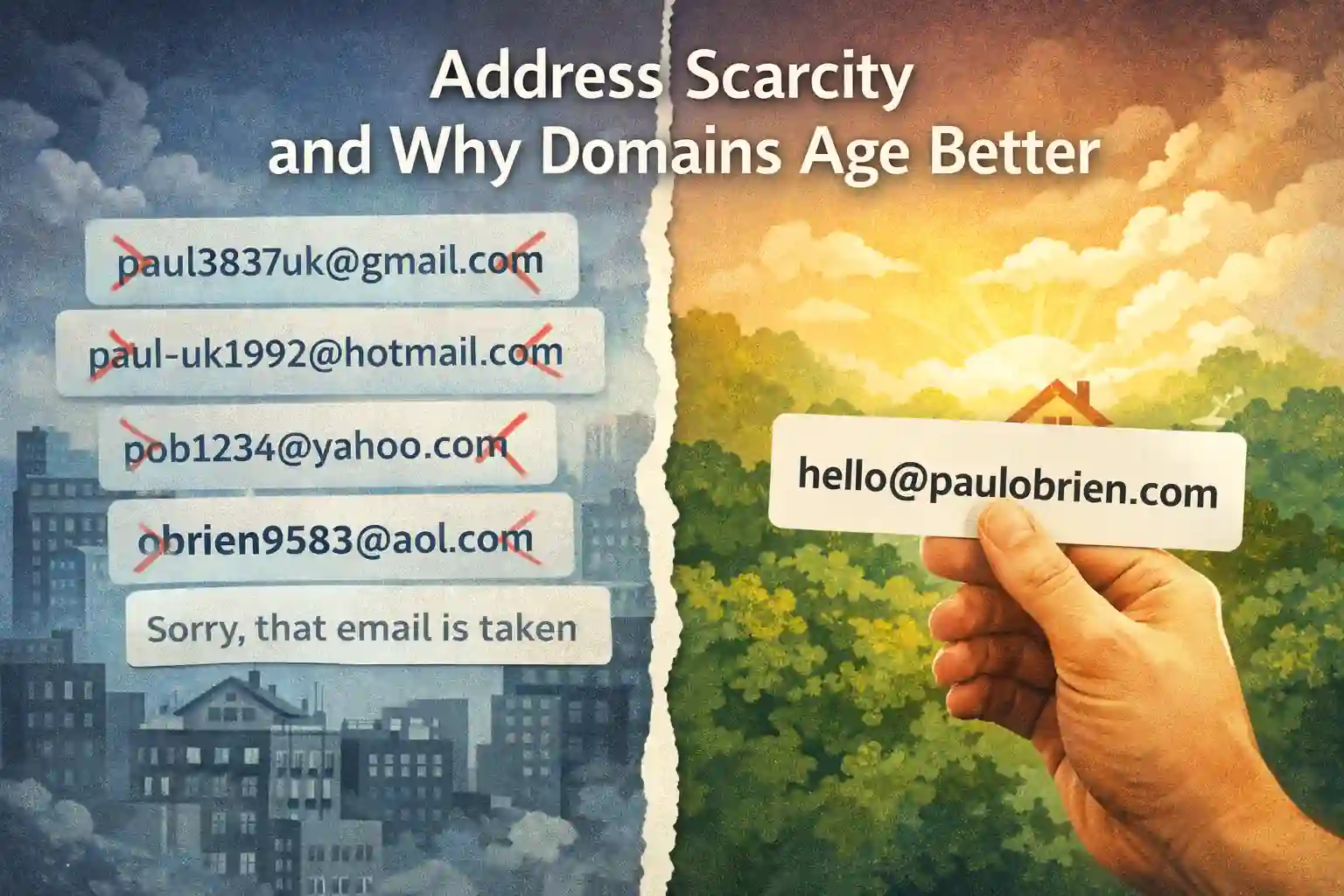
Email addresses feel abundant, but memorable ones aren’t. Most large providers have been issuing addresses for decades, and the pool of short, readable names has long been exhausted. What remains are compromises: numbers, separators, regional suffixes, or variations that are easy to mistype and hard to remember.
That’s how people end up with addresses like [email protected] — not because they chose it, but because everything cleaner was already taken. The address works, but it carries friction. It’s less legible, easier to misread, and often feels like a temporary solution that somehow became permanent.
A domain-backed address avoids that scarcity entirely. You’re no longer competing with millions of other users for a shared namespace — you define the namespace yourself. An address like [email protected] is available because the domain is yours, not because you happened to sign up early.
This isn’t about branding or presentation. It’s about clarity and durability. A simple, predictable address is easier to share, harder to mistype, and more likely to survive unchanged over time. Small improvements in legibility compound when an address is used for years rather than months.
Free providers will continue issuing addresses, but they can’t create more memorable ones without adding complexity. Domains don’t have that constraint. They scale with the person using them, not with the platform issuing the address.
This scarcity is part of the broader history of how email evolved — and why early design decisions still shape inboxes today.
Owning a domain email address isn’t expensive
Using your own domain for email often sounds like a premium choice — something technical, costly, or reserved for businesses. In practice, it’s usually neither.
A domain name typically costs less per year than a couple of coffees. Email hosting, depending on the provider, often costs less than a streaming subscription. Spread over a year, the total is small enough that most people wouldn’t notice it if it weren’t framed as “paid email”.
What makes it feel expensive isn’t the price — it’s the comparison point. Free email has trained people to expect zero upfront cost, even when the trade-offs show up later in lock-in, complexity, or loss of control. Against that baseline, any paid option can feel disproportionate, even when the actual numbers are modest.
The key difference is what you’re paying for. With a domain-backed address, the cost isn’t just storage or features. It’s portability. You’re paying to keep your identity stable while everything underneath it can change. That’s a different category of value than inbox tools or extra gigabytes.
This also means the cost is predictable. Domains don’t get more expensive as your email history grows, and switching providers doesn’t require buying a new identity. Once the domain is yours, it continues to work whether you host email with one provider today or a different one years later.
For something as long-lived as an email address — something many people keep for decades — the ongoing cost of ownership is small. What tends to be expensive isn’t paying for email, but being unable to move when circumstances change.
Owning your email address doesn’t require enterprise pricing. In practice, using a custom domain with a paid email provider often costs less than people expect:
| Provider / Item | Domain cost (per year) | Email hosting (per year) | Approx. total | Notes |
|---|---|---|---|---|
| Your own domain | £10–£15 | — | £10–£15 | You own the address (e.g. [email protected]) |
| Proton Mail Plus | — | ~£48 | ~£48–£63 | Privacy-first, 1 custom domain |
| Proton Mail Unlimited | — | ~£120 | ~£120–£135 | Multiple domains, higher storage |
| Fastmail | — | ~£60 | ~£60–£75 | Fast, reliable, strong domain support |
| Zoho Mail (basic) | — | £0–£24 | £0–£39 | Low cost, fewer privacy controls |
| Email via web hosting | £0–£15 | £13–£30 | £13–£45 | Bundled, limited reliability |
Cost often feels like the barrier, but incentives matter more than price — a theme I return to in Free vs Paid Email: What You’re Really Paying With.
Why this isn’t “expensive”
- You could spend less on email + domain in a year than most people pay for a streaming subscription.
- Many providers (e.g., Zoho) let you use a custom domain at very low or zero hosting cost if your needs are simple.
- Even privacy-first providers like Proton Mail or Fastmail (which cost more than basic shared hosting) still keep total costs in the low double digits per month — comparable to other digital services people already pay for.
This shows that owning your email identity doesn’t have to be expensive — it’s about choice and control, not high bills.
Bringing it together
Using your own domain for email isn’t about status, professionalism, or clever configuration. It’s about time.
Email addresses tend to live far longer than the services behind them. Providers change priorities, features shift, prices move, and sometimes platforms disappear entirely. When your address is tied to a provider, every one of those changes affects not just how you send and receive mail, but how easy it is to move on when the fit no longer feels right.
A domain-based email address separates identity from infrastructure. Your address stays constant, while the service behind it becomes replaceable. That one decision quietly reduces lock-in, lowers the cost of change, and gives you more control over something that often acts as the backbone of your digital life.
It’s also a surprisingly practical choice. Domains are inexpensive, paid email doesn’t have to be, and memorable addresses are becoming harder to find on free platforms. Over time, a simple address like [email protected] tends to age far better than whatever variation happens to be available on a crowded free service.
You don’t need to do this for every inbox, and it won’t matter equally to everyone. But if email is something you rely on — not just something you occasionally check — owning the address you use is one of the quietest ways to future-proof it.
If email plays a central role in your digital life, it’s worth understanding how much of that role you actually control.
And like many good infrastructure decisions, its value isn’t obvious on day one. It shows up years later, when change becomes easier than it otherwise would have been.
Get the weekly email
A short weekly roundup on email, privacy, and digital trust. No promos. Unsubscribe anytime.

