
Why Businesses Choose Microsoft 365 Over Google Workspace
Why do enterprises default to Microsoft 365 while startups choose Google Workspace? Discover the hidden friction of institutional inertia, ecosystem locks, and scaling pressures driving business IT decisions.

The Modern Productivity Paradox: Institutional Inertia vs Cloud-Native Agility
For small businesses, scaling firms, and multi-national corporations alike, selecting a primary productivity suite is rarely a simple battle of feature comparison charts. While Google Workspace and Microsoft 365 offer functionally equivalent core tools—email, document editing, cloud storage, and video conferencing—their market dynamics reveal a fundamental split in modern business operations.
Microsoft 365 remains the default enterprise platform of traditional corporate enterprise, while Google Workspace serves as the intentional engine for agility, startups, and solo operators. Understanding why organisations choose one over the other requires looking past software specs and evaluating corporate habit, risk perception, and ecosystem architecture..
The Corporate Default: Why Organisations Inherit Microsoft
For established enterprises, adopting Microsoft 365 is seldom an active choice; it is an inherited posture. Several deep-rooted factors keep traditional corporations tethered to the Microsoft ecosystem:
The Educational Pipeline
Higher education, business schools, and IT administration programmes overwhelmingly train students on Microsoft systems. System administrators enter the workforce fluent in Active Directory, Exchange Server, and PowerShell, creating a permanent structural bias toward Microsoft-first environments.
Perceived Corporate Legitimacy
Google still battles a persistent perception within conservative boardrooms of being a consumer-grade search engine that happens to sell email. Microsoft, by contrast, is viewed purely as an enterprise software partner.
The "Safe Choice" Fallacy
Deploying Microsoft acts as an operational insurance policy for C-suite leaders. If Microsoft Outlook experiences an outage, it is treated as a systemic industry event. If an IT director migrates a traditional firm to Google Workspace and encounters user resistance, it is judged as a management failure.
Complex Compliance & Governance
While Google Workspace satisfies standard regulatory frameworks, Microsoft 365’s high-tier suites (such as E5 and Purview) offer the granular data loss prevention (DLP), legal hold capabilities, and complex eDiscovery frameworks demanded by heavily regulated sectors like defense, financial services, and legal.
Deep Third-Party Integration
Legacy enterprise resource planning (ERP) platforms, custom financial models, and industry-specific software were built over decades to hook natively into Windows and Exchange infrastructure. Replacing these connectors often introduces unacceptable operational risk.
Market Footprint & Sector Breakdown
While domain-level statistics show Google Workspace holding roughly 50% of the overall productivity market share due to massive adoption among small businesses, startups, and education, enterprise penetration tells a very different story.
| Platform Metric | Microsoft 365 | Google Workspace |
|---|---|---|
| Global Office Market Share | ~45% | ~50% |
| Enterprise Penetration (1,000+ seats) | ~58% | ~32% |
| Core Dominant Sectors | Finance, Legal, Healthcare, Government, Heavy Industry | Startups, Media, Tech SaaS, Primary/Secondary Education |
| Primary Architecture | Hybrid (Desktop applications + Cloud backend) | Browser-native (Zero local client dependencies) |
| Primary Advantage | Advanced Excel processing, deep Windows OS management | Real-time co-authoring, rapid user onboarding, low IT overhead |
Despite the widespread belief that Google cannot serve scale, global giants such as Airbus (130,000+ users), Whirlpool (80,000+ users), Heineken (70,000+ users), and PwC (200,000+ users) run their global operations on Google Workspace. Similarly, hyper-scale platforms like Uber, Spotify, and Netflix rely on Google to match their flat, asynchronous operational cultures.
The Agility Engine: Where Google Workspace Wins
When an organisation intentionally rejects the Microsoft default in favour of Google, it is usually driving a cultural and operational pivot toward speed.
- Solopreneurs & Early SMEs: For solo workers and micro-businesses, Google is the undisputed starting line. A founder can set up a custom domain, configure email, and deploy collaborative tools in under 15 minutes without engaging an external IT consultant.
- Zero IT Overhead: Managing user identity and security policy in Google’s Admin Console requires a fraction of the specialized expertise demanded by Microsoft Entra ID (formerly Azure AD) and Microsoft Intune.
- True Synchronous Collaboration: Google Workspace was architected natively for the browser. While Microsoft has added real-time co-authoring to web and desktop Office apps, Google’s document engine produces significantly fewer file lockouts, sync errors, and version-control conflicts during multi-user editing sessions.
- Modern SaaS Ecosystem Integration: Early-stage firms rely on agile tools like Slack, HubSpot, Jira, and Zoom. Google’s open authentication and lightweight APIs connect seamlessly with third-party web stacks, whereas Microsoft continually encourages users to stay within its proprietary ecosystem (e.g., Teams, SharePoint, Dynamics).
The SME Friction Zone: The Scaling Dilemma
Small and medium-sized enterprises frequently encounter a pivotal crossroads as they scale past 20 to 50 employees.
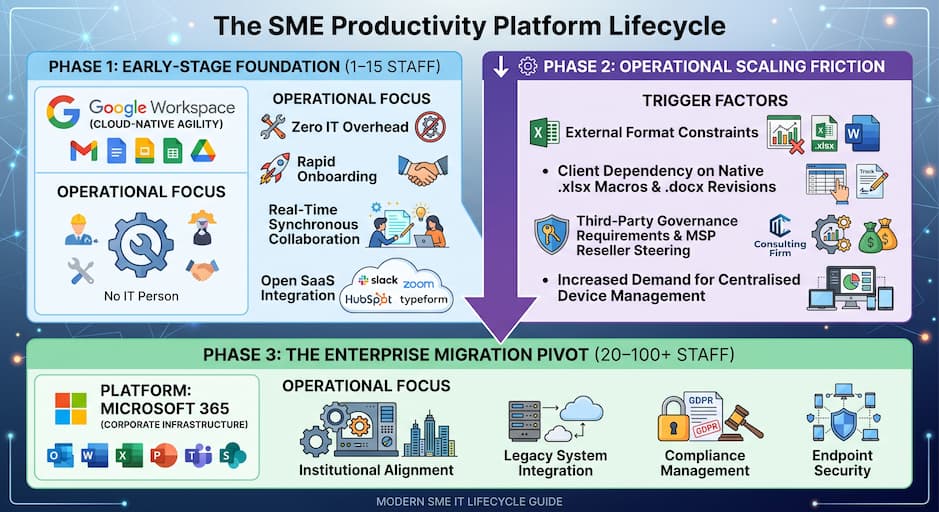
As an SME scales, external pressure builds. Clients request complex Excel workbooks with embedded macros that break when converted to Google Sheets. External law firms and auditors request track-changes in native .docx formats. Simultaneously, outsourced Managed Service Providers (MSPs) often push the business toward Microsoft 365, where reseller margins and remote management tools are more lucrative and established.
The Competitor Void: Apple and Yahoo
An analysis of business communication is incomplete without addressing the missing alternatives:
- Why Apple Doesn't Compete: While Apple dominates high-margin consumer hardware, it deliberately avoids building an enterprise mail and productivity suite. Enterprise B2B software carries low profit margins, requires massive compliance infrastructure, and demands dedicated enterprise sales teams—an operational distraction from Apple's hardware-centric business model.
- The Failure of Yahoo: Despite maintaining a beloved consumer email portal in the early web era, Yahoo failed to build a true business-class ecosystem. A lack of productivity applications (docs, sheets), coupled with high-profile security incidents, prevented Yahoo from making the enterprise transition achieved by Google.
Ultimately, businesses rarely switch from Microsoft to Google (or vice versa) to lower licensing costs by a few pounds per user. They switch when their organisational identity changes. Microsoft 365 remains the default tool for structured, process-driven governance, while Google Workspace serves as the engine for browser-first, collaborative execution.