I Moved from Proton Mail to Fastmail — Here’s Why
I still care deeply about email privacy — but I recently moved my primary inbox from Proton Mail to Fastmail. Here’s why the trade-offs finally tipped.

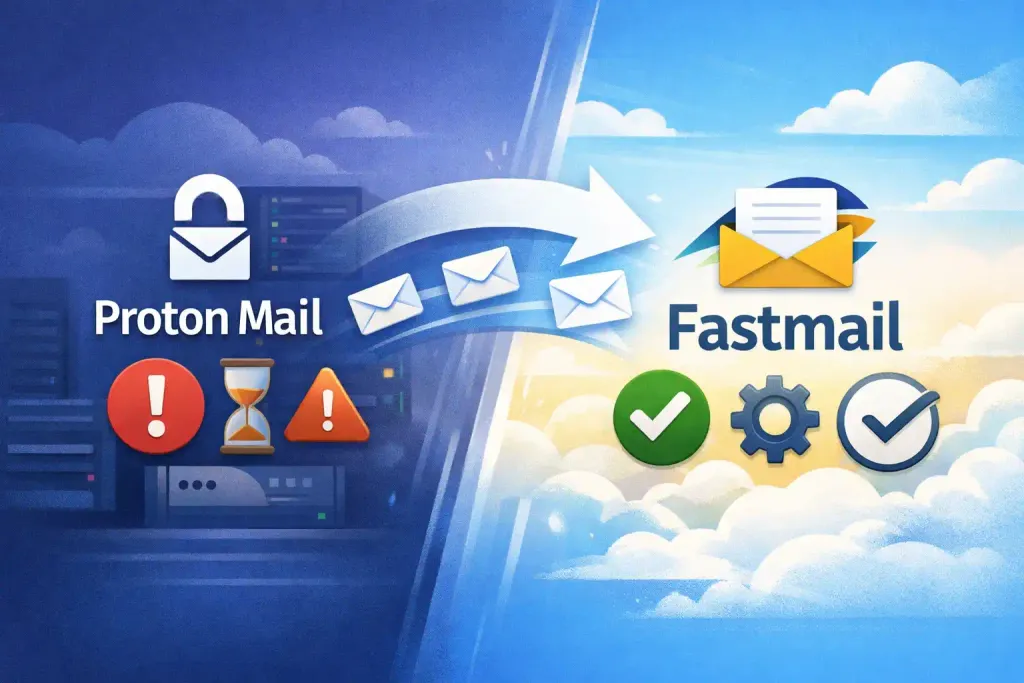
I care deeply about email privacy. That hasn’t changed.
What has changed is how I balance privacy guarantees against day-to-day usability, cost, and reliability — especially as email becomes less about ideology and more about getting work done without friction.
Recently, when my Proton Mail billing anniversary came around, I made a decision I’d been circling for a while: I moved my primary inbox from Proton Mail to Fastmail.
This wasn’t a dramatic break, and it wasn’t driven by a sudden loss of faith in privacy-first email. It was a reassessment — prompted by cost, constraints, and how my own usage has evolved.
This isn’t a reversal on privacy
Let’s be clear upfront.
I haven’t suddenly decided that Gmail is “good enough,” or that advertising-funded inboxes are harmless. I still believe that free email funded by data extraction creates incentives that don’t work in the user’s favour. That hasn’t changed.
What has changed is my threat model.
For my own day-to-day use — newsletters, client emails, admin, domains, and long-term archiving — I’m balancing privacy with reliability, speed, and flexibility, and choosing a service that stays out of the way of how I actually work.
Where Proton Mail started to feel constrained
I’ve written at length about what Proton Mail gets right: zero-access encryption, reduced provider visibility, and a business model that doesn’t depend on advertising. I still respect that architecture, and I still think Proton is one of the most credible privacy-first email providers available.
But over time, friction crept in.
Some of that was technical. Some of it was structural. And some of it was simply about cost relative to what I actually need.
Cost vs flexibility
As someone with multiple domain names, Proton’s pricing model became harder to justify.
Adding more domains, more aliases, and more storage meant moving up tiers. I reached a point where I didn’t want to keep upgrading my Proton account just to accommodate how I already work.
Fastmail, by contrast, allows:
- Up to 100 custom domains on a single account
- 600 aliases at no extra cost
- Generous defaults without feature gating
For someone managing multiple identities and domains, that difference isn’t academic — it’s practical.
Workflow friction
Proton Mail works best inside its own ecosystem.
That’s not a flaw; it’s a design choice. But over time, it felt increasingly constrained. Search is slower on encrypted content. Some workflows feel heavier than they need to be. And while Proton Bridge works, it always feels like an adapter rather than a native experience.
Fastmail, by contrast, is unapologetically IMAP-native. It works naturally with Apple Mail and other standard desktop and mobile email clients, and it also offers its own fast, lightweight apps across platforms.
That flexibility mattered more than I expected.
Service quality and support started to matter more
Another factor — and one I didn’t expect to carry as much weight — was service responsiveness.
Over the past year, I’ve seen increasing reports from Proton users about slow responses and stretched support.
Trustpilot review summaries
“Many reviewers praise the customer service, describing it as fast, helpful, and patient.”
— Trustpilot reviews of Fastmail
“Some reviewers mention that they did not receive a response from customer support…”
— Trustpilot reviews of Proton Mail
Separately from that public user feedback, I’ve also experienced service delays myself — not with day-to-day email support, but through Proton’s partner channels. Recent communications went unanswered for months and, at the time of publishing, still remain unanswered.
That gave me pause. If partners struggle to get timely responses, it becomes harder to confidently recommend the service or refer business without hesitation. It also forces a rethink about how — or whether — I recommend them going forward.
By contrast, Fastmail’s support has been consistently fast, human, and practical. When something needs clarification or breaks, you reach someone who understands email infrastructure — not a ticket that disappears into a queue.
That reliability is part of the product, and it’s something you only fully appreciate once you’ve had to rely on it.
What Fastmail gives me day to day
Fastmail doesn’t position itself as a privacy crusade. It positions itself as a fast, well-run email service that expects users to trust it — and then works hard not to betray that trust.
In practice, that looks like:
- Very fast search, even across large archives
- A calm, responsive interface
- Excellent spam filtering without drama
- 50 GB of mail storage and 10 GB of file storage
- Seamless use with Apple Mail and other standard clients
- Aliases and domains treated as first-class features
For an “average” user like me — not high-risk, not anonymous, but privacy-conscious — it ticks all the boxes that actually affect daily use.
How I handled the switch
The migration itself wasn’t entirely frictionless, but it was manageable.
I installed Proton Mail Bridge, connected Proton Mail to Apple Mail on macOS, added my Fastmail account via IMAP, and then simply dragged my mail across folder by folder.
It wasn’t glamorous, but it worked. And once it was done, it was done.
No vendor lock-in. No proprietary export formats. Just email behaving like email.
Why having my own domain made the switch easier
One reason this move was relatively painless is that I don’t treat my email address as disposable — or provider-owned.
I use my own domain names for email. That means my public-facing addresses don’t change when I change providers. I can move the infrastructure underneath without asking everyone else to update their address books.
I’ve written before about why this matters in Why using your own domain for email makes sense, and this switch was a good example of that principle in practice. Owning the domain turns email providers into services you can leave — not identities you’re locked into.
It also changes how features like forwarding matter. Proton Mail only offers email forwarding on paid plans, whereas other providers treat forwarding as a baseline capability. HEY, for example, allows email forwarding permanently — even after you cancel your account.
None of these policies are inherently wrong, but they reinforce an important point: if your email address lives on a provider’s domain, their rules determine how easy it is to leave. If your address lives on your own domain, you keep that control.
I didn’t leave Proton entirely
I still keep my @proton.me address. When I want that extra layer of privacy — sensitive sign-ups, one-off communications, or situations where provider visibility genuinely matters — Proton is still there.
But for day-to-day email, Fastmail is now my primary provider.
That split feels honest. I’m not pretending one service can or should solve every problem.
Why the billing anniversary mattered
I tend to reassess my email provider when the renewal notice lands. Proton’s did — and it forced a decision.
At that point, Fastmail simply made more sense for how I actually use email today:
- Lower cost for my setup
- Fewer constraints
- Faster performance
- Better domain and alias handling
- Dependable, human support
That doesn’t invalidate Proton’s mission. It just reflects a different set of priorities.
Final thoughts
Email is a long-term relationship. What matters isn’t which provider has the strongest marketing claims, but which one aligns with how you actually work — now, not in theory.
Proton Mail remains one of the strongest privacy-first email services available, and I still recommend it for users whose threat model justifies its constraints.
For me, at this point in time, Fastmail strikes a better balance.
Not because privacy stopped mattering — but because usability, flexibility, and reliability started to matter just as much.
Get the weekly email
A short weekly roundup on email, privacy, and digital trust. No promos. Unsubscribe anytime.

