Why We’ll Pay for Almost Anything — Except Email
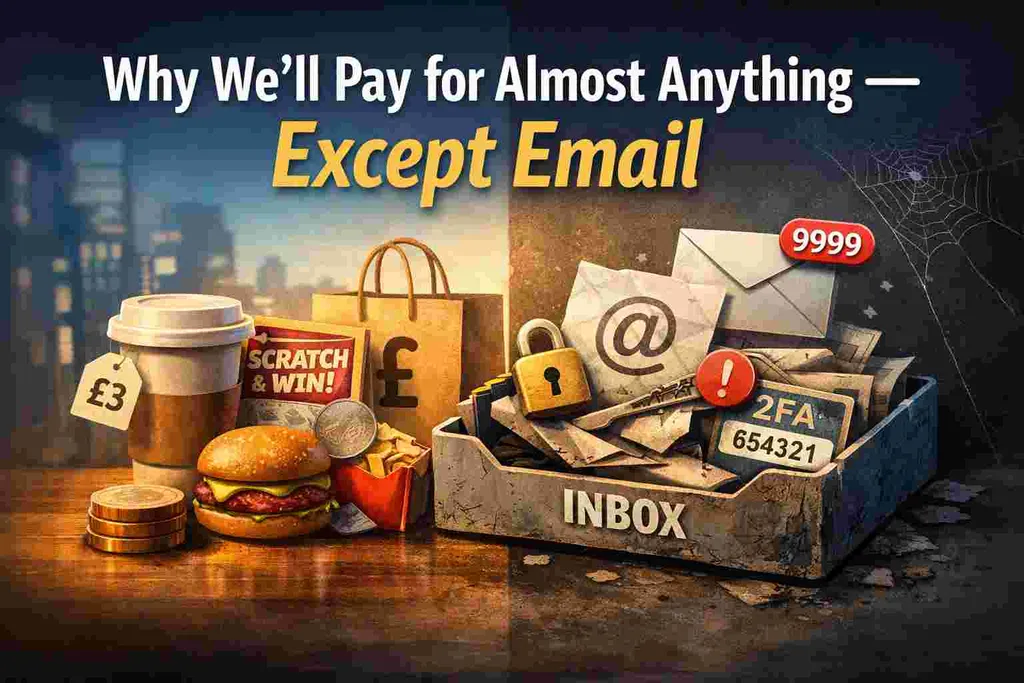
Most people think nothing of paying for everyday comforts, yet hesitate to spend even a few pounds protecting the email account that underpins their online identity.

Why I’m Writing This Now
Reading the comments and emails I receive, it’s clear that many of my readers already understand the trade-offs around email. They recognise that free services function effectively, but that “free” does not mean free of consequence. They understand that scale shapes incentives, that automation replaces human judgement, and that support models reflect business models.
In other words, they approach email as something worth evaluating rather than simply accepting.
Outside of that circle, however, the default assumption remains largely unchallenged: email should cost nothing, and questioning that expectation feels unnecessary. The gap between those two perspectives is wider than it first appears. That gap is what prompted this article.
Why Paying for Email Feels Out of Place
The issue is not that people choose free email. It is how rarely paying for it is treated as a serious option.
In a previous piece, I described HEY as expensive relative to other platforms. Some readers disagreed — not because the price was low, but because they felt the service justified it. They pointed to the overall experience, the structure of the inbox, and the quality of support. Their reasoning was practical rather than emotional. They were willing to pay because they could see a direct relationship between cost and value.
That response highlights something important. People will pay for services when the benefit is visible and the comparison feels familiar.
Email rarely enters that category. Most people acquire their primary email account during device setup or when creating a Google or Apple account. Email arrives bundled with something else. It is treated as a feature of a broader platform rather than a standalone decision. Few people compare providers in the way they compare mobile contracts, streaming subscriptions, or insurance policies.
When a price is attached to email, it feels unusual because email is perceived as part of the background infrastructure of the internet rather than as a service with its own economics.
Free Email and the Logic of Scale
Free email does not remove cost; it redistributes it.
Providers such as Gmail and Yahoo operate at extraordinary scale. At that level, efficiency depends on automation. Spam filtering, abuse detection, account recovery, and moderation are handled primarily through systems designed for consistency across hundreds of millions or billions of accounts. Human review exists, but it is structured, gated, and secondary to automated processes.
This model is not inherently flawed. It is rational for platforms operating at global scale. Most users benefit from the stability and predictability that such systems provide.
However, automation is optimised for the majority case. When a problem falls outside standard parameters — when an account lockout does not fit expected patterns, or when recovery loops fail — escalation becomes more difficult. Support pathways are narrower because they must remain manageable at scale.
In a free model, the individual user is part of a large, standardised system. The platform’s priority is consistency and resilience across millions of accounts rather than tailored resolution for edge cases. That is not a criticism of intent; it is a reflection of operating reality.
Support as Infrastructure
Email is often evaluated on storage limits, interface design, or privacy positioning. Support tends to be invisible until it becomes necessary.
Experience suggests that support only becomes visible when something has already gone wrong. At that point, switching providers is rarely simple. Email underpins identity and access. Losing access can cascade into broader disruption.
An account lockout may block access to financial services, professional tools, or personal records. Compromised credentials can trigger recovery cycles that are difficult to unwind. Delivery failures can prevent critical messages from arriving, sometimes without clear explanation.
These scenarios are not rare anomalies. They are part of the operational reality of email as infrastructure.
Paid services do not guarantee immunity from problems. What they often provide instead is a clearer escalation path, defined accountability, and a business model in which the user is the direct customer. That difference does not always manifest in features; it manifests in response when systems fail.
In this context, payment functions less as a fee for cosmetic improvements and more as a mechanism for aligning incentives. When revenue flows directly from users, there is a clearer line of responsibility between service quality and financial sustainability.
A Practical Example
I encountered this dynamic while using HEY.
At the time, their forwarding configuration was not handling authentication correctly. SPF alignment was inconsistent, DMARC behaviour required refinement, and forwarded messages were failing under conditions that should have been predictable.
Email forwarding is technically complex. Maintaining correct SRS behaviour, preserving DKIM signatures, and ensuring DMARC alignment requires careful implementation, particularly for newer providers building infrastructure from scratch.
The technical flaw itself was less important than the response. The issue was discussed directly with an engineer. The exchange was open, detailed, and solution-focused. The weakness was acknowledged and corrected without defensiveness.
That interaction illustrated what accountable support looks like in practice. Not perfection, but responsiveness and transparency. In that case, a delivery problem became evidence of a willingness to engage and improve.
Why Email Still Feels Too Cheap to Question
Email occupies a distinctive position in digital life. It is essential, persistent, and deeply integrated into identity systems. It governs account recovery, authentication, contracts, receipts, and long-term access.
Yet it rarely feels like a deliberate decision.
As long as it operates quietly, the assumption that it should cost nothing appears reasonable. Only when access is disrupted does the dependency become visible.
I have written separately about how I think about email as a control layer rather than merely a communication tool. That perspective shapes how I evaluate whether paying for email is justified.
The decision is not purely about interface design or additional features. It concerns resilience, accountability, and the relationship between user and provider.
Do Major Failures Change Behaviour?
Significant events often shift perceptions more effectively than arguments.
Large-scale breaches or prolonged outages tend to prompt reconsideration because they make underlying dependency visible. When a widely used platform fails, the fragility of what seemed permanent becomes apparent.
Most users do not analyse email architecture in advance. They reconsider only after disruption. By that point, the cost of switching can feel higher.
The Question Beneath the Price
Free email functions effectively for most users most of the time. That fact is not disputed.
The more interesting question is whether email receives the level of scrutiny it deserves. Email underpins identity, authentication, contractual communication, and long-term digital access. Few other systems carry comparable responsibility.
Hosting is evaluated carefully. Financial services are compared. Insurance is scrutinised. Yet email, which connects and protects all of these, is often treated as incidental.
The central issue is not whether paid email is universally superior. It is why paying for email feels unreasonable when paying for other foundational services does not.
Email is not optional infrastructure. It is structural. Systems that hold structural power deserve deliberate evaluation, even when they appear to function quietly in the background.
Get the weekly email
A short weekly roundup on email, privacy, and digital trust. No promos. Unsubscribe anytime.

