Gmail vs Proton Mail: Why I Switched for Privacy
After years using Gmail, I moved to Proton Mail. This isn’t a feature checklist — it’s why privacy and control mattered more to me.

I used Gmail for a long time. Like many people, it was one of the first web services I signed up to, and over the years it became the default place for everything — personal email, work messages, accounts, newsletters, and receipts.
It worked reliably, and for a long time I didn’t question it. Gmail didn’t become that default by accident. I’ve written separately about how it grew from an invitation-only experiment into the world’s baseline inbox — and why reliability, scale, and ecosystem ultimately mattered more than privacy for most users — in Gmail: From Invitation-Only Experiment to the World’s Default Inbox.
But gradually, I started to feel less comfortable with how much of my digital life was tied to a single platform. That’s what eventually led me to move my personal email away from Gmail and over to Proton Mail. I’ve written a fuller assessment of Proton’s privacy model and its practical trade-offs in my Proton Mail review.
Gmail is convenient — and that’s the problem
There’s no denying Gmail’s strengths. It’s fast, dependable, and deeply integrated into Google’s wider ecosystem. Search works well, spam filtering is excellent, and it’s easy to access from anywhere.
But that convenience comes at a cost.
Over time, Gmail became more than just an inbox. It became a data hub — connected to search, ads, calendars, documents, and countless third-party services. The more I relied on it, the harder it felt to separate email from everything else Google does.
Email is more personal than we admit
Email still sits at the centre of most people’s online lives. It’s where password resets arrive, where personal conversations live, and where long-term records quietly accumulate.
Once I started thinking about that more carefully, it became clear that email isn’t just another app. It’s a private archive.
Knowing that my inbox existed primarily inside an advertising-driven ecosystem started to feel uncomfortable — even if the scanning was automated and largely invisible.
Privacy isn’t about having something to hide
One of the common reactions to privacy-focused services is the idea that they’re only necessary if you’re doing something secretive. I don’t see it that way.
Privacy is about control. It’s about deciding who can access your data, how it’s processed, and what assumptions are built into the system you’re using.
That idea of control plays out in very different ways across email providers — from encryption models to services like HEY that rethink who gets access to your inbox in the first place.
I didn’t move away from Gmail because it suddenly stopped working. I moved because I wanted my email provider’s incentives to align more closely with my own.
Why Proton Mail felt like a better fit
Proton Mail takes a very different approach. It’s built around the idea that email should be private by default, not private only if you configure it carefully.
Messages are end-to-end encrypted, meaning Proton itself can’t read the contents of your emails. There’s no advertising model behind the service, and the focus is clearly on providing a secure communication tool rather than feeding a wider data ecosystem.
That shift in priorities mattered to me.
At a high level, the difference between Gmail and Proton Mail comes down to priorities rather than features.
| Feature | Gmail | Proton Mail |
|---|---|---|
| Primary focus | Convenience and integration | Privacy and security |
| Business model | Advertising-supported ecosystem | Paid subscriptions, no ads |
| Email encryption | In transit and at rest | End-to-end encryption |
| Provider access to email content | Possible (automated processing) | Not possible by design |
| Data usage | Used across Google services | Limited to email functionality |
| Interface | Feature-rich, highly integrated | Clean, minimal, distraction-free |
| Ecosystem | Deeply tied to Google services | Designed to stand alone |
| Best suited for | Users prioritising convenience | Users prioritising privacy |
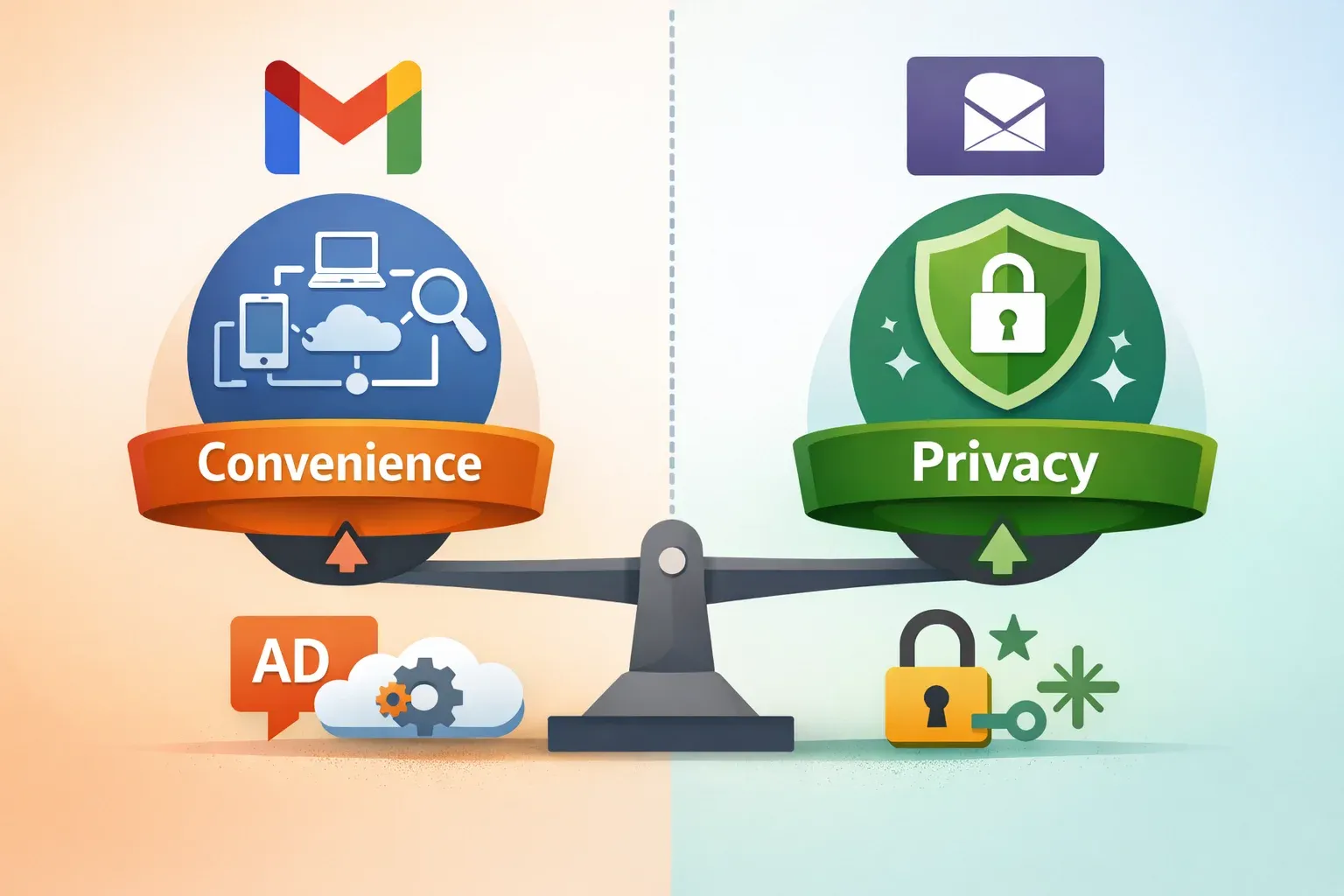
A calmer relationship with email
One unexpected benefit of switching was how it changed my relationship with email itself. Without ads, nudges, or cross-service prompts, the inbox feels quieter.
It’s still functional, still reliable, but noticeably less distracting. That might sound minor, but over time it makes a difference.
Email feels like a tool again, not a surface for engagement optimisation.
Trade-offs are inevitable
Proton Mail isn’t a drop-in replacement for Gmail in every respect. Google’s ecosystem is vast, and some conveniences don’t translate directly.
But for my personal email, the trade-offs felt reasonable. The core experience — sending, receiving, organising messages — works well, and the privacy model is clearer and easier to understand.
That clarity was worth more to me than another set of smart features.
Final thoughts
Gmail remains a solid service, and I still use Google tools where they make sense. This wasn’t about rejecting everything Google offers.
It was about making a deliberate choice for one part of my digital life that feels especially personal.
Moving my email to Proton Mail gave me more confidence about how my messages are handled and reminded me that convenience isn’t the only thing worth optimising for.
If you’re happy with Gmail, there’s no urgency to change. But if you’ve ever felt uneasy about how much your inbox reveals — even passively — it’s worth exploring alternatives.
Get the weekly email
A short weekly roundup on email, privacy, and digital trust. No promos. Unsubscribe anytime.
This is an affiliate link — using it supports this site at no extra cost to you.

