When Yahoo Was the Internet — and Why Yahoo Mail Lost Our Trust
Yahoo Mail didn’t disappear overnight. It faded from relevance as trust eroded, decisions stalled, and breaches exposed deeper problems. This is the story of how the internet’s most trusted brand lost its place at the centre of email.

For a period in the late 1990s and early 2000s, choosing Yahoo Mail did not feel like a decision. It felt automatic.
People did not compare providers. They did not analyse privacy policies. They did not weigh security architecture. They created a Yahoo account because Yahoo itself felt like the centre of the web, and if Yahoo offered email, it must be the safest place to keep it.
That assumption built Yahoo Mail into one of the largest email platforms in the world. It also explains why its decline was gradual, understated, and ultimately permanent.
This is not the story of a product defeated by cleaner design or smarter branding. It is the story of what happens when trust erodes inside infrastructure.
When Yahoo Functioned as the Map of the Web
Yahoo did not begin as an email company. It began as a directory.
In the mid-1990s, the web was expanding rapidly but remained largely unstructured. Yahoo’s human-curated directory imposed order. Categories were created and maintained by editors. Websites were reviewed and classified manually. Before algorithmic search engines determined relevance, Yahoo determined placement.
Even when Yahoo later introduced search — and for a period relied on Google’s search results behind the scenes — its authority was rooted in curation rather than computation. Yahoo’s value lay in its judgement.
That judgement carried weight.
When Yahoo Mail launched in 1997, it entered a market where email was becoming mainstream but remained tied to desktop software and internet service providers. Webmail was still a new concept. Being able to access your inbox from any browser was transformative.
Yahoo’s brand made that shift feel safe. If Yahoo organised the web, it could be trusted to hold your identity within it.
By the early 2000s, a @yahoo.com address was more than an inbox. It was a digital identity. It was used for forums, early e-commerce accounts, online communities, and emerging social networks. Long before centralised single sign-on systems, Yahoo accounts quietly performed that function.
Yahoo Mail grew not because it was technically superior, but because Yahoo itself felt permanent.
Authority as a Business Model
Yahoo’s authority was not merely cultural; it was monetised.
For years, website owners paid to have their sites reviewed for inclusion in Yahoo’s directory. In the UK, this fee was widely remembered as being around £200. Payment did not guarantee inclusion. It guaranteed review.
Businesses paid because inclusion signalled legitimacy. A listing implied that a human editor at Yahoo had evaluated the site and deemed it acceptable. That approval carried reputational value at a time when trust on the web was fragile.
Inclusion was conditional. Yahoo enforced strict listing guidelines and removed sites that failed to meet them. The directory model rested on editorial authority.
That authority extended naturally to Yahoo Mail. If Yahoo could be trusted to curate the web, it could be trusted with personal correspondence. The logic was simple and persuasive.
Trust transferred across products.
A Competitive Web That Still Had Leaders
The early web was not empty. It was competitive.
Yahoo reached hundreds of millions of users globally. Hotmail, later acquired by Microsoft, accumulated tens of millions. Portals such as Excite and Lycos combined search, content, and webmail into unified destinations that attracted vast traffic.
The prevailing assumption was that the web would be navigated through portals. Users would begin at a homepage and move outward. Email was one feature among many.
Yahoo excelled in that model.
What changed was not competition within the portal framework. What changed was the framework itself.
The Shift From Portals to Utilities
Google introduced a different pattern of behaviour. Instead of browsing through a portal, users entered queries directly into a search bar and left as soon as they found what they needed.
Search became a utility rather than a destination.
That shift had implications beyond search. It encouraged services that were fast, focused, and infrastructure-like. Email, too, began to be treated less as a media feature and more as a core identity layer.
Yahoo continued to operate as a media company. It invested heavily in content, advertising, and portal-style engagement. The industry, however, increasingly rewarded reliability and foundational services.
Yahoo Mail remained large, but it no longer defined direction.
Gradual Stagnation and Perception Drift
Yahoo Mail did not collapse suddenly. For years it continued to function competently. However, the perception of stagnation grew.
Interfaces evolved slowly. Performance often lagged behind competitors. Feature updates appeared incremental or reactive. None of these factors individually triggered mass departures. Email addresses are sticky. People are reluctant to abandon long-established identities.
Yet stagnation sends a signal.
In infrastructure services, visible maintenance and improvement reinforce confidence. When change slows or feels cosmetic, users infer something about priorities. Even if functionality remains intact, perceived inattention undermines reassurance.
By the time Yahoo implemented more aggressive redesigns, they arrived against a backdrop of accumulated doubt. Rapid change following prolonged drift rarely restores confidence.
The Breaches and the Collapse of Confidence
Yahoo’s decline did not begin with its data breaches, but the breaches crystallised existing concerns.
Over multiple years, Yahoo disclosed a series of security incidents affecting billions of user accounts. Attackers accessed account details including email addresses, hashed passwords, and security questions. Some breaches were disclosed long after they occurred. User impact figures were revised over time.
The scale was unprecedented. However, the deeper issue was transparency and timing.
Email is identity infrastructure. When an email provider appears uncertain about the scope of compromise, or when disclosure feels delayed or incomplete, users reassess risk quickly. Once confidence in identity infrastructure weakens, restoring it is exceptionally difficult.
The consequences extended beyond users. Yahoo faced lawsuits, regulatory scrutiny, and direct financial impact. During acquisition negotiations, the breaches materially affected valuation. When Verizon acquired Yahoo, security issues were central to the discussion.
The breaches did not destroy Yahoo Mail in a single moment. They confirmed a longer narrative about drift and declining stewardship.
Migration Is Quiet but Permanent
After the breaches, there was no dramatic exodus visible in headlines. Instead, there was gradual migration.
Email differs from social media platforms. When users move their inbox, they rarely return. Too many dependent services must be updated. Too much effort is required. The decision to migrate is disruptive enough that it is rarely reversed.
Yahoo Mail continued operating. Accounts remained accessible. Messages were delivered. Yet the service shifted from default to legacy.
Users did not publicly protest. They simply stopped choosing it.
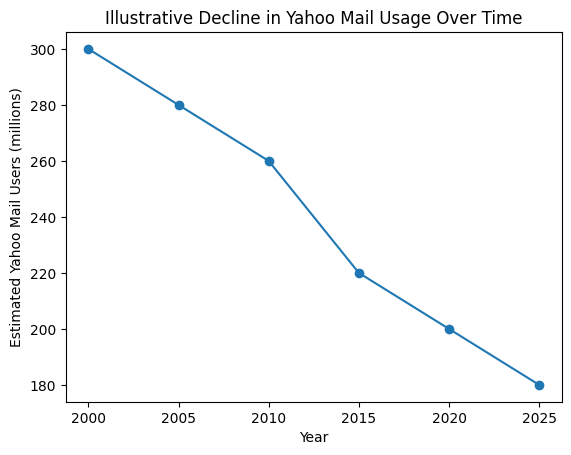
Illustrative trend showing the long-term decline in Yahoo Mail usage. Exact figures vary by source, but the direction is consistent.
Yahoo Mail in 2026
Yahoo Mail still exists in 2026. It continues to serve users, many of whom maintain long-standing addresses tied to older accounts and services. It remains functional infrastructure.
What has changed is position.
Yahoo Mail no longer defines expectations for what an inbox should be. It no longer shapes design direction. It no longer competes aggressively for new users.
Searching for Yahoo Mail today leads primarily to a login interface. There is little narrative positioning, little persuasion, and little attempt to articulate a differentiated future. The product is maintained rather than advanced.
That distinction matters. Infrastructure can survive in maintenance mode, but it does not lead from that position.
The Structural Lesson
Yahoo Mail did not lose because Gmail was more aesthetically refined. It lost because Yahoo did not adapt to what email was becoming.
Email evolved from a feature within a portal to a foundational identity layer. It underpins account recovery, commerce, communication, and access control. It demands sustained attention to reliability, security, and transparency.
Yahoo once monetised trust successfully enough that businesses paid for its endorsement. That same reservoir of trust sustained Yahoo Mail long after innovation slowed. When trust eroded — through stagnation, breaches, and perceived opacity — it did not regenerate.
Infrastructure platforms do not fail dramatically. They fade from relevance.
In email, relevance is inseparable from survival.
Get the weekly email
A short weekly roundup on email, privacy, and digital trust. No promos. Unsubscribe anytime.

