Gmail: From Invitation-Only Experiment to the World’s Default Inbox
Gmail didn’t become the world’s default inbox by accident. This piece explores how scale, design, and ecosystem beat privacy-first ideals.

I often write about Gmail critically. That tends to happen when you spend most of your time thinking about privacy, metadata, and the structural power of large technology platforms. From that vantage point, Gmail is easy to scrutinise.
But the truth is more complicated. I used Gmail for work for many years. I was there during the early invitation-only period. I bought access when it was scarce. I recommended it to clients. I explored reselling it. I became an affiliate. More importantly, I genuinely liked using it.
In many ways, I still do.
I don’t use Gmail today, not because it is a weak product, but because it optimises for a different set of priorities than I now care most about. That distinction matters. Gmail did not stumble into its dominance. It became the default inbox because it made deliberate, consistent decisions about what email should prioritise.
I have written more broadly about how providers balance those trade-offs in my work on email privacy. This piece is not an attack on Gmail. It is an attempt to understand how it became the baseline against which every other inbox is measured.
Gmail did not become the world’s default inbox by accident.
From Internal Experiment to Industry Baseline
Gmail began inside Google’s 20% time culture, where engineers were encouraged to explore ideas outside formal product roadmaps. Paul Buchheit started the project as a side experiment. The initial question was not how to compete with Hotmail or Yahoo, but whether email itself could be rethought if storage and search were treated as abundant rather than scarce.
Internally, the project was known as “Caribou.” At that stage, there was no clear monetisation model, no roadmap to enterprise dominance, and no expectation that it would define a generation of inboxes. What Google was testing was whether email could be treated as searchable data rather than something that needed constant deletion and manual filing.
When Gmail launched publicly in 2004, the industry context mattered. Email was not broken, but it had stagnated. Storage limits were restrictive. Interfaces were slow. Spam filtering was inconsistent. Searching old mail was unreliable. Webmail felt like a compromise compared to desktop clients.
Gmail reset expectations overnight. Vast storage, fast search, conversation threading, and a responsive interface reframed what people thought an inbox could be. Instead of managing scarcity, users were invited to keep everything. Instead of filing, they were encouraged to search. Instead of micromanaging spam, filtering happened largely in the background.
That shift was not cosmetic. It changed behaviour.
Archive Instead of Delete
One of Gmail’s most consequential design decisions was philosophical rather than technical. It encouraged archiving rather than deleting. At the time, deleting mail was considered good hygiene. Storage was limited, and inboxes were meant to be cleared regularly.
Gmail challenged that assumption. If storage was abundant and search was reliable, why delete anything at all?
Over time, this model became normal. Email stopped being something you tidied obsessively and became something you retained indefinitely. Archiving replaced filing. Search replaced structure. The idea of an empty inbox shifted from necessity to preference.
Nearly every major provider eventually adopted similar assumptions, whether explicitly or not. Gmail did not simply optimise email. It redefined what people expected from it.
Conversation View and the Reshaping of Reading
Conversation View was another defining decision. Gmail grouped related messages into threaded conversations and made that structure mandatory at launch. There was no toggle. This was how Gmail believed email should function.
Traditional email clients treated each message as a separate object. Replies appeared as new entries. Forwarded messages were independent. Gmail rejected that model in favour of continuous threads.
For many users, this was jarring. Long threads became unwieldy. Messages that felt unrelated were sometimes grouped together. There was no easy way to separate them. Yet over time, the logic of threaded communication became intuitive. Reading an exchange in context reduced repetition and cognitive load.
Google did not initially present this as a preference. It was presented as the correct way to read email. Only later, as the user base diversified and enterprise adoption grew, did the company introduce the option to disable it.
The pattern is instructive. Gmail did not wait for consensus. It implemented a model and allowed behaviour to adapt around it.
Spam Filtering as Invisible Infrastructure
Spam filtering is where Gmail quietly secured long-term dominance. Powered by Google’s data scale and strengthened through acquisitions such as Postini, Gmail’s filtering systems improved rapidly and continuously.
For most users, spam largely disappeared from conscious thought. That absence of friction mattered more than feature lists. When email simply works — when junk mail rarely intrudes and legitimate messages arrive reliably — users stop questioning the platform.
Reliability creates loyalty more effectively than ideology.
From Inbox to Work Infrastructure
Gmail’s true transformation occurred when it stopped being merely an inbox and became the front door to a broader ecosystem.
Between 2004 and 2010, Google added Calendar, Docs, Sheets, and Chat. Initially these were discrete tools. Gradually they converged under a single identity. In 2006, Google Apps for Your Domain marked a turning point. Custom domains, shared documents, and administrative controls repositioned Gmail from consumer experiment to business infrastructure.
Email became the entry point to work itself.
Attachments gave way to shared documents. Local storage gave way to Drive. Collaboration moved into browser-based tools. Small businesses no longer needed on-premise Exchange servers. A single Google login became sufficient for messaging, documents, and scheduling.
By the time Google Workspace emerged as a formal brand, the infrastructure had already been built. Switching away from Gmail was no longer a simple preference change. It required retraining, migration planning, and operational risk management.
Email had become embedded.
The Network Effect of Identity
Gmail’s dominance also rests on identity. It became the assumed inbox for software integrations, SaaS sign-ups, and online accounts. Services were built with Gmail compatibility as a baseline expectation.
This network effect reinforced itself. The more platforms assumed Gmail usage, the more frictionless Gmail felt. That assumption extended into CRM systems, support platforms, analytics tools, and developer workflows.
Gmail did not need proprietary lock-in mechanisms. Its scale created gravitational pull.
Apple and the Limits of Bundled Productivity
Apple’s iCloud Mail and productivity tools offer a polished personal experience. Pages, Numbers, and Keynote integrate cleanly for individuals. Yet Apple never positioned email as enterprise infrastructure in the same way.
Google built administrative depth, domain controls, and collaborative workflows designed for organisations. Apple built tools designed primarily for individuals within its ecosystem.
That difference shaped adoption. Gmail became embedded in workplaces because it was engineered for them.
Privacy, Advertising, and Structural Trade-offs
Gmail’s growth was not without controversy. Early contextual advertising based on email content drew criticism from regulators and privacy advocates. Google ended ad targeting based directly on email content in 2017, as reported by the BBC, but automated content processing for spam filtering and feature enhancement remained part of the architecture.
More broadly, Gmail reflects Google’s economic model. It prioritises intelligence, integration, and scale. It encrypts data in transit and at rest, but it does not attempt to minimise metadata collection or provide sealed end-to-end encryption by default.
Trust in email at the protocol level depends on standards such as SPF, DKIM, and DMARC. Gmail supports these mechanisms robustly, but they address authenticity and deliverability rather than minimising provider visibility.
The trade-off is deliberate. Gmail optimises for reliability, deliverability, and ecosystem depth rather than strict minimisation of data exposure.
For many users, that balance is acceptable. The service rarely fails. Spam filtering is effective. Performance is consistent. In practice, reliability outweighs abstract concerns for the majority.
Optimised for Scale
Gmail did not win because it was the most private option. It won because it was optimised relentlessly for scale and integration.
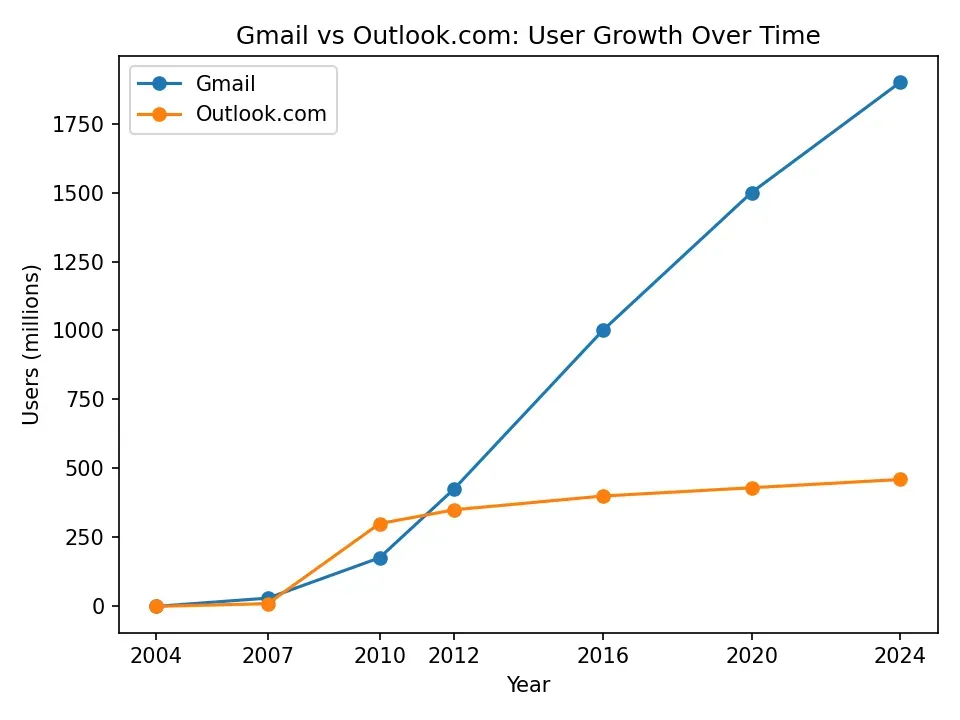
Gmail’s rise from novelty to default inbox was driven by ecosystem integration and sustained optimisation rather than marketing preference alone.
It became the default because it worked, and because the surrounding ecosystem made leaving costly.
Why Gmail Still Matters
Every serious email provider today defines itself in relation to Gmail. Some attempt to replicate its polish while narrowing data exposure. Others reject its integration-heavy model in favour of structural privacy.
The contrast is clearest when comparing services such as Proton Mail, Fastmail, and Tuta Mail. Each answers a different question about what email should prioritise in 2026.
Yet Gmail remains the baseline. Not because it is flawless, but because it established the expectations modern users carry into every inbox they evaluate.
The Underlying Question
The real question has never been whether Gmail is good or bad.
It is what you want your email provider to optimise for.
Integration and ecosystem depth.
Intelligence and scale.
Or constraint and minimisation.
Gmail chose its priorities early and executed consistently. That clarity, more than any single feature, explains why it became the world’s default inbox.
Get the weekly email
A short weekly roundup on email, privacy, and digital trust. No promos. Unsubscribe anytime.
