HEY World: Everything Else Seems Overkill
HEY World isn’t a normal blogging platform. It’s a free add-on to HEY Email that lets you publish by sending an email — fast, plain, and away from social media noise.

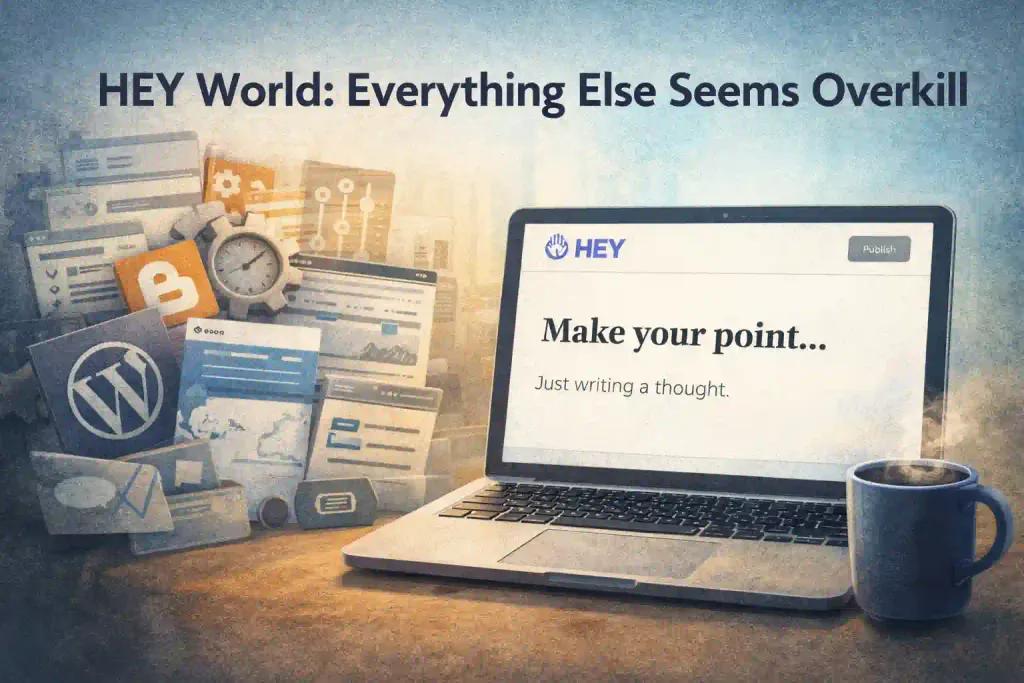
Updated February 2026 with an expanded edit and clearer framing.
HEY World is easy to misunderstand if you approach it like a normal blogging platform. It isn’t one. You can’t sign up for HEY World on its own, and you don’t choose it instead of Ghost or WordPress. It comes bundled with HEY Email, as a free bolt-on that appears once you’re already inside HEY’s ecosystem.
It’s also more limited than people assume. HEY World is only available to HEY for You personal accounts, which means you need a @hey.com address to use it. And despite the “just email the web” simplicity, it isn’t available on trials — it only works on paid HEY accounts in good standing.
That framing matters because it changes what the product is really for. HEY World isn’t asking you to migrate your writing life. It’s closer to a lightweight public notebook that happens to be attached to your inbox — something you can use without gearing up, without ceremony, and without the feeling you’re about to start a project.
Most publishing tools do the opposite. They assume you’re building a platform: structure, design, optimisation, and all the choices that come with doing “proper publishing”. HEY World starts earlier than that. It starts at the moment you have something to say.
That broader “HEY posture” shows up in email too: HEY: I’m Nearly All Yours.
How HEY World actually works
HEY World’s trick is almost embarrassingly simple: you publish by sending an email.
If you’re a paid HEY for You customer (it doesn’t work on trials), you start a new email in HEY and put [email protected] in the To field. It has to be the first and only address — no CC, no BCC. You write like you normally would, hit send, and HEY turns that email into a public post.
Once you’ve published your first one, you get a permanent home at a URL in the shape of world.hey.com/you/ — with the “you” part matching your @hey.com address — and each post gets its own clean page. People can follow along without social media too: HEY World offers email subscriptions and an RSS feed.
And the output is deliberately quiet. HEY says the published pages are served without trackers, cookies, or JavaScript — just your words on a fast page. That matters, because it positions HEY World less like a “platform” and more like a public notebook: write, send, published.
The friction before the first sentence
A lot of writing doesn’t fail because the tools are difficult. It fails because they’re heavy in the wrong place.
Full platforms are excellent at what they do. WordPress can do almost anything. Ghost is a beautifully coherent writing-first system with strong publishing primitives — and it’s a favourite of mine. This site runs on Ghost for a reason. Both can be the right answer if you’re building a home for your work.
But there’s still a kind of weight they introduce, simply by being complete: you’re reminded, constantly, that publishing is more than writing.
Before you’ve written a sentence, you’re already aware of titles, excerpts, tags, collections, feature images, social previews, navigation, internal linking, content strategy, SEO knobs, templates, and the general question of where this sits in the bigger structure of your site. You don’t have to touch half of those things for them to matter. The mere presence of the options can slow you down.
That’s not a complaint. It’s an observation about how systems shape behaviour. A tool that feels “professional” often asks you to behave professionally from the first click.
HEY World doesn’t.
What HEY World removes
HEY World’s most important design decision is the one it makes before you do anything: it refuses to give you a setup phase.
There’s no theme choice. No plugin ecosystem. No decisions about layout. No “make it yours” onboarding. You start an email, write, and send.
That might sound like a small UX decision, but it sets the tone for everything else. HEY World is built to be used casually. It assumes that not every piece of writing deserves a full production run. It assumes the best way to publish more is to remove the little moments where you can talk yourself out of it.
And because it’s bundled, it doesn’t need to persuade you to commit. It’s just there — like a pad of paper attached to your inbox.
That bundling is not a footnote. It’s the whole trick. A standalone platform has to sell itself as an alternative. A bundled tool can be smaller and quieter, because it doesn’t need to carry the entire weight of your identity online. It can simply be convenient.
Why “overkill” is often the wrong question
When I say everything else can feel like overkill, I don’t mean that Ghost, WordPress, or any other platform is doing too much in general. They’re doing the job they were built to do.
They shine when you care about durability and structure — when you want an archive that will make sense in five years, when you want a site that feels like a place, when you want design consistency, when you want search traffic to find you, when you want ownership and portability and the feeling that you’re building something that’s yours.
HEY World isn’t trying to compete on those axes.
It competes on one axis: how quickly you can publish words.
If your goal is “write something and put it out there,” a full platform can feel like wearing hiking boots to walk to the corner shop. The boots are excellent. They’re just not what the moment calls for.
HEY World calls for the moment.
Writing without preparation changes what gets written
The most interesting outcome of HEY World is what it makes possible: writing that would never have survived the weight of a full platform.
There’s a category of work that lives between a note and an article. It’s too long to disappear into a private notebook, but not ambitious enough to justify the full publishing ritual. It’s a thought that wants daylight, not a strategy. A short argument. A moment of noticing. A link with commentary. A paragraph you want to have somewhere public so you can point back to it later.
Most tools make that kind of writing feel illegitimate. They don’t say it directly, but they imply it. A dashboard with analytics and optimisation features subtly asks: is this worth publishing? Is it worth doing properly?
HEY World removes the judgement layer. It makes small writing feel normal again.
That’s the value. Not that it replaces your blog, but that it catches the things that would otherwise be lost.
Minimal doesn’t mean temporary
Minimal tools often get treated as “starter” versions — something you use until you graduate to a real platform. HEY World doesn’t feel like a starter. It feels like a deliberate refusal to turn everything into a system.
It’s narrow on purpose. It gives you a clean editor, a simple published page, and very little else. It doesn’t try to become a CMS, and it doesn’t pretend it’s the foundation of a business. It’s closer to the older web instinct of posting because you have something to say, not because you have something to build.
That’s why it fits inside HEY’s broader posture. HEY Email is opinionated about attention: screen first, separate streams, reduce the sense of constant demand. HEY World is the same attitude applied to writing: reduce the upfront cost, remove the ceremony, and let the act itself be the thing.
I’ve tried to write that idea down properly here: How I think about email.
The trade-offs are real — and clarifying
None of this means HEY World is “better”. It means it’s smaller. And small has consequences.
You give up control. You give up deep customisation. You give up the satisfaction of a site you shape over years. You give up the feeling of full ownership and portability that comes with running your own platform on your own domain.
If those things are central to why you publish, HEY World will feel boxed in. It doesn’t invite tinkering, and it won’t reward it. You can’t slowly craft it into your perfect home.
But that’s also the point. HEY World isn’t asking to become your home. It’s offering to be your notebook that happens to be public.
It’s also a shame you can’t use a custom domain, because that’s the point where “quick and lightweight” starts to bump into “I want this to be mine.”
It’s also worth knowing that HEY’s “no recycling” policy carries across. When you leave HEY, they don’t delete your @hey.com address — they keep it reserved and offer lifetime forwarding. The same logic applies to HEY World. You can stop using it, but anything you’ve already published stays live. You can keep posting and editing, but you can’t “take the site down” in the normal sense, because the address doesn’t go away. My old HEY World page is still there: https://world.hey.com/paul.obrien.
And for a certain kind of writing, that’s the right size.
Who it’s for
HEY World makes the most sense for people who already have a “main” publishing home but want a lighter place for smaller work — the pieces that don’t want to be a post on the main site, but also don’t want to disappear into drafts forever.
It’s also a good fit if you know your enemy is friction. If the main thing stopping you writing is that you over-prepare, over-polish, or over-think, HEY World is quietly helpful. It reduces the number of decisions you can use as excuses.
At the same time, it’s not a replacement for anyone building a structured archive, a publication, or a long-term body of work that needs to live in a place they own. Those are different goals, and they deserve different tools.
Why it matters
The reason HEY World sticks in my head isn’t that it’s a superior platform. It’s that it acts like a reminder.
We’ve normalised a version of publishing where every sentence is potentially content strategy, and every tool is potentially a growth machine. Even if you don’t participate in that mindset, you still inherit the gravity of it through software design. The tools are loud. They want you to build.
HEY World is quiet. It doesn’t try to turn writing into a project. It doesn’t try to upsell you into a bigger vision of yourself. It just makes it easy to publish words.
The longer HEY context is here: HEY: Brilliant reinvention, or overpriced experiment?
That’s why everything else can feel like overkill. Not because other platforms are flawed, but because they’ve made a different bet: that you want power, flexibility, and scalability.
I’ll admit I miss HEY World. It was the quickest way I’ve found to share what’s on my mind without turning it into a “post” — and without feeding it into the social media machine. No performance layer, no comment thread to manage, no sense you’re publishing for an algorithm. Just writing, out loud, on your own little page.
HEY World makes the opposite bet: that sometimes you just want to write.
And sometimes that’s enough.
Get the weekly email
A short weekly roundup on email, privacy, and digital trust. No promos. Unsubscribe anytime.
If you’re considering HEY more broadly, I’ve written a longer piece on whether it’s a brilliant reinvention or an overpriced experiment.

