Somewhere out there, a Nigerian oil minister still owes me $26 million
From Nigerian prince emails to modern phishing, 419 scams evolved with the internet — exposing how email’s openness can be exploited.

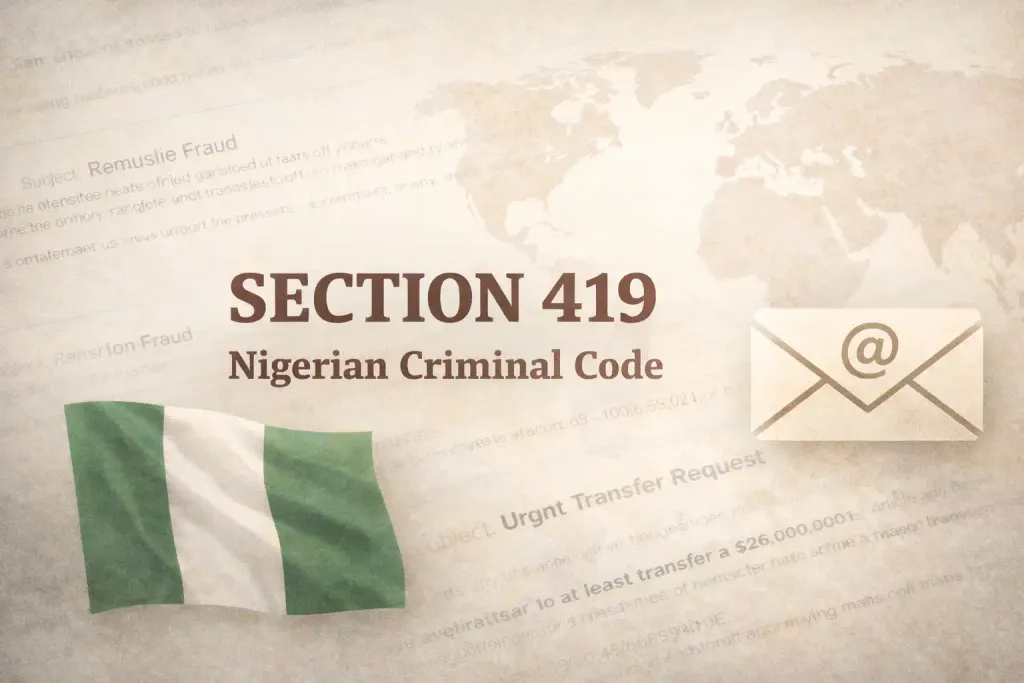
At least, that’s what the email promised.
If you were online in the early 2000s, it probably found you too. These messages became known as “419 scams” — a term we’ll come back to shortly. The email was long and dramatic — full of political instability, frozen accounts, dying relatives, and vast sums of money trapped overseas.
At first, there was no demand — just a story and an appeal for help. Only after a back-and-forth exchange would a small “administrative fee” appear, positioned as the final obstacle between you and sudden wealth.
It was implausible, badly written, and oddly theatrical. “Nigerian prince” became shorthand for something obviously fraudulent.
The logic behind the bad grammar
For years, people assumed the spelling mistakes and awkward phrasing were signs of incompetence. In reality, the rough edges served a purpose.
Advance-fee fraud operates at scale. These emails were sent out in vast quantities, reaching thousands — sometimes millions — of inboxes at once. At that volume, efficiency matters more than persuasion.
Poor grammar and implausible stories acted as a filter. They discouraged sceptical readers and attracted those more willing to continue the exchange — often people experiencing financial pressure, isolation, grief, or simply a moment of optimism. Fraud does not select for education level; it exploits circumstance and psychology.
What looked careless was often strategic. By narrowing the field early, scammers reduced wasted time and concentrated effort on the small number of recipients willing to engage.
The early 419 emails were already optimised — not for universal appeal, but for operational efficiency.
They also revealed something fundamental about how email works. The system was designed to be open. Anyone, anywhere, could send a message to anyone else. The protocol did not verify identity in a way that guaranteed authenticity. A sender could invent a name, adopt a title, or perform authority, and the message would still arrive.
That openness is not an accident. It is the reason email became universal. It is also the reason deception can travel through it just as easily.
When the joke stopped being funny
As those emails became widespread, a small counter-culture emerged. Some recipients responded playfully, dragging conversations out or attempting to waste scammers’ time. Sites like 419Eater documented elaborate efforts to turn the tables, often in humorous ways.
It was easy to focus on the absurdity.
But not everyone treated it as a joke. Advance-fee fraud has caused significant financial and emotional harm. Some victims lost savings or borrowed heavily under the belief that a transfer was imminent. In rarer cases, people travelled abroad to “complete” the transaction and found themselves in dangerous situations. What began as an implausible email sometimes escalated into coercion or threat.
The humour masked the seriousness of what was, and still is, an organised criminal model exploiting the same thing email makes possible: direct, unfiltered access to strangers across borders.
Why they’re called “419” scams
The term “419 scam” comes from Section 419 of the Nigerian Criminal Code, which deals with advance-fee fraud. The law covers schemes where someone is persuaded to pay money upfront with the promise of a much larger return that never materialises.
While many of the early email versions originated from criminal networks operating in Nigeria, the technique itself is not geographically unique. Advance-fee fraud existed long before email, and today it is carried out from many different countries using a wide range of digital channels.
The core structure is simple:
- A compelling story
- A large promised reward
- A series of escalating requests
- A final financial loss
In legal terms, it is fraud. In practical terms, it is psychological manipulation stretched over time.
The early “Nigerian prince” emails were only the digital expression of a much older crime: convince someone that a windfall is close, then introduce just enough friction to require payment.
Evolution, not extinction
Do those emails still exist?
Yes, but rarely in the form we remember.
That early 419 format has largely given way to more sophisticated approaches. Romance scams now unfold over weeks or months, building emotional trust before introducing financial pressure. Business email compromise schemes mimic internal company communication and rely on timing and plausibility rather than fantasy. Phishing emails replicate familiar login pages with unsettling precision.
The tone has changed. The mechanics have not.
Where early 419 emails relied on exaggeration and spectacle, modern scams rely on realism. Spelling errors that once filtered for the credulous have been replaced by fluent prose, often assisted by automation and AI tools. The linguistic barrier that once exposed fraud has narrowed considerably.
Awareness has grown, but so has professionalism.
What hasn’t changed
Email remains open, global, and largely permissionless. Anyone can send a message to anyone else. The protocol does not verify identity in a way that guarantees authenticity. Instead, trust is layered on top of a neutral transport system.
That design decision is the reason email became indispensable. It allows businesses to operate, governments to communicate, families to stay connected, and ideas to travel freely. It also allows deception to travel just as easily.
The early Nigerian prince emails did not represent a flaw that was later fixed. They exposed the trade-off embedded in the medium from the beginning.
Security in email has never lived solely in encryption or filters. It has depended heavily on human behaviour — on scepticism, verification, and, perhaps most importantly, pause.
The value of the pause
“If it sounds too good to be true” became common advice for a reason. These scams rely on urgency and information imbalance. One side appears to hold all the opportunity; the other is asked to act quickly with limited context.
An unexpected opportunity. A looming deadline. A request that feels small and harmless in isolation.
Click here. Reply quickly. Keep this confidential.
Email’s strength is that it is asynchronous. It creates space between receiving and responding. That space allows for reflection, cross-checking, and second thoughts. When we use it deliberately, that gap becomes protective.
The Nigerian oil minister may have faded from our inboxes, but the dynamic he represented has not disappeared. It has adapted alongside the medium.
Email continues to work because it is open and flexible. That same openness ensures that trust will always need to be supplied by the people using it.
We laughed at the promise of $26 million. What those emails really demonstrated was something more enduring: openness comes with a cost.
Get the weekly email
A short weekly roundup on email, privacy, and digital trust. No promos. Unsubscribe anytime.

